Welcome to the new Gustave Roussy website
A new website designed to offer you a simpler, clearer, and more intuitive experience. Patients, caregivers, healthcare professionals, and donors: find information, news, and services more easily.
Clinical Research
Director
Prof. Laurence Albiges
Deputy Director:
Prof. Benjamin Besse
Contact
Phone: +33 (0)1 42 11 62 18
Email
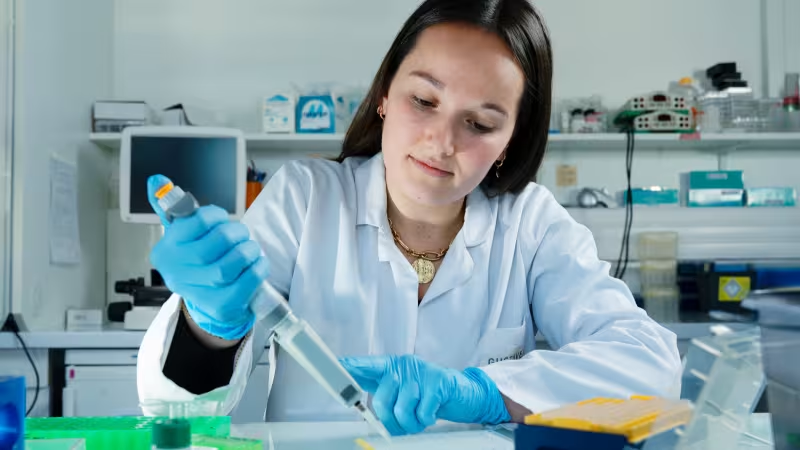
The clinical research conducted at Gustave Roussy addresses society’s needs in the face of cancer. It encompasses all studies conducted with and for patients to better understand cancers, evaluate new diagnostic or therapeutic approaches, and improve the quality of care. Serving as a bridge between scientific discoveries and their application in medical practice, it transforms research advances into tangible benefits for patients.
To advance patient care and improve available treatments, Gustave Roussy is developing clinical research that is integrated into patient care. As part of this effort, data is collected, analyzed, and utilized to inform research and improve future treatments.
At Gustave Roussy, the integration of research and medicine forms the foundation of patient-centered translational research. Each program combines clinical studies, analyses conducted using state-of-the-art technological platforms in biology and imaging, and a system for collecting, organizing, and analyzing data. These complementary approaches make it possible to answer fundamental questions and transform scientific discoveries into concrete advances for patients.
What is clinical research?
Clinical research in oncology encompasses all studies conducted with patients to better understand cancers, improve their diagnosis, evaluate new treatments, and optimize the quality of care. It is an essential step in transforming scientific discoveries from the laboratory into tangible advances that benefit patients.
It can take various forms: clinical trials evaluating new drugs, studies on risk factors or quality of life, research aimed at better understanding disease progression, or analyses of health data. Conducted within a strict regulatory framework that ensures the safety and rights of participants, clinical research contributes every day to advancing cancer care and paving the way for tomorrow’s treatments.
An Important Tool in the Fight Against Cancer
Clinical research is driven by the committees and departments at Gustave Roussy, which contribute to the development of new therapeutic strategies and the improvement of patient care.
Patient participation in clinical trials offers them the opportunity to access innovative therapies—particularly in early-phase trials—or treatments specifically tailored to their situation, thanks to precision medicine approaches.
The goal of clinical research is to optimize its performance and expand its capacity to conduct large-scale national and international academic trials that offer high added value and are aimed at regulatory approval. Gustave Roussy also aims to consolidate its position as a preferred platform for hosting industry-sponsored trials and as a partner to innovative biotechnology companies.
Key Figures
-
1st
a leading center in France and Europe in terms of the number of patients enrolled in clinical trials
-
40.5%
That is, 40.5% of patients
-
618
clinical trials
-
73
Of which 73 were funded by Gustave Roussy and 266 were coordinated by Gustave Roussy
-
914
patients enrolled in a Phase I and II study
-
961
patients enrolled in Phase II and III trials
2025 Data
How does a clinical trial work?
A temporary protocol used on an exceptional basis for Birabresib
Birabresib is a targeted therapy that acts on BET (Bromodomain ExtraTerminal) proteins, which are dysregulated in certain types of tumors, particularly NUT carcinomas. These rare and aggressive tumors primarily affect young adults and currently have no available treatment.
As part of an early-phase clinical trial, Birabresib was evaluated in patients with NUT carcinoma. This drug, developed at Gustave Roussy, has been available for prescription since late 2025 for adult and pediatric patients, within the safe framework of a temporary use protocol for exceptional cases, developed in collaboration with the French National Agency for Medicines and Health Products Safety (ANSM).

The Different Phases of Clinical Trials
Clinical trials are divided into four phases, each with different objectives.
During this first phase, doctors and researchers assess the safety of the compound in humans. Lasting an average of several months, this phase involves 20 to 30 patients. Approximately 70% of the products tested pass this stage.
During a Phase II trial, doctors and researchers evaluate the drug’s efficacy and tolerability in patients. This phase lasts from several months to several years and involves 100 to 200 participants.
During Phase III, doctors and researchers evaluate the drug’s efficacy compared to existing treatments and confirm its benefits for patients. This phase, which generally lasts one year or more, is conducted with 500 to 1,000 patients. Between 70 and 90 percent of drugs that enter Phase III subsequently receive marketing authorization.
Finally, during a Phase IV trial, doctors and researchers assess the drug’s long-term tolerability. Lasting one year or longer, this phase involves up to several thousand people.
Join a clinical trial
Many clinical trials are open to patients with cancer. Participating in a clinical trial provides access to innovative treatments while contributing to the development of new therapies.

The Clinical Research Division
Clinical research is overseen by a dedicated department: the Clinical Research Department, headed by Prof. Laurence Albiges, a medical oncologist.
Designated as a “Delegation for Clinical Research and Innovation” (DRCI) by the Ministry of Health, it is part of the Île-de-France Interregional Group for Clinical Research and Innovation (GIRCI), whose missions include training and informing clinical research professionals and assisting with responses to European calls for proposals.
The Clinical Research Department is organized into five offices. Each office supports Gustave Roussy’s goals, ensures transparency for partners, facilitates the review, implementation, and promotion of projects, and upholds international quality standards.
The Projects and Promotion Office oversees clinical research activities for studies sponsored by Gustave Roussy, the implementation of studies in which it serves as the principal investigator, as well as contractual and budgetary matters.
Accredited as a Data Processing Center by INCa since 2007, the Biostatistics and Epidemiology Office is responsible for designing the methodology for clinical trials, epidemiological studies, and real-world studies, as well as for data management, analysis, and the publication of results. It also conducts evaluations and meta-analyses of individual data.
→ Learn more about the Office of Biostatistics and Epidemiology
Designated a Clinical Research Center (CRC) by the Ministry of Health, the Clinical Operations Office coordinates the clinical research activities for all studies in which Gustave Roussy serves as the principal investigator, from early to advanced phases, from initiation to completion.
The Quality Office is responsible for communicating and implementing regulations, standardizing and disseminating rules and procedures, preparing for audits and inspections, and organizing ISO 9001 certification for clinical research. It also provides training in Good Clinical Practice (GCP), supports committees, and monitors quality in collaboration with partner departments involved in clinical research. The Quality Office also includes the Pharmacovigilance Functional Unit (UFPV), which manages pharmacovigilance for trials sponsored by Gustave Roussy, while developing a dedicated research program.
The Data Utilization Office supports data dissemination and optimizes the use of clinical and biological data. It also promotes synergy with translational research.
Organigramme Bureau Valorisation
BIOTHERIS, the Clinical Research Center
BIOTHERIS, a Clinical Investigation Center (CIC), is dedicated to the development of new cancer immunotherapies. It specializes in directly injecting innovative treatments into tumors to stimulate the immune system as close as possible to the cancer, with the goal of improving treatment efficacy while minimizing side effects.
Founded in 2019 under the auspices of Inserm, the DGOS, and Gustave Roussy, and led by Prof. Lambros Tselikas, the BIOTHERIS center conducts clinical trials on cutting-edge treatments, such as monoclonal antibodies, oncolytic viruses, and therapeutic RNAs, thanks to close collaboration between physicians, researchers, and specialists in interventional radiology.
Clinical Research Professionals
Discover careers in clinical research through video
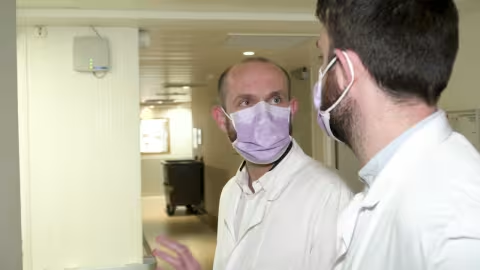
Clinical Research Associate
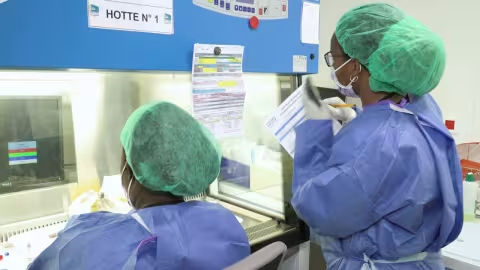
Pharmacist specializing in clinical research
A department dedicated to Phase I clinical trials
The Clinical Research Division works in collaboration with the Department of Therapeutic Innovation and Early-Phase Trials (DITEP). Dedicated to Phase I clinical trials, this department has several missions:
- To provide patients whose current treatments have failed with access to innovative drugs
- To accelerate the development of new cancer treatments
The DITEP is accredited by the National Cancer Institute as an Early-Phase Center (CLIP²) and is authorized by the Regional Health Agency to conduct Phase I trials.

Contact and Practical Information
Gustave Roussy
114 Rue Edouard Vaillant
94805 Villejuif
Phone: +33 01 42 11 62 18
Email
Learn more
- ANSM
Comments: Protocol for the temporary, exceptional use of Birabresib in adult and pediatric patients with NUT carcinoma - Summaries of clinical trial results for the general public