Welcome to the new Gustave Roussy website
A new website designed to offer you a simpler, clearer, and more intuitive experience. Patients, caregivers, healthcare professionals, and donors: find information, news, and services more easily.
Passing on Your Estate
Make your estate plan meaningful by supporting cancer research. Whether through a bequest, donation, or life insurance policy, Gustave Roussy will guide you through the process and provide information on the applicable tax provisions.
Contact
Phone: +33 (0)1 42 11 57 86
Email
Overview
Make a bequest to a nonprofit organization or public benefit organization dedicated to the fight against cancer
What is a bequest? How do I write a will? What assets can I bequeath? Our experts explain everything.
Decide today to fund tomorrow’s research
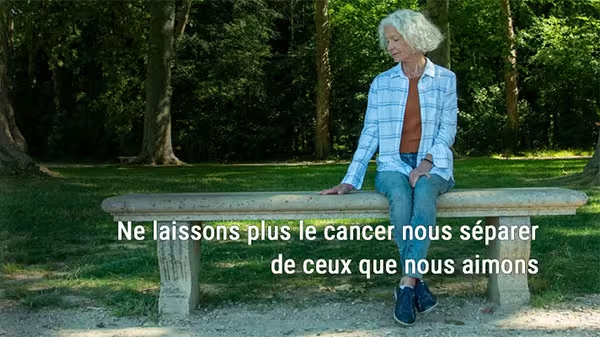
By bequeathing your estate to the Gustave Roussy Institute or its cancer research foundation—both of which are recognized as public-benefit organizations and authorized to receive donations, bequests, and gifts—you have the power to cure cancer in the 21st century.
Would you like to support medical research against cancer beyond your own lifetime? You can make this choice a reality through your will. You can thus make personal property or real estate available to others and leave a bequest to a recognized public-benefit organization or an authorized entity such as the Gustave Roussy Institute or its Cancer Research Foundation.
Your bequest takes the form of a written document, called a will, in which you specify your wishes regarding the transfer of all or part of your estate. It is important to note that the provisions of your will will take effect only after your death. You may therefore change your mind at any time by amending or revoking your will. To ensure it is valid and enforceable when the time comes, we recommend that you file your will with a notary to certify its validity.
Bequeathing a portion of your estate to the Gustave Roussy Institute or its Foundation is a wonderful gift of life for future generations.
What assets can I bequeath to a nonprofit organization, a foundation, or a recognized public-benefit organization?
When making a bequest to a nonprofit, foundation, or authorized organization, you have the option to pass on all types of assets, whether personal property (bank accounts, furniture, works of art, life insurance policies, etc.) or real estate (apartments, houses, land, etc.). Every bequest made to the Gustave Roussy Institute or its Cancer Research Foundation, regardless of its financial value, helps advance medical research against cancer and fuels hope for a better future.
What kind of bequest can I make?
There are several types of bequests, depending on the portion of your estate that you wish to leave to the Institute or its Gustave Roussy Cancer Research Foundation:
- Universal bequest: The testator bequeaths their entire estate to one or more beneficiaries.
- A universal bequest: In this case, the testator bequeaths a portion of their estate to one or more beneficiaries. This may consist of an entire category of assets or a fraction of their total estate.
- Specific bequest: The testator bequeaths one or more specific assets of their choosing. These may include a sum of money, land, furniture, jewelry, a work of art, etc.
A bequest may be made to any nonprofit organization, foundation, or entity recognized as serving the public interest or authorized to receive donations and bequests.
As a Private Healthcare Institution of Public Interest (ESPIC), the Gustave Roussy Institute is authorized to receive bequests, donations, and life insurance proceeds under the ordinance of October 1, 1945, as is its research foundation, which is recognized as a public-benefit organization. As a result, they are fully exempt from estate taxes on assets bequeathed to them.
Wills: When and How?
The existence of a valid will is an absolute prerequisite for a bequest to be transferred to the beneficiary of your choice. A will can be written at any time in your life, as long as you are committed to leaving a legacy to the people and causes that matter to you.
There are several ways to create a valid will:
- A holographic will: This is a handwritten document drafted by the testator; it must be dated and signed but does not require the involvement of a notary. It is the most flexible, least expensive, and least restrictive form of will to draft. However, it is strongly recommended that you have it registered with the central registry of last wills and testaments through a notary.
- The notarized will: This is a document drafted by a notary based on the testator’s dictation. This notarized document is drawn up and certified by the notary in the presence of two witnesses, which gives it a high degree of legal reliability.
- The secret will: This is a handwritten document drafted by the testator and delivered to a notary in a sealed envelope. Its contents are kept confidential. However, this procedure is more complex than the previous two.
To name the Gustave Roussy Institute or its Cancer Research Foundation as the beneficiary of your bequest, please include the following address in your will:
Gustave Roussy Institute OR Gustave Roussy
Foundation 39 rue Camille Desmoulins
94800 Villejuif
Other administrative information: Gustave Roussy Institute SIRET
number: 775 741 101 00031
Gustave Roussy Foundation SIRET number: 488 090 028 00017
Bequests, donations, life insurance: Request your brochure
If you would like to receive our brochure on bequests, donations, or life insurance free of charge and with no obligation, or if you would like our experts to contact you confidentially, please fill out the form below.

Contact the Donations Team
Mathilde Hérault
Head of Donor Development and Testator
Relations Phone: 01 42 11 57 86
Email: mathilde.herault@gustaveroussy.fr
Célina Daniel
, Donations
Development Officer Phone: 01 42 11 55 71
Email: celina.daniel@gustaveroussy.fr