
Welcome to the new Gustave Roussy website
A new website designed to offer you a simpler, clearer, and more intuitive experience. Patients, caregivers, healthcare professionals, and donors: find information, news, and services more easily.
Gynecological Cancers
Director:
Dr. Patricia Pautier
Contact
Tel.: +33 (0)1 42 11 66 99

Understanding the Disease
Gynecologic cancers refer to all cancers that develop in a woman’s reproductive organs. They include:
- Endometrial cancers (cancers of the uterine lining).
- Cancers of the ovaries, fallopian tubes, and peritoneum.
- Cervical cancers.
- HPV-related cancers
- Cancers of the vulva and vagina.
- Rare gynecologic or ovarian malignancies.
- Gynecologic sarcomas (uterine or other).
- Trophoblastic diseases.
All of these conditions are treated at Gustave Roussy by the gynecological committee.
Prevention and Risk Factors
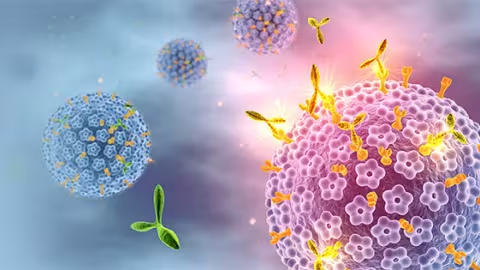
HPV is a major risk factor for several gynecological cancers. It is responsible for nearly all cases of cervical cancer and is also implicated in some cases of vaginal and vulvar cancer. It is a very common sexually transmitted infection that is usually cleared spontaneously by the body, but which can sometimes persist and lead to the development of precancerous lesions and eventually cancer.
HPV vaccination is one of the most effective ways to prevent these cancers. In France, HPV is responsible for 7,130 new cases of cancer each year, and approximately 30,000 precancerous lesions of the cervix are detected and treated annually. Vaccination is recommended for girls and boys aged 11 to 14, with catch-up vaccination available up to age 26 for those who were not vaccinated at a younger age.
Despite its effectiveness, vaccination coverage remains insufficient in France. In 2023, it was estimated at 54.6% for at least one dose among 15-year-old girls, and at 44.7% for two doses among 16-year-old girls. Santé publique France notes that these figures are improving but remain below public health targets.
Cervical cancer can be prevented through two complementary measures: vaccination and screening. Screening helps detect precancerous lesions or abnormalities before cancer develops. Even for women who have been vaccinated, screening remains essential.
Tobacco use is a recognized risk factor, particularly for cervical cancer. It can interact with a persistent HPV infection and promote the development of precancerous lesions. It is also implicated more broadly in many types of cancer.
Being overweight or obese increases the risk of several gynecological cancers, particularly endometrial cancer, which is the most common gynecological cancer in France. They are also associated with an increased risk of ovarian cancer. Regular physical activity, on the other hand, plays a protective role, particularly against endometrial cancer.
Diabetes is a recognized risk factor for endometrial cancer. Other medical conditions can also increase the risk depending on the site of the cancer; for example, HIV infection is a risk factor for cervical cancer, and certain hormone therapies, such as tamoxifen, are risk factors for endometrial cancer.
As with many cancers, the risk increases with age. Endometrial and ovarian cancers most commonly affect women after menopause. Ovarian cancer is diagnosed at a median age of 70, and endometrial cancer also most often occurs after menopause.
Certain types of gynecological cancers are influenced by a genetic predisposition. This is particularly true for ovarian cancer, where mutations in the BRCA1 and BRCA2 genes—or, more rarely, Lynch syndrome—are significant risk factors. The presence of multiple cases of breast or ovarian cancer in the same family may also warrant special vigilance.
Symptoms
The symptoms of gynecological cancers can be subtle and nonspecific, especially in the early stages. It is important to seek medical attention if you experience any unusual and persistent symptoms.
These symptoms may include:
- Unusual vaginal bleeding (between periods, after menopause, or after intercourse).
- Persistent pelvic or abdominal pain.
- A feeling of bloating or an increase in abdominal size.
- Recent and persistent digestive problems (constipation, nausea, feeling full quickly).
- Frequent or urgent need to urinate.
- Unusual vaginal discharge (heavy, foul-smelling, or abnormal).
- Pain during sexual intercourse.
- Persistent fatigue.
- Unexplained weight loss.
Coverage
Gustave Roussy treats patients with the following gynecologic cancers:
- Endometrial cancer (cancer of the uterine body).
- Cancer of the ovary, fallopian tubes, or peritoneum.
- Cervical cancer.
- Rare gynecologic or ovarian malignant tumors.
- Gynecologic sarcoma (uterine and others).
- Trophoblastic disease.
- Cancer of the vagina or vulva.
The Gynecology Committee at Gustave Roussy has also developed expertise in fertility preservation as well as in the management of gynecologic cancers during pregnancy.
The Diagnosis
The Institute provides diagnosis—if it has not yet been established—and treatment for gynecological cancers.
The diagnosis is based on a medical history, physical examination, and histology. Additional tests are always necessary: blood tests, abdominal and pelvic ultrasound, CT scan, MRI (Magnetic Resonance Imaging), PET (Positron Emission Tomography), colposcopy (examination of the cervix), diagnostic hysteroscopy, or exploratory laparoscopy. The need for these tests depends on the results of clinical and laboratory examinations and the type of tumor suspected. A definitive diagnosis of a malignant lesion must be based on histology.
InstaDiag
Spotlight on InstaDiag Gynecology
Gustave Roussy offers an InstaDiag Gynecology program designed to diagnose and provide prompt, appropriate care to patients with suspicious results from an examination performed at a local clinic.

Treatments
Decisions regarding the specifics of cancer treatment are made during the weekly gynecology multidisciplinary team (MDT) meeting. The conclusions and treatment recommendations are communicated to patients by the referring physician or during the meeting.
Once a diagnosis of gynecologic cancer has been made, treatment may involve:
- Surgery
- Chemotherapy
- Brachytherapy and/or external beam radiation therapy
The indication, modalities, and sequence of treatment are determined based on the type of cancer being treated, the extent of the disease, and the results of laboratory, clinical, and/or radiological tests.
In cases of a suspicious ovarian lesion, Gustave Roussy offers a one-day gynecologic surgery program, allowing patients to schedule all necessary appointments prior to surgery.
After Treatment
After treatment for gynecologic cancer, follow-up care is necessary. Follow-up visits with the referring physician (radiation oncologist, surgeon, medical oncologist) are scheduled at regular intervals (usually every 4 months, then every 6 months, and then annually). Depending on her personal and/or family history, the patient may be referred for an oncogenetics consultation.
Join a clinical trial
Many clinical trials are open to patients with cancer. Participating in a clinical trial provides access to innovative treatments while contributing to the development of new therapies.

Search
The research team dedicated to gynecologic cancers, led by Prof. Alexandra Leary at Gustave Roussy, is at the forefront of current challenges in oncology, focusing on three major types of cancer: ovarian, endometrial, and cervical cancers. These diseases represent a major public health challenge, particularly due to their sometimes late diagnosis and the lack of effective treatment options in the event of a relapse. The team is therefore developing an integrated and translational approach, in close collaboration with clinicians, to better understand the disease and propose solutions tailored to patients’ needs.
Its work is based on several complementary research areas, ranging from the identification of biomarkers that can predict treatment efficacy to the study of mechanisms of resistance to existing therapies. The team is also focused on developing new therapeutic strategies, particularly in immunotherapy, to expand treatment options. This research, directly informed by questions arising from clinical practice, aims to accelerate the transition of laboratory discoveries into concrete applications for patients.
The goal is clear: to improve the survival and quality of life of women with gynecological cancers by providing them with access to increasingly personalized and innovative treatments. Driven by a strong collective spirit and supported by the commitment of patients and donors, this team is helping to advance care standards for cancers that are still under-recognized, by placing patients at the center of research and innovation.
Contacts
Chair of the Multidisciplinary Gynecologic Oncology Committee:
Dr. Patricia Pautier
Contact
Tel.: +33 (0)1 42 11 66 99
Appointments and Second Opinions

Testimonial
Brigitte, who is being treated for ovarian cancer at Gustave Roussy
“I was diagnosed with ovarian cancer in 2016. At the time, I was being treated in Chartres because I live outside the city. In 2022, the cancer returned. I had surgery in 2022 in Villejuif, where they removed lymph nodes under my collarbone. And since April 2023, I’ve been participating in a clinical trial—the TEDOVA trial—which involves administering the TEDOPI vaccine in combination with immunotherapy. I’m also receiving tumor-suppressing chemotherapy. At first, I received this vaccine every three weeks; now it’s every six weeks, and I’m currently in remission. I have a few side effects, including pain at the injection site and muscle aches. I trust science, and I have complete confidence in Prof. Leary. Joining a clinical trial is inevitably scary, but the people at Gustave Roussy are wonderful. In 2021, I had run out of treatment options; it was just a matter of maintenance therapies, but I was fortunate enough to be accepted into this clinical trial—for myself, but also for others, and to advance research.”

-
Les cancers féminins
Chaque année en France, près de 190 000 femmes découvrent qu’elles sont touchées par un cancer

-
Les questions à poser si l’on m’annonce un cancer de l’ovaire
Le cancer de l’ovaire touche environ 5 200 femmes chaque année en France. À l’occasion de Septembre Turquoise, la Dr Patricia Pautier, cheffe du service d'oncologie gynécologique de Gustave Roussy, répond aux questions qui peuvent apparaître à l’annonce du diagnostic.

-
Cancers gynécologiques et ORL : pourquoi la lutte contre les papillomavirus est-elle cruciale ?
À l’occasion de Septembre Turquoise et de la campagne Make Sens "Prendre le cancer à la gorge", deux campagnes de prévention et de sensibilisation respectivement consacrées aux cancers gynécologiques et aux cancers ORL, Gustave Roussy rappelle son engagement contre les papillomavirus humains, responsable de nombreux cas dans ces deux pathologies. Le 20 septembre, une journée de sensibilisation aux cancers gynécologiques a été organisée dans le hall de Gustave Roussy en présence des médecins du comité gynécologie de l’Institut et d’associations.
-
Cancer du col de l’utérus : se vacciner, se faire dépister et agir vite
Le cancer du col de l’utérus touche chaque année environ 3 000 femmes en France, alors qu’il pourrait être évité dans plus de neuf cas sur 10 grâce à la vaccination et à un dépistage régulier. À Gustave Roussy, le parcours InstaDiag Gynéco permet aujourd’hui un diagnostic rapide en cas de suspicion.



Appointments and Second Opinions