
Welcome to the new Gustave Roussy website
A new website designed to offer you a simpler, clearer, and more intuitive experience. Patients, caregivers, healthcare professionals, and donors: find information, news, and services more easily.
Lung cancer

Understanding the Disease
Lung cancer, also known as bronchial cancer, is the second most common cancer in men and the third most common in women; it claims the lives of more than 30,000 people each year in France. It is a disease that develops from cells in the bronchi or, more rarely, the alveoli. Lung cancer results from a cell that undergoes transformation and multiplies uncontrollably to form a malignant tumor. Cells from this tumor can then spread throughout the body to form secondary tumors, known as metastases.
Screening is crucial: when detected early, lung cancer is curable in 80% of cases. Smoking remains the primary risk factor for the development of this cancer. Since a lung tumor can remain painless for a long time, it may be suspected when symptoms such as a persistent cough, a change in voice, recurrent bronchial infections, pain in the chest and arms, coughing up blood, etc., appear.
Prevention and Risk Factors
Lung cancer is one of the most common cancers in France, affecting both men and, to an increasing extent, women. Smoking remains the leading risk factor for this cancer, as it is responsible for 8 out of 10 cases of lung cancer.
A program specifically designed for heavy smokers aged 50 to 74 who are at increased risk of lung cancer has been implemented as part of the Interception prevention program at Gustave Roussy. The goal: to offer screening and a personalized prevention and follow-up plan, developed over the course of a single day. This innovative pilot program in France will eventually be rolled out to other centers across the country.
Symptoms
Being alert to the onset of any unusual symptoms—whether in the chest or elsewhere—is essential for early treatment of the disease, especially among smokers: when detected early, lung cancer is curable in 80 percent of cases.
Symptoms of lung cancer may include:
- An unusual or persistent cough
- A fever that won't go away
- Coughing up blood
- Unusual chest pain
Diagnosis
Gustave Roussy has partnered with Marie-Lannelongue Hospital and Paris Saint-Joseph Hospital—both internationally renowned institutions—to combine their complementary expertise by creating the International Center for Thoracic Cancers (CICT). This healthcare cooperation group enables the provision of comprehensive care to patients at risk of or diagnosed with lung, pleural, or mediastinal cancers.
Instadiag Program
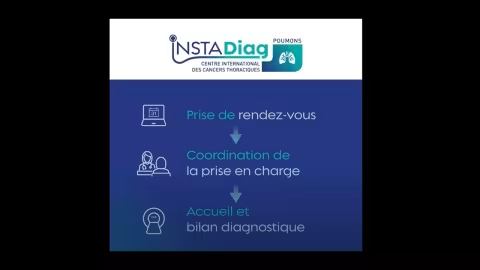
In collaboration with the CICT member hospitals, Gustave Roussy offers a rapid diagnostic pathway for lung, bronchial, and other thoracic cancers: the InstaDiag pathway.

Coverage
Gustave Roussy treats patients with various types of cancer of the lung, the pleura (the lining of the lungs), and the mediastinum (the region between the two lungs that includes the heart, the esophagus, the trachea, lymph nodes, and the two main bronchi), such as:
- Bronchopulmonary cancers in adults: non-small-cell carcinomas and small-cell carcinomas
- Pleural tumors: mesotheliomas and others
- Mediastinal tumors: thymomas and others
- Pleuropulmonary metastases eligible for local treatment (management coordinated by the committee corresponding to the location of the patient’s primary tumor)
The International Center for Thoracic Cancers
Gustave Roussy has partnered with Marie-Lannelongue Hospital and Paris Saint-Joseph Hospital—both internationally renowned institutions—to combine their complementary expertise by creating the International Center for Thoracic Cancers (CICT). This healthcare cooperation group provides comprehensive care to patients at risk of or diagnosed with lung, pleural, or mediastinal cancers.

Treatments and Clinical Trials
Various treatments may be offered to patients with lung, pleural, or mediastinal cancer, depending on the type of cancer and its extent at the time of diagnosis. These treatments may be combined during the course of therapy.
Treatments may include:
- Surgery
- Radiation therapy
- Thermoablation via interventional radiology
Search
The Rare Circulating Cells (RCC) research platform at Gustave Roussy studies tumor cells circulating in patients’ blood, particularly those with lung cancer. These cells, detected through a simple blood draw, provide valuable insights into why certain treatments work and others do not.
Using cutting-edge molecular analysis technologies and innovative experimental models, the research platform contributes to the development of new personalized therapeutic strategies. It also participates in European consortia aimed at standardizing these approaches, with the goal of improving patient diagnosis and follow-up.
Join a clinical trial
Many clinical trials are open to patients with cancer. Participating in a clinical trial provides access to innovative treatments while contributing to the development of new therapies.

Contact
Chair of the Thoracic Pathology Committee:
Prof. David Planchard
Contact
Phone: +33 (0)1 42 11 53 99
Email
Appointments and Second Opinions

Risk Factors
Tobacco is the leading cause of lung cancer, accounting for nearly 80 percent of cases. The earlier you start smoking, the longer you smoke, and the more you smoke, the higher your risk. But secondhand smoke—that is, regularly breathing in smoke from others—is also recognized as a serious risk factor. Lung cancer can, however, affect people who have never smoked, which shows that other factors also play a role.
Exposure to certain substances is directly linked to the development of lung cancer. Radon, a radioactive gas naturally present in some homes, is the second leading cause of lung cancer after tobacco. Asbestos, which was used for decades in construction, also poses a major risk, as does occupational exposure to chemicals such as arsenic or chromium.
Quitting smoking—or never starting in the first place—remains the most effective way to reduce your risk. The benefits are evident within the first few years after quitting.
-
Les dernières avancées thérapeutiques dans les cancers du poumon
À l’occasion de Novembre thoracique, le mois de sensibilisation aux cancers du poumon, la Dr Pernelle Lavaud, oncologue médicale au sein du comité de pathologie thoracique de Gustave Roussy, revient sur les dernières avancées dans le traitement de cette maladie.
-
The Lancet - des progrès pour les patients atteints d’un cancer du poumon porteurs d’une mutation réputée difficile à traiter
Les résultats de l’essai de phase III KRYSTAL-12, publiés dans The Lancet, démontrent l’efficacité de l’adagrasib, une thérapie ciblée innovante, chez les patients atteints d’un cancer du poumon non à petites cellules, porteurs de la mutation KRASG12C. Ce traitement montre également un bénéfice sur les métastases cérébrales, une localisation particulièrement difficile à contrôler. Ces avancées confirment l’intérêt de s’attaquer à cette mutation, fréquente dans de nombreux cancers, mais longtemps considérée comme « inciblable ».
-
Dépistage du cancer du poumon : où en est-on ?
Responsable d'environ 30 000 décès chaque année en France, le cancer du poumon est la première cause de mortalité par tumeur maligne dans l'Hexagone. Le dépistage précoce de la maladie est un enjeu majeur de santé publique. À l’occasion de Novembre Perle, mois dédié à la sensibilisation aux cancers thoraciques, tour d’horizon des pratiques et projets de recherche en France et dans le monde.
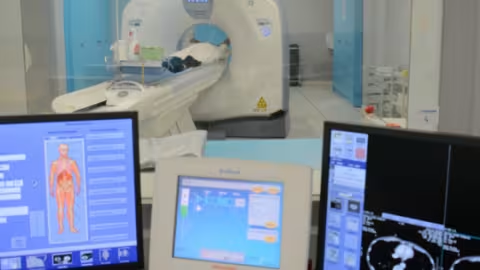


Lung cancer is a malignant tumor that develops from cells in the bronchi or lung tissue. It is one of the most common cancers in France and the leading cause of cancer-related deaths. There are two main types: small-cell lung cancer and non-small-cell lung cancer, with the latter accounting for about 85% of cases.
Tobacco remains by far the leading cause, accounting for nearly 80% of cases. But other factors also play a role: exposure to toxic substances such as asbestos or radon, air pollution, and certain genetic predispositions. Lung cancer also affects nonsmokers, which underscores the importance of vigilance for everyone.
Lung cancer often has no symptoms in its early stages, which makes early detection difficult. A persistent cough, unusual shortness of breath, chest pain, or blood in the sputum are signs that should prompt you to see a doctor right away.
Treatments have evolved significantly in recent years. Depending on the type of tumor and its stage, doctors may recommend surgery, radiation therapy, chemotherapy, as well as targeted therapies or immunotherapy. These last two approaches, which are based on the tumor’s molecular characteristics, have transformed the care of many patients.
Personalized medicine involves analyzing the genetic and molecular characteristics of each patient’s tumor to determine the most appropriate treatment. At Gustave Roussy, specialized platforms make it possible to create a comprehensive molecular profile of tumors—even from a simple blood sample—paving the way for increasingly precise and effective treatment strategies.