
Welcome to the new Gustave Roussy website
A new website designed to offer you a simpler, clearer, and more intuitive experience. Patients, caregivers, healthcare professionals, and donors: find information, news, and services more easily.
Cancer Screening
Depending on a person’s age and gender, everyone will at some point in their life be eligible for a cancer screening program, whether national or individual. Organized by disease type, screening involves examinations and tests conducted on people who do not have any symptoms.
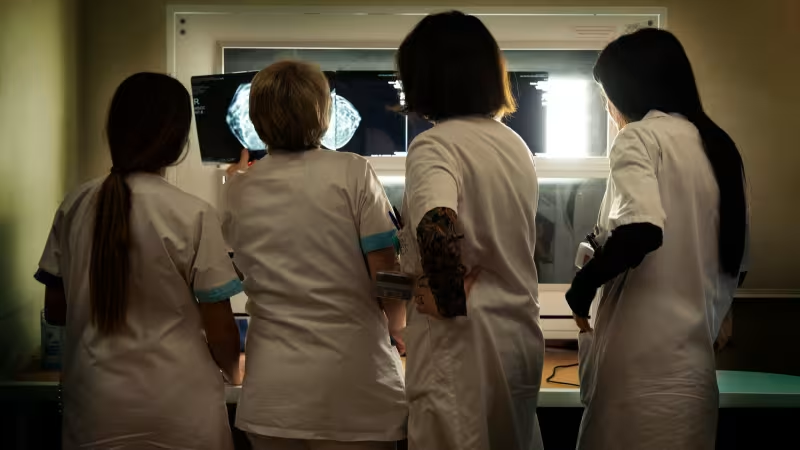
Cancer Screening: Why Get Screened?
Screening aims to identify potential abnormalities, such as precancerous cells or malignant tumors. The goal? To diagnose cancers at an earlier stage, in order to increase the effectiveness of treatments and improve the chances of recovery.
Several screening methods
Screening takes place in various ways:
-
“Organized” screening, in which a segment of the national population is invited to undergo a specific test. This involves information campaigns, accompanied by the mailing of an invitation letter to participants’ homes.
-
“Individual” screening, in which screenings are arranged as part of the relationship between the patient and their doctor.
Key Point
People with specific risk factors, such as a personal or family history of the condition, receive specialized follow-up care.
In France, three national screening programs are in place:
- Cervical cancer screening, which targets women aged 25 to 65 (including pregnant women, postmenopausal women, and women vaccinated against human papillomavirus).
- Breast cancer screening, for women aged 50 to 74.
- Colorectal cancer screening, which is for women and men aged 50 to 74.
How does a screening work?
How a screening is conducted depends on the type of cancer involved.
Cervical Cancer Screening
Screening involves a Pap test, which should be performed at regular intervals:
-
Women aged 25 to 30: the first two tests should be performed one year apart, followed by a Pap test every three years if the results are normal.
-
Women aged 30 to 65: one test three years after the last normal Pap test, followed by a test every five years until age 65.
Several steps:
-
Make an appointment with the healthcare provider of your choice (gynecologist, primary care physician, midwife) at a health center or hospital.
-
Have the Pap test performed.
-
The sample is sent to a specialized practice or laboratory. You’ll receive the results within a few days. If an abnormality is detected, your healthcare provider will contact you to schedule further tests.
Key Point
Vaccination against human papillomavirus (HPV) is recommended for girls and boys aged 11 to 14, as well as for people aged 15 to 26 who have not yet been vaccinated. This serves as a complement to screening in the prevention of cervical cancer.
Figures
Breast Cancer Screening
In France, the National Health Insurance system organizes a national breast cancer screening campaign for all women between the ages of 50 and 74. The goal is to detect tumors as early as possible in women with breast cancer, in order to increase their chances of recovery.
It is recommended that women undergo breast cancer screening every 2 years. Eligible women receive an invitation from the French National Health Insurance by mail, which is also available in their Ameli account. This invitation includes a list of approved radiologists in your department.
Several steps:
- Schedule an appointment with a radiologist.
- A mammogram is performed by a technologist, followed by a clinical examination (visual inspection and palpation) by the radiologist. This examination helps detect certain abnormalities that may not be visible on the mammogram.
- The radiologist will give you a preliminary verbal result. If necessary, they will perform an ultrasound. If the images and clinical examination show no abnormalities, a second reading is performed by another radiologist as a precautionary measure, as part of the national screening program organized by the Health Insurance Agency.
Figures
Colorectal Cancer Screening
Colorectal cancer screening is intended for the general population—specifically, all men and women aged 50 to 74 with no family history of colorectal cancer.
This screening program uses the Fecal Immunological Test (FIT), which has replaced the Hemoccult test. It comes in the form of a kit that can be picked up at a pharmacy or from your primary care physician after you receive a letter from the health insurance provider. It can also be ordered online at monkit.depistage-colorectal.fr.
Once you receive the kit, the entire process takes place at home. Place a small paper bag over the toilet bowl to collect the stool sample. Then use the swab to collect a sample, place it in a resealable tube, and return it the same day in an envelope—no postage required. You must also include a personal information sheet in the envelope. All the materials needed to perform the test and send it back are provided in the kit.
Steps to follow:
- Obtain the test from your pharmacist, doctor, state-licensed nurse, or online at monkit.depistage-colorectal.fr
- Perform the test yourself at home.
-
Mail the test using the provided envelope within 24 hours of taking it.
-
You’ll receive a text message with your results.
To learn more:
→ Colorectal Cancer Screening: What You Need to Know
Figures
Lung Cancer Screening Is Evolving
In 2026, Gustave Roussy joined the IMPULSION program, launched by the National Cancer Institute (INCa). This initiative is a preliminary step toward an organized lung cancer screening program in France.
Rolled out in five regions of France and involving 20,000 volunteers, this screening program consists of performing a low-dose chest CT scan and offering smoking cessation support to smokers. Gustave Roussy is participating in this initiative.
Prostate Cancer: A Specific Diagnosis
As the most common cancer and the third leading cause of cancer-related deaths among men, prostate cancer raises the question of screening. The risk varies from person to person, particularly depending on family history. It is also higher in people with certain genetic abnormalities, particularly in the BRCA2 gene, which are often associated with more aggressive forms of cancer.
Current guidelines recommend beginning screening in one’s 40s, notably with a blood test for PSA, a biological marker. Other screening techniques, such as prostate MRI, are currently being evaluated. At Gustave Roussy, the Interception personalized prevention program has developed a specific care pathway, HARVEY, designed for men with an above-average risk of cancer due to a genetic predisposition.