Welcome to the new Gustave Roussy website
A new website designed to offer you a simpler, clearer, and more intuitive experience. Patients, caregivers, healthcare professionals, and donors: find information, news, and services more easily.
PCCR: Rare Circulating Cells Platform
Joint Service Unit
US23 – AMMICa
Platform Type:
Translational Platform
Scientific Director:
Prof. Marianne Oulhen
Research Areas:
Cytometry, Genomics, Cell Imaging, Microscopy, Models, Proteomics, Single-cell, Transcriptomics
Guardianships


Abstract
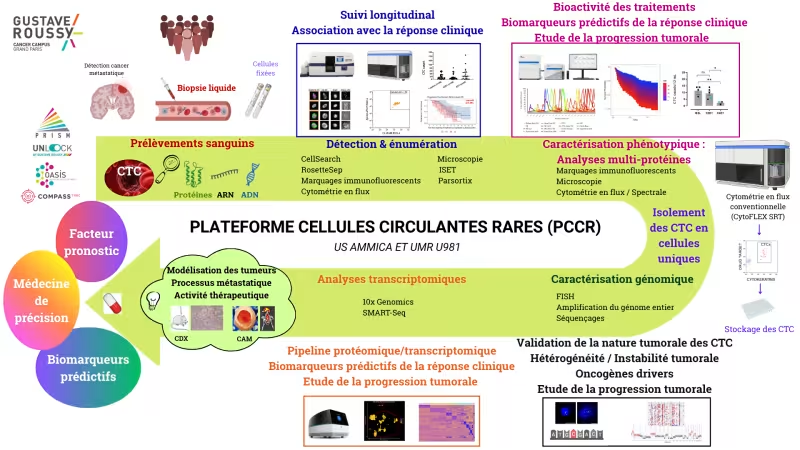
The CCR platform is dedicated to the phenotypic and molecular analysis of extremely rare cells found in the blood, such as circulating tumor cells (CTCs). Our laboratory has gained globally recognized expertise in this field through the publication of numerous articles on the detection and characterization of these cells.
As part of clinical trials, the laboratory evaluates various non-invasive biomarkers (therapeutic targets, tyrosine kinase receptors, signaling pathways, DNA repair) to assess treatment response in CTCs.
The objectives are (I) to count and characterize CTCs detected at different points in the patients’ clinical course, (II) to assess the early bioactivity of treatments, (III) to predict sensitivity or resistance to therapies, and (IV) to better understand tumor progression.
The platform relies on cutting-edge technologies: microscopy (immunofluorescent staining and FISH analyses), flow cytometry (single-cell detection and isolation, multi-protein analyses), and single-cell sequencing (targeted, whole-exome, whole-genome, transcriptome). It develops innovative projects such as xenografts derived from CTCs (CDX) or culture on the chorioallantoic membrane (CAM) of chicken embryos to model tumors and test therapeutic activity. Mouse models are used to validate data from liquid biopsies.
Research Programs and Initiatives
Our laboratory is affiliated with the IHU PRISM as part of the UNLOCK program.
As a partner in European consortia, the platform contributes to the development of liquid biopsy analysis technologies, affirming its central role in personalized medicine and translational research in oncology.
Services Offered
The platform’s services are open to everyone, both within Gustave Roussy and to external teams. The project leader is invited to present the project at a dedicated meeting, where its scientific, technical, and financial feasibility are discussed and approved, subject to acceptance of a preliminary cost estimate.
Service 1
: Detection and quantification of CTCs following enrichment methods or directly in whole blood.
Technologies: CellSearch, RosetteSep, Immunofluorescent labeling, ISET, Parsortix, Microscopy, Flow cytometry.
Application: Longitudinal monitoring of the total CTC count detected at various points during the patients’ clinical course; evaluation of the correlation between these CTC counts and clinical outcomes.
Phenotypic characterization of detected CTCs: Multi-protein analyses (therapeutic targets, tyrosine kinase receptors, signaling pathways, DNA repair).
Technologies: Immunofluorescent labeling, microscopy, conventional flow cytometry, spectral cytometry (currently under development).
Applications: Assessment of treatment bioactivity, early prediction of sensitivity or resistance to therapies, and study of tumor progression.
Isolation of CTCs detected as single cells.
Technologies: Flow cytometry.
Application: Storage of CTCs for subsequent molecular analysis.
Single-cell transcriptomic analyses of CTCs, currently under development.
Technologies: 10x Genomics, Smart-Seq, robust bioinformatics pipelines ensuring quality and accuracy.
Applications: Validation and complementation of protein biomarkers detected in CTCs; establishment of a comprehensive proteomic/transcriptomic pipeline; evaluation of biomarkers predictive of treatment response; study of tumor progression.
Genomic characterization of CTCs detected and isolated as single cells: Gene copy number analysis, mutation analysis.
Technologies: Whole-genome amplification and associated quality controls; next-generation “LowPass whole genome” sequencing; next-generation targeted sequencing using a commercially available cancer panel (60 genes); robust bioinformatics pipelines ensuring quality and accuracy.
Applications: Validation of the tumor origin of detected and isolated CTCs, analysis of tumor heterogeneity, determination of a tumor instability score, identification of driver oncogenes, assessment of the correlation between these genomic alterations and clinical outcomes, and study of tumor progression.
Development of innovative projects such as xenografts using circulating tumor cells (CDX) in mice, or the culture of tumor cells on the chorioallantoic membrane (CAM) of chicken embryos.
Technologies: Animal experiments, small-animal imaging.
Applications: Tumor modeling, analysis of the metastatic process, testing of therapeutic activity.
Contact Us
If you are considering entrusting us with an analysis, please contact us to learn more about the available options, define the service, and obtain a quote: GD-BCC@gustaveroussy.fr

Team
OULHEN Marianne - Platform Operations Manager
Research Engineer or Equivalent
Employer: Gustave Roussy
Noémie BEUSCART
Research Technician or equivalent
Employer: Gustave Roussy
PAWLIKOWSKA, Patrycja
Research Engineer or equivalent
Employer: Gustave Roussy
CAMARA, Kousso
Other status, including apprentice
Employer: Gustave Roussy
SANCHEZ-BECERRA Maria Virginia
Doctoral Student
Employer: Gustave Roussy
COURTOIS Arthur
Research Technician or equivalent
Employer: Gustave Roussy
Key Publications
Contact