Welcome to the new Gustave Roussy website
A new website designed to offer you a simpler, clearer, and more intuitive experience. Patients, caregivers, healthcare professionals, and donors: find information, news, and services more easily.
Metabolic Plasticity in Cancer
- Thematic(s)
- Tumor Metabolism, Tumor microenvironment
- Attachment unit
- UMR9018 - Cancer Biology and Metabolism (METSY)
- Manager(s)
- Catherine Brenner, Svetlana Dokudovskaya
- Institutional connection
-
Gustave Roussy, CNRS, Paris-Saclay University
Summary
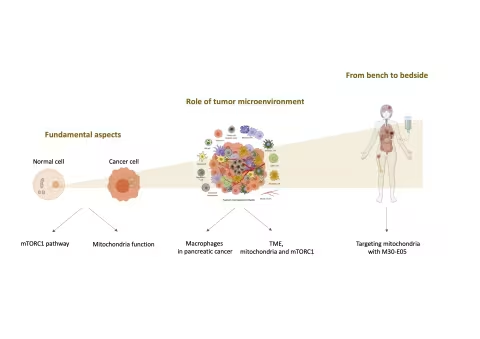
Metabolic plasticity allows cancer cells and their microenvironment to adapt to physiological stress, variations in nutrients, and anticancer treatments. Our program aims to understand how mitochondrial function and mTORC1 signaling promote tumor progression, immune adaptation, and therapeutic resistance. The goal is to identify metabolic vulnerabilities that can be targeted in cancer therapy.
Our research is organized into three complementary areas.
-
Track 1 (Principal Investigator – Svetlana Dokudovskaya): Metabolic adaptation and treatment resistance. We are studying how the dysregulation of the mTORC1 suppressor, GATOR1, disrupts mitochondrial homeostasis and contributes to cisplatin resistance. We have shown that GATOR1 regulates autophagy, mitophagy, and the response to DNA damage, and that its loss reduces the intracellular accumulation of cisplatin while increasing mTORC1 activity.
-
Research Area 2 (Principal Investigator – Camille Bleriot): Metabolic interactions in the tumor microenvironment. Using mouse models, spatial transcriptomics, and single-cell approaches, we are studying the differentiation of tumor-associated macrophages in pancreatic cancer. We have identified populations expressing TREM2 and CD36, suggesting that metabolic signals control macrophage specialization and their pro-tumoral functions.
-
Research Area 3 (Principal Investigator – Catherine Brenner): Translational targeting of mitochondrial pathways and mTORC1. We have shown that disruption of the mitochondrial AIF/CHCHD4 complex reduces metabolic flexibility and induces apoptosis in tumor cells that overexpress these two proteins. In collaboration with chemists and clinicians, we have identified the flavonoid derivative M30-E05 as a promising anticancer compound for pediatric and adult solid tumors.
Future studies will focus on tumor metabolism associated with obesity, immuno-metabolic interactions, and the development of new therapeutic strategies targeting mitochondrial and mTORC1 pathways.
Team members
-
BRENNER Catherine - Team Leader
Research Director and Equivalents, CNRS
DOKUDOVSKAYA Svetlana - Team Leader
Research Director and Equivalents, CNRS
ANDRE Franck
Research Associate and Equivalents, CNRS
BLERIOT Camille
Research Associate and Equivalents, CNRS
COLLIN Thibaut
Design Engineer or equivalent, INOVARION
Boris COLUSSI CORTE
Ph.D. Candidate, SANOFI
Frédéric DESCHAMPS
Hospital Physician, Gustave Roussy
Pascal DRANE
Researcher and equivalent positions, CNRS
Cesar Antonio GONZALEZ
Research Director and Equivalents, IMNC
Théo HERAIL
Ph.D. Candidate, VIROXIS
LAI Hong Toan
Research Engineer or equivalent, Gustave Roussy
Amélia LAVEILLE
Ph.D. student, Paris-Saclay University
Robin MENTHEOUR
Postdoctoral researcher, CNRS
MIR, Luis
Emeritus Research Director, CNRS
Antoine MOYA PLANA
University Professors and Hospital Practitioners, Paris-Saclay University
NGUYEN Tran Ngoc Anh
Research Engineer or equivalent, CNRS
TSERANKOVA Veronika
Ph.D. Candidate, Gustave Roussy
WERNER Marie
Ph.D. student, Inserm
XIAO Xia
Ph.D. student, Université Paris-Saclay
Key publications
Contacts
- Phone
- 01.42.11.51.28