Welcome to the new Gustave Roussy website
A new website designed to offer you a simpler, clearer, and more intuitive experience. Patients, caregivers, healthcare professionals, and donors: find information, news, and services more easily.
Genetics and Biology of Thyroid Cancers
- Thematic(s)
- Epigenetics, Genetics / Genomics, Precision Medicine, Tumor microenvironment
- Attachment unit
- U981 - Molecular Predictors and New Targets in Oncology
- Manager(s)
- Iñigo Landa
- Institutional connection
-
Gustave Roussy, Inserm, Paris-Saclay University
Summary
Objectives and Challenges
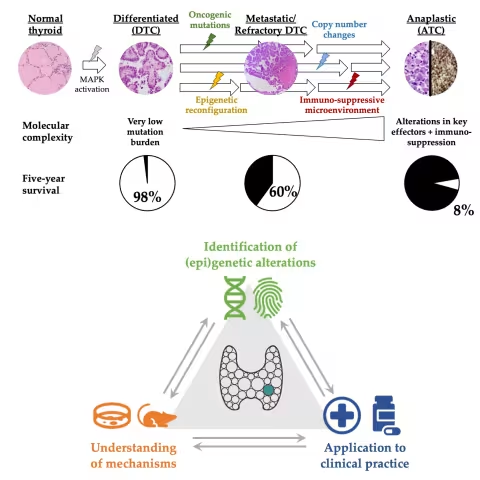
Differentiated thyroid cancers (DTC) have an excellent prognosis but can progress to more aggressive forms. DCTs that have become metastatic and refractory to radioiodine therapy (DCT-RR), and more specifically anaplastic thyroid cancers (ATC), account for the majority of morbidity and mortality associated with this disease. The progression of DTC to ATC results from the acquisition of a limited number of oncogenic mutations, copy-number alterations, and epigenetic modifications affecting key effectors, as well as an increasingly immunosuppressive tumor microenvironment. Our research aims to identify and understand the mechanisms underlying the key genetic and epigenetic events in thyroid cancer progression, using preclinical models of human cancer cells, genetically modified mouse models, and patient samples. A deeper understanding of the biology of thyroid cancer may pave the way for therapeutic interventions tailored to tumors carrying specific alterations.
Research Areas/Major Projects
The team’s current research areas focus on i) understanding the consequences of TERT (telomerase reverse transcriptase) reactivation in the progression of thyroid cancer through non-telomeric mechanisms, ii) investigating the role of loss-of-function mutations in histone acetyltransferase genes in the transformation into CAT, as well as the potential for targeting these alterations using protein-degrading agents, iii) the exploitation of homozygous deletions on chromosome 9p21.3 to refine and develop better therapeutic approaches, iv) the identification of epigenetic determinants with therapeutic potential in RR-CDT, through the generation and disruption of patient-derived organoids, with the aim of improving the outcomes of redifferentiation trials, v) characterizing the immune microenvironment of CAT using single-cell and spatial technologies to predict response to immune checkpoint inhibitor therapies.
Key Findings and Scientific, Clinical, and Societal Impacts
Our long-term goal is to provide a preclinical foundation that can inform genomics-driven, molecular-mechanism-centered decisions for the clinical management of patients with aggressive thyroid cancers and, ultimately, other endocrine tumors.
Team members
-
LANDA, Iñigo—Team Leader
Researcher and equivalent positions, Inserm
BANI Mohamed-Amine
Hospital Physician, Gustave Roussy
BAUDIN Eric
Hospital Physician, Gustave Roussy
Julien HADOUX
Hospital Physician, Gustave Roussy
Dana Hartl
Hospital Physician, Gustave Roussy
Livia Lamartina
Hospital Physician, Gustave Roussy
Hélène Lecourt
Design Engineer or equivalent, Gustave Roussy
Laurane LHOSTE
Ph.D. Candidate, Paris-Saclay University
Julia MAIER
Ph.D. student, Paris-Saclay University
MEMMADI Meryem
Bioinformatician, Gustave Roussy
Sophie Moog
Hospital Physician, Gustave Roussy
Key publications
Contacts