
Welcome to the new Gustave Roussy website
A new website designed to offer you a simpler, clearer, and more intuitive experience. Patients, caregivers, healthcare professionals, and donors: find information, news, and services more easily.
Pediatric Cancers: Why Some Forms of Leukemia Only Affect Children
On
Pediatric Cancers: Why Some Forms of Leukemia Only Affect Children
Acute myeloid leukemia (AML) mainly affects children, with the prognosis often being poor despite several decades of research into more effective treatments. A new study led by Thomas Mercher (Inserm U1170/Gustave Roussy/Université Paris-Sud-Paris Saclay), and performed in collaboration with Jürg Schwaller (UKBB, Department of Biomedicine, Universität Basel) explains why some forms of leukemia develop in very young children. The study – published in Cancer Discovery, a journal of the American Association for Cancer Research – has also revealed potential new therapeutic targets.
Each year, 2,500 pediatric cancers are diagnosed in France, with one third of cases concerning leukemia – commonly known as blood cancer. Over recent decades, research into pediatric cancer has intensified and treatments have improved, but the prognosis remains particularly unfavorable for these young patients.
Acute myeloid leukemia (AML) accounts for 15% of cases of leukemia diagnosed in children and adolescents. Overall survival at 5 years is around 60%, with relapse being the most common cause of mortality.
Abnormal protein fusion
There are several subtypes of AML. One of the most aggressive, which is linked to treatment resistance and a particularly unfavorable prognosis, is acute megakaryoblastic leukemia (AML-M7). In their new study published in Cancer Discovery, the team focused their efforts specifically on this type of acute myeloid leukemia. Their work is co-financed by the National League Against Cancer.
Through the CONECT-AML collaborative network [1], the scientists obtained samples from young patients with AML-M7. In 2012, their analysis of these samples had already revealed AML-M7 to frequently present genetic alterations that lead to the expression of an abnormal protein resulting from the fusion of the two proteins normally independent in the cell. At that time, although this fusion – known as ETO2-GLIS2 – had been identified in 30% of AML-M7 cases, the researchers could not explain its mechanism of action.
They also wanted to understand why AML-M7 is diagnosed in children who are on average a lot younger (under 2 years of age) than those diagnosed with the other pediatric AML subtypes (on average towards the age of 6).
"One of the objectives of our new study was to look at the mechanism of action of the ETO2-GLIS2 fusion, and to better elucidate its consequences. We wanted to answer two major questions, with the first being why this disease is specific to children – since the fusion is not found in adults, and then what the potential therapeutic avenues could be", explains Thomas Mercher.
This involved the researchers analyzing the characteristics of human leukemia cells and developing a mouse model to study the consequences of the ETO2-GLIS2 fusion.
Towards new therapeutic avenues
In this model, the researchers showed that this fusion is sufficient in order to rapidly induce aggressive leukemia, if it is activated in fetal hematopoietic cells. However, there is little to link its activation in adult cells with the development of leukemia. Moreover, blocking the ETO2-GLIS2 fusion in the in vivo model brings tumor proliferation to a halt, with the abnormal blood cells once again able to differentiate into normal blood cells.
These findings suggest that some forms of leukemia develop specifically in children because the properties of the fetal cells differ from those of adult cells.
Findings which also make it possible to propose new target mechanisms in fetal cells and pediatric leukemia in order to improve treatments for these patients. "We now want to understand exactly how this fusion works. Targeting it in order to directly inhibit it with molecules that could be used in patients is not something we are able to do at present, so instead we will identify and try to target the surrounding proteins that are important for it to function", concludes Thomas Mercher.
Read the article: https://cancerdiscovery.aacrjournals.org/content/early/2019/10/25/2159-8290.CD-18-1463
Sources
Ontogenic changes in hematopoietic hierarchy determine pediatric specificity and disease phenotype in fusion oncogene-driven myeloid leukemia
Cécile K. Lopez1,2,3,4, Esteve Noguera1,2,4, Vaia Stavropoulou5, Elie Robert1,2,4, Zakia Aid1,2,4, Paola Ballerini6, Chrystèle Bilhou-Nabera7, Hélène Lapillonne7, Fabien Boudia1,2,4,9, Cécile Thirant1,2,4, Alexandre Fagnan1,2,4,9, Marie-Laure Arcangeli10, Sarah J. Kinston11, M’Boyba Diop2, Bastien Job2, Yann Lecluse2, Erika Brunet12, Loélia Babin12, Jean-Luc Villeval1,2, Eric Delabesse13, Antoine H.F.M. Peters14, William Vainchenker1,2, Muriel Gaudry1,2, Riccardo Masetti15, Franco Locatelli16, Sébastien Malinge1,2,3,4, Claus Nerlov17, Nathalie Droin1, Camille Lobry1, Isabelle Godin1,2, Olivier A. Bernard1,2,3,4, Berthold Göttgens11, Arnaud Petit6, Françoise Pflumio10, Juerg Schwaller5,*, Thomas Mercher1,2,4,9,*
1 INSERM U1170, Gustave Roussy, 94800 Villejuif, France
2 Gustave Roussy, 94800 Villejuif, France
3 Université Paris-Saclay, 94800 Villejuif, France
4 Equipe labellisée Ligue Nationale Contre le Cancer, 75013 Paris, France
5 University Children’s Hospital Beider Basel (UKBB) and Department of Biomedicine,
University of Basel, 4031 Basel, Switzerland
6 Hôpital Trousseau, AP-HP, 75012 Paris, France
7 Sorbonne Université, CRSA – Unité INSERM, AP-HP, Hôpital Trousseau, F-75012 Paris
8 Hôpital Saint Antoine, AP-HP, 75012 Paris, France
9 Université Paris Diderot, 75013 Paris, France
10 Unité Mixte de Recherche 967 Inserm-CEA/DRF/IBFJ/IRCM/LSHL- Université Paris Diderot-Université Paris-Sud, Equipe labellisée Association Recherche contre le Cancer, 92265 Fontenay-aux-Roses Cedex, France
11 Wellcome and MRC Cambridge Stem Cell Institute and the Cambridge Institute for Medical Research, University of Cambridge, Cambridge, UK
12 Genome Dynamics in the Immune System Laboratory, Institut Imagine, INSERM, UMR 1163, Université Paris Descartes, Sorbonne Paris Cité, Equipe Labellisée Ligue Contre le Cancer, 75015 Paris, France
13 INSERM U1037, Team 16, Center of Research of Cancerology of Toulouse, Hematology laboratory, IUCT-Oncopole, France
14 Friedrich Miescher Institute for Biomedical Research (FMI), 4058 Basel, Switzerland; Faculty of Sciences, University of Basel, 4056 Basel, Switzerland
15 Department of Pediatrics, "Lalla Seràgnoli", Hematology-Oncology Unit, Sant'Orsola-Malpighi Hospital, University of Bologna, Via Massarenti 11, 40137, Bologna, Italy
16 Department of Pediatrics - Sapienza - University of Rome, Hematology-Oncology - IRCCS Ospedale Bambino Gesù - Rome, Italy
17 MRC Molecular Hematology Unit, MRC Weatherall Institute of Molecular Medicine, Radcliffe Department of Medicine, University of Oxford, Oxford OX3 9DS, UK
Researcher contact
Thomas Mercher
Phone: +33 1 42 11 44 83
Juerg Schwaller
Phone: +41 61 265 3504
Press contact
[1] French network of various teams of researchers, clinical pathologists and pediatric hematologists
Press contact
If you are a journalist and have a question, please contact:
Claire Parisel or Léona Pinto
Tel. +33 1 42 11 50 59
Tel. +33 1 42 11 63 59
Mob. +33 6 17 66 00 26
Email
The Media Team cannot respond to patient inquiries.
Last press releases
-
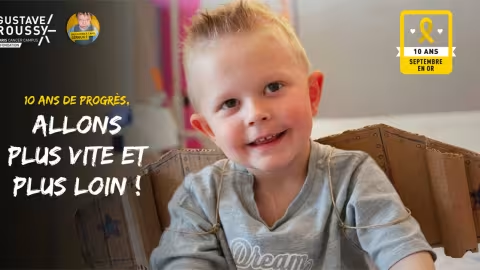
Gold september: two new research programmes launched to tackle childhood cancers
Two of Gustave Roussy’s four new medical and scientific programmes are dedicated to childhood cancers. The first, DECRIPT, aims to improve understanding of the role played by genetics in the development of certain childhood cancers, as well as second cancers that may occur in adulthood. The second, INSPIRE, will draw on the knowledge and techniques already developed at the Institute to create organoids, with the aim of deciphering the mechanisms underlying metastasis and resistance to treatment.
-
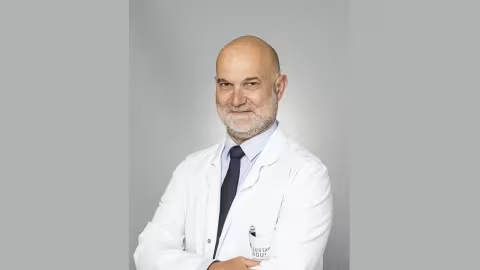
Prof. Fabrice Barlesi reappointed at the head of Gustave Roussy, the leading cancer center in France and Europe
By order of Ms. Stéphanie Rist, Minister of Health, Families, Autonomy and Persons with Disabilities, dated 27 July 2026, Professor Fabrice Barlesi has been reappointed as Director General of Gustave Roussy, effective 1 August 2026. At the helm of the Institute for five more years, Prof. Barlesi will continue the transformations undertaken during his first term. This renewal reflects the confidence placed in the project led by the institution to accelerate progress in the fight against cancer, foster and support the development of innovations set to change the future of oncology, and strengthen the influence of one of the world's leading cancer centers.
-
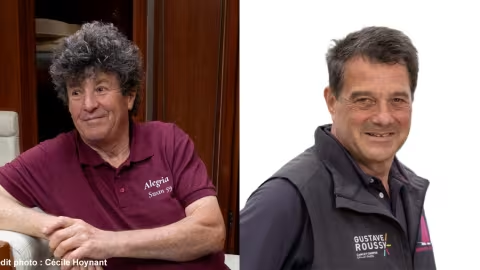
Route du Rhum 2026 Jean Le Cam and Christophe Rateau to sail for Gustave Roussy
For the Route du Rhum - Destination Guadeloupe 2026, Jean Le Cam and Christophe Rateau will sail under the colors of Gustave Roussy, the leading cancer center in France and Europe. Competing respectively in the Vintage and Class40 categories, the two skippers will carry the Institute's mission to the general public, supporting cancer research and raising awareness of prevention, innovation and patient care.
-
Owkin and Gustave Roussy partner to bring K Pro into real-world clinical practice
Owkin and Gustave Roussy, Europe's leading cancer center, today announced a partnership to test K Pro directly within the hospital's real-world clinical and research workflows.