Welcome to the new Gustave Roussy website
A new website designed to offer you a simpler, clearer, and more intuitive experience. Patients, caregivers, healthcare professionals, and donors: find information, news, and services more easily.
Launch of the European programme DOSELIA: artificial intelligence in the service of paediatric radiotherapy
On
Changed on
Villejuif, 1 April 2025
Launch of the European programme DOSELIA: artificial intelligence in the service of paediatric radiotherapy
DOSELIA, a collaborative European research project involving leading institutions across Europe and coordinated by Gustave Roussy, aims to improve paediatric radiotherapy by reducing the long-term side effects of treatments. The initiative seeks to optimise care for young cancer patients by integrating cutting-edge technologies to better assess and limit healthy tissue exposure to radiation.
Every year, 35,000 children and adolescents in Europe are diagnosed with cancer, with a five-year survival rate exceeding 80%. In 2020, Europe had approximately 600,000 survivors of paediatric cancer, a number expected to continue rising.
Radiotherapy is a critical treatment for many childhood cancers, but it can have lasting side effects, affecting both nearby and distant healthy tissues.
According to epidemiological studies, one in five patients cured of paediatric cancer develops a second tumour before the age of 50, with a risk twice as high as that of the general population, even 40 years after the end of treatment. While genetic predisposition and certain chemotherapies can also increase the risk of secondary cancer, radiotherapy remains a significant risk factor. For example, cranial irradiation increases the long-term risk of developing a new brain tumour tenfold. Thoracic irradiation exposes female patients to a breast cancer risk comparable to that of women carrying a BRCA1 mutation. Moreover, the younger the age at radiation exposure, the higher the risk of developing leukaemia, breast cancer, brain tumours, and thyroid cancer.
Developing an AI Tool for Precision Radiotherapy
Current planning systems do not allow for precise estimation of radiation doses received at a distance from the treated area, complicating risk assessment and treatment optimisation. Coordinated by Charlotte Robert, a researcher at Gustave Roussy and associate professor in medical physics at Université Paris-Saclay, the DOSELIA project aims to address this challenge by using artificial intelligence to better model the patient's overall exposure to radiation and anticipate long-term risks.
"The main objective of this project is to develop a dosimetric modelling software based on artificial intelligence. This tool will enable precise evaluation of the doses the entire body receives in young patients undergoing radiotherapy treatment. All irradiations received by the patient during their care, including those related to the planning CT scan and the positioning images taken at each treatment session, will be considered. This project will also provide predictive models for the risk of secondary cancers in cured patients. Finally, this AI tool will serve as a real clinical decision support system, enabling radiation oncologists to adjust treatment parameters based on each patient's profile, optimising the balance between therapeutic efficacy and side-effect reduction," explains Charlotte Robert.
Currently, precise whole-body dose assessments require time-consuming Monte Carlo simulations, which model the interaction of ionising radiation with biological tissues. However, these simulations require access to supercomputers and are not suitable for direct clinical use. DOSELIA’s AI-driven approach aims to deliver comparable accuracy in a fraction of the time.
Validating Models with Real-World Data
To validate its models and refine its predictions, the DOSELIA project will rely on data from the European HARMONIC-Radiotherapy registry (NCT 04746729), funded by the European Commission. This registry, coordinated by Neige Journy, an Inserm researcher and epidemiologist at Gustave Roussy, along with Beate Timmermann, a paediatric radiation oncologist at the West German Proton Therapy Centre in Essen, ensures long-term follow-up of children, adolescents, and young adults treated with photon or proton radiotherapy. HARMONIC-Radiotherapy collects clinical, dosimetric, and biological data. Through this collaboration, DOSELIA will be able to leverage a unique European database to train and validate its algorithms using real-world data, thereby enhancing the accuracy of dose estimations and risk projections for future patients.
"Integrating the AI tool developed under the DOSELIA project into routine clinical practice could transform paediatric radiotherapy by providing a more detailed view of the doses received by the entire body. This approach will enable doctors to optimise each treatment to reduce healthy tissue exposure while maintaining maximum tumour control," concludes Charlotte Robert.
Funding and Collaboration
DOSELIA has received €944,000 in funding from the European Union under the PIANOFORTE project (Grant no. LW Contract 2025-0019). PIANOFORTE, a Euratom-funded initiative, supports research to improve protection against ionising radiation in medical and environmental settings.
Project Partners:
- Gustave Roussy (France, Project Coordinator)
- French Alternative Energies and Atomic Energy Commission (France)
- French National Institute of Health and Medical Research (France)
- University of Caen Normandie (France)
- Centre François Baclesse (France)
- Aarhus University (Denmark)
- Aarhus University Hospital (Denmark)
- Ludwig Maximilian University of Munich (Germany)
- West German Proton Therapy Centre Essen (Germany)
- Essen University Hospital (Germany)
This pan-European effort underscores the power of collaboration in advancing paediatric cancer care through innovation.
Funded by the European Union. Views and opinions expressed are however those of the author(s) only and do not necessarily reflect those of the European Union or the European Health and Digital Executive Agency (HADEA). Neither the European Union nor the granting authority can be held responsible for them.
pr-doselia-ia-en-030425.pdf
Press contact
If you are a journalist and have a question, please contact:
Claire Parisel or Léona Pinto
Tel. +33 1 42 11 50 59
Tel. +33 1 42 11 63 59
Mob. +33 6 17 66 00 26
Email
The Media Team cannot respond to patient inquiries.
Last press releases
-
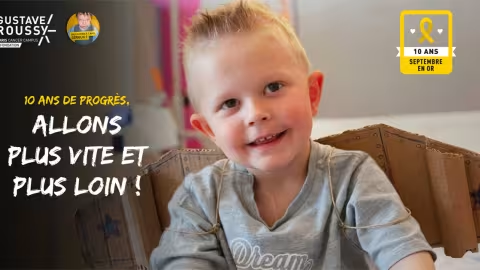
Gold september: two new research programmes launched to tackle childhood cancers
Two of Gustave Roussy’s four new medical and scientific programmes are dedicated to childhood cancers. The first, DECRIPT, aims to improve understanding of the role played by genetics in the development of certain childhood cancers, as well as second cancers that may occur in adulthood. The second, INSPIRE, will draw on the knowledge and techniques already developed at the Institute to create organoids, with the aim of deciphering the mechanisms underlying metastasis and resistance to treatment.
-
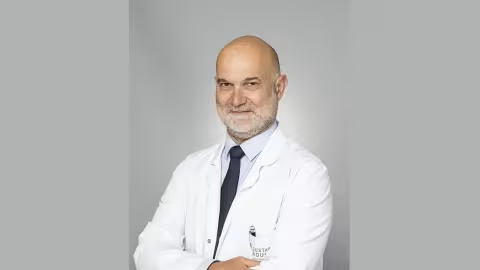
Prof. Fabrice Barlesi reappointed at the head of Gustave Roussy, the leading cancer center in France and Europe
By order of Ms. Stéphanie Rist, Minister of Health, Families, Autonomy and Persons with Disabilities, dated 27 July 2026, Professor Fabrice Barlesi has been reappointed as Director General of Gustave Roussy, effective 1 August 2026. At the helm of the Institute for five more years, Prof. Barlesi will continue the transformations undertaken during his first term. This renewal reflects the confidence placed in the project led by the institution to accelerate progress in the fight against cancer, foster and support the development of innovations set to change the future of oncology, and strengthen the influence of one of the world's leading cancer centers.
-
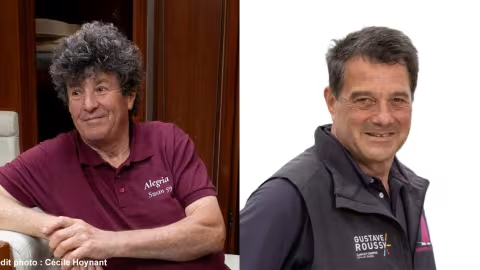
Route du Rhum 2026 Jean Le Cam and Christophe Rateau to sail for Gustave Roussy
For the Route du Rhum - Destination Guadeloupe 2026, Jean Le Cam and Christophe Rateau will sail under the colors of Gustave Roussy, the leading cancer center in France and Europe. Competing respectively in the Vintage and Class40 categories, the two skippers will carry the Institute's mission to the general public, supporting cancer research and raising awareness of prevention, innovation and patient care.
-
Owkin and Gustave Roussy partner to bring K Pro into real-world clinical practice
Owkin and Gustave Roussy, Europe's leading cancer center, today announced a partnership to test K Pro directly within the hospital's real-world clinical and research workflows.