
Welcome to the new Gustave Roussy website
A new website designed to offer you a simpler, clearer, and more intuitive experience. Patients, caregivers, healthcare professionals, and donors: find information, news, and services more easily.
ASCO 2020 - Childhood cancers: Early promising results of a dual therapy in treatment of some low grade gliomas
On
Changed on
ASCO 2020
Childhood cancers: Early promising results of a dual therapy in treatment of some low grade gliomas
Villejuif, 29 may 2020
Oral dabrafenib-trametinib combination therapy is already recognised treatment for certain melanomas and lung cancers. This might also help in children with low grade gliomas carrying the BRAF V600 mutation. Data from the phase I/IIa multicentre study presented at ASCO show that this combination of two protein kinase inhibitors reduces the size of lesions in the majority of patients and that the side effect profile is satisfactory.
By targeting two enzymes (BRAF and MEK) involved in signalling pathways in certain cancer cells, dabrafenib and trametinib inhibit tumour proliferation. From 2013, combining these two targeted therapies has been known to be effective in some cancers. The combination of these two oral agents is indicated at present only for some adult cancers: non-small cell lung cancers and inoperable or metastatic melanoma, and as post-resection adjuvant treatment of stage III melanoma, when genetic analysis of these tumours shows the presence of a BRAF V600 mutation.
This is the case in 40% of melanomas. “10 to 20% of low grade gliomas in children also carry this mutation,” pointed out Dr. Birgit Geoerger, onco-paediatrician, head of the Laboratory for Development of Novel Therapies for Paediatric Tumours at Gustave Roussy and principal investigator in the trial presented at an oral virtual session at ASCO 2020. The trial evaluated the safety and efficacy of the dabrafenib-trametinib combination in children with this cancer type.
Low grade gliomas are the commonest childhood cerebral tumours. Although low grade gliomas grow slowly, they still pose a problem. They are not always entirely operable. Complementary radiotherapy to destroy the remaining malignant cells following surgery “is often omitted because of significant effects of cerebral irradiation on cognitive function,” explained Dr. Geoerger. Standard treatment is therefore based on carboplatin and vincristine chemotherapy for about one year. As soon as promising dabrafenib results appeared for tumours carrying the BRAF mutation, “we started to treat children with this histological sub-group. The findings were encouraging,” explained Dr. Geoerger. “All the studies conducted using the dabrafenib-trametinib combination in a number of adult cancers showed that although the response was not necessarily better than with dabrafenib alone, the combination did prevent escape from treatment more effectively.”
Starting in 2015, 36 patients aged less than 18 with low grade gliomas carrying the BRAF V600 mutation were recruited from 16 Cancer Centres in 5 countries to the phase I/II trial to assess for the first time in paediatric practice the safety and efficacy of this dual therapy. The mean age was 10 and only a single patient was less than one year-old. Patients had been diagnosed 40 months (median value) earlier and had already received chemotherapy.
All were given the oral combined targeted therapy (in tablet or liquid form depending to their age) in doses previously determined by the research group: dosage of 5.25 mg/kg/day or 4.5 mg/kg/day of dabrafenib divided into two equal doses per day for children aged less or more than 12 respectively. Trametinib dosage was 0.032 mg/kg/day as a single dose for those under six years of age and 0.025 mg/kg/day for the older children. The cut-off for the data analysis of the trial was on 16th August 2019. The data presented at ASCO demonstrate a clinical effect of the targeted dual therapy with an 89% measure of disease control (stability or regression of lesions seen on imaging and defined by an independent review). The median duration of treatment administered was 14 months. 26 children remain on treatment “and some have now been on it for more than 40 months,” emphasised Dr. Geoerger.
The main adverse effects seen – fever and dermatological features (dry skin and rash) – were predominantly of low grade: “surprisingly these agents prove to be better tolerated in combination than when administered singly,” observed Dr Geoerger, “and side effects were easily controlled.” The research group is now going to extend its work by comparing the benefits of the dabrafenib-trametinib combination with those of conventional chemotherapy over one year in patients with newly diagnosed low grade glioma.
Oral presentation by Dr Birgit Geoerger
▶ See abstract N° 10506
Key facts
- 10 to 20% of low grade gliomas in children carry the BRAF V600 mutation
- The dabrafenib-trametinib combination limits tumour escape and the side effect profile is better than that seen with monotherapy.
- The disease control value is 89%
▶
cp-asco-2020-childhood-cancers-geoerger-en-29052020.pdf
Press contact
If you are a journalist and have a question, please contact:
Claire Parisel or Léona Pinto
Tel. +33 1 42 11 50 59
Tel. +33 1 42 11 63 59
Mob. +33 6 17 66 00 26
Email
The Media Team cannot respond to patient inquiries.
Last press releases
-
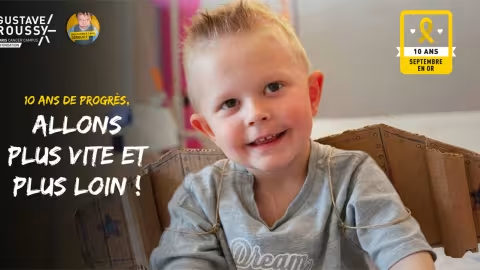
Gold september: two new research programmes launched to tackle childhood cancers
Two of Gustave Roussy’s four new medical and scientific programmes are dedicated to childhood cancers. The first, DECRIPT, aims to improve understanding of the role played by genetics in the development of certain childhood cancers, as well as second cancers that may occur in adulthood. The second, INSPIRE, will draw on the knowledge and techniques already developed at the Institute to create organoids, with the aim of deciphering the mechanisms underlying metastasis and resistance to treatment.
-
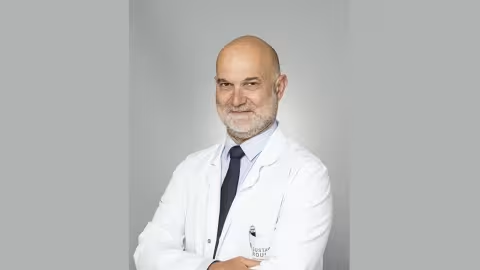
Prof. Fabrice Barlesi reappointed at the head of Gustave Roussy, the leading cancer center in France and Europe
By order of Ms. Stéphanie Rist, Minister of Health, Families, Autonomy and Persons with Disabilities, dated 27 July 2026, Professor Fabrice Barlesi has been reappointed as Director General of Gustave Roussy, effective 1 August 2026. At the helm of the Institute for five more years, Prof. Barlesi will continue the transformations undertaken during his first term. This renewal reflects the confidence placed in the project led by the institution to accelerate progress in the fight against cancer, foster and support the development of innovations set to change the future of oncology, and strengthen the influence of one of the world's leading cancer centers.
-
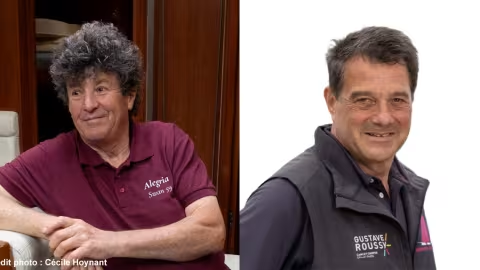
Route du Rhum 2026 Jean Le Cam and Christophe Rateau to sail for Gustave Roussy
For the Route du Rhum - Destination Guadeloupe 2026, Jean Le Cam and Christophe Rateau will sail under the colors of Gustave Roussy, the leading cancer center in France and Europe. Competing respectively in the Vintage and Class40 categories, the two skippers will carry the Institute's mission to the general public, supporting cancer research and raising awareness of prevention, innovation and patient care.
-
Owkin and Gustave Roussy partner to bring K Pro into real-world clinical practice
Owkin and Gustave Roussy, Europe's leading cancer center, today announced a partnership to test K Pro directly within the hospital's real-world clinical and research workflows.