
Welcome to the new Gustave Roussy website
A new website designed to offer you a simpler, clearer, and more intuitive experience. Patients, caregivers, healthcare professionals, and donors: find information, news, and services more easily.
Ovarian cancer drug offers new genetically targeted approach against range of cancers
On
Changed on
Friday 23 april 2021
Ovarian cancer drug offers new genetically targeted approach against range of cancers
A type of drug used against ovarian and breast cancers could offer a brand new targeted approach for treating a range of cancers with particular genetic defects, including a common form of kidney cancer.
Researchers found that drugs known as PARP inhibitors killed cancer cells harbouring a defect in the PBRM1 gene, by stripping cells of their DNA defences so they could no longer repair damage to their genetic code.
Scientists first discovered that PARP inhibitors could be effective in women with BRCA gene mutations – taking advantage of their cancers’ pre-existing weaknesses in repairing their DNA.
The new study, carried out by Gustave Roussy, cancer institute based near Paris together with The Institute of Cancer Research, London, has found PARP inhibitors could also exploit weaknesses in DNA repair in patients whose cancers have defects in the PBRM1 gene.
PBRM1 mutations are found in around half of all kidney cancer cases, affecting around 6,000 people in the UK each year – as well as in mesothelioma, a cancer linked to asbestos exposure, and in some lung or bile duct cancers.
Although PBRM1 gene defects are common, there are currently no treatments that target them.
Scientists investigated whether tumours with weaknesses in one system for DNA repair through defects in PBRM1 could be vulnerable to treatment with PARP inhibitors, which target a second repair system.
The team at Gustave Roussy and The Institute of Cancer Research (ICR) found that treating PBRM1-defective cancer cells with PARP inhibitors like rucaparib, olaparib or talazoparib in the lab had a ‘synthetic lethal’ effect, causing the cells to die.
They also found that using the PARP inhibitor talazoparib in mice with kidney tumours harbouring genetic defects in PBRM1 halted tumour growth.
The findings from this study, published in the journal Cancer Research today (Friday), have prompted the development of two Gustave Roussy-sponsored multicentre phase II clinical trials looking at combining a PARP inhibitor with immunotherapy in patients with a range of cancers with faulty PBRM1 genes, including kidney, lung, bladder and bile duct cancers.
The research was funded by the Institut National de la Santé et de la Recherche Médicale (Inserm, ATIP-Avenir program, SIRIC Socrate 2.0), La Ligue Nationale Contre le Cancer (LNCC), Institut National du Cancer (INCa), Cancéropôle Ile-de-France, Association pour la Recherche contre le Cancer (Fondation ARC), and Cancer Research UK.
The study found that cells lacking the PBRM1 protein had higher than usual levels of DNA damage, which worsened when the cells were treated with PARP inhibitors.
Both PARP and PBRM1 proteins are involved in repairing cancer cells’ DNA. Cancer cells can survive with just one of PARP or PBRM1, but they will die if both DNA repair systems are switched off – left unable to adequately repair their DNA.
Researchers also found that the presence of PBRM1 had an influence on the anti-cancer immune response. Exposing PBRM1-defective cancer cells to PARP inhibitors not only caused additional DNA damage, but also activated the body’s anti-cancer immune response, further contributing to the elimination of cancer cells, and potentially opening opportunities for keeping cancer patients alive for longer.
Scientists at the ICR – a charity and research institute – discovered how to genetically target the PARP inhibitor olaparib, which became the world’s first cancer drug targeted against inherited genetic faults when it was approved for the treatment of BRCA-mutant ovarian cancer in 2014. Researchers now hope that PARP inhibitors could also be targeted against faults in the PBRM1 gene.
Study co-leader, Doctor Sophie Postel-Vinay at Gustave Roussy in Paris, said:
“PBRM1 defects occur frequently on several cancer types, and have for long been ignored because we had no technology that allowed to look for them and diagnose them in the clinical practice, until recently. Our findings open novel perspectives for the treatment of these cancers for which there are currently limited treatment options.
“The fact that PARP inhibitors could also activate the immune response is important, as immunotherapies have brought unprecedented benefits in patients with tumours types where PBRM1 is frequently mutated, such as kidney or lung cancer. We therefore hope that the two clinical trials that we have developed will benefit to patients and bring new hope for patients with cancers where PBRM1 is defective.”
Study co-leader, Professor Chris Lord, Professor of Cancer Genomics at The Institute of Cancer Research, London, said:
“Defects in the PBRM1 gene are common in various cancers, including half of all clear cell renal cell carcinomas, a common form of kidney cancer. Our findings suggest that cancers with faulty PBRM1 genes are sensitive to PARP inhibitors – drugs that strip cancer of its DNA defences.
“These findings are promising and our colleagues in Paris have already begun trials in patients based on this work. We’re hopeful that this could become a brand new genetically targeted approach to treating cancer, and could offer hope to patients with various cancer types including a common form of kidney cancer.”
Professor Paul Workman, Chief Executive at The Institute of Cancer Research, London, said:
“At the ICR, our scientists are working to identify and develop new smarter, kinder cancer treatments which attack cancers in brand new ways – including by stripping cancers of their DNA defences and so preventing them from repairing genetic damage. There are currently no personalised medicine approaches that target cancers with defects in the PBRM1 gene and we need new treatments urgently for people with these cancers. The results show the exciting potential of PARP inhibitor drugs to be active in PBRM1 deficient tumours, including kidney cancer, as well as for increasing the immune response against these cancers. It’s great to see studies like this which seek to turn scientific discoveries about the complexity of cancer into innovative new treatments with the potential to greatly benefit patients.”
Neil Fairbrother, 57, from Maidenhead, was diagnosed with clear cell renal cell carcinoma in 2017. He said:
“I was diagnosed with cancer really unexpectedly. I’d been experiencing headaches, but these had been put down to mild whiplash, and then suddenly one day I became really ill and was rushed off to hospital in an ambulance.
“They found out I had kidney cancer which had spread to my brain. I had surgery to remove my kidney and the tumour in my brain, and then started taking a targeted medication which I’ve been on ever since. I’ll stay on this medication for as long as it works, and I’m really delighted to hear that more treatment options might become available. It gives me a lot of hope for the future, and I’d like to congratulate and thank the team involved.”
Press contact
If you are a journalist and have a question, please contact:
Claire Parisel or Léona Pinto
Tel. +33 1 42 11 50 59
Tel. +33 1 42 11 63 59
Mob. +33 6 17 66 00 26
Email
The Media Team cannot respond to patient inquiries.
Last press releases
-
Gold september: two new research programmes launched to tackle childhood cancers
Two of Gustave Roussy’s four new medical and scientific programmes are dedicated to childhood cancers. The first, DECRIPT, aims to improve understanding of the role played by genetics in the development of certain childhood cancers, as well as second cancers that may occur in adulthood. The second, INSPIRE, will draw on the knowledge and techniques already developed at the Institute to create organoids, with the aim of deciphering the mechanisms underlying metastasis and resistance to treatment.

-
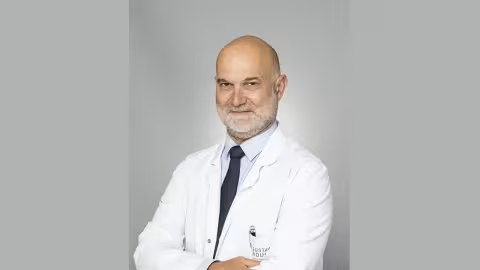
Prof. Fabrice Barlesi reappointed at the head of Gustave Roussy, the leading cancer center in France and Europe
By order of Ms. Stéphanie Rist, Minister of Health, Families, Autonomy and Persons with Disabilities, dated 27 July 2026, Professor Fabrice Barlesi has been reappointed as Director General of Gustave Roussy, effective 1 August 2026. At the helm of the Institute for five more years, Prof. Barlesi will continue the transformations undertaken during his first term. This renewal reflects the confidence placed in the project led by the institution to accelerate progress in the fight against cancer, foster and support the development of innovations set to change the future of oncology, and strengthen the influence of one of the world's leading cancer centers.
-
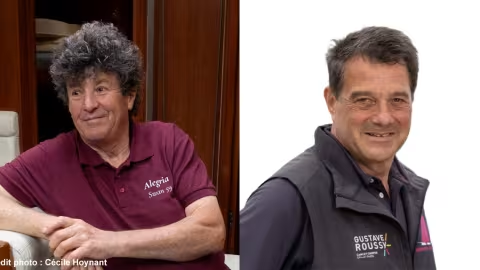
Route du Rhum 2026 Jean Le Cam and Christophe Rateau to sail for Gustave Roussy
For the Route du Rhum - Destination Guadeloupe 2026, Jean Le Cam and Christophe Rateau will sail under the colors of Gustave Roussy, the leading cancer center in France and Europe. Competing respectively in the Vintage and Class40 categories, the two skippers will carry the Institute's mission to the general public, supporting cancer research and raising awareness of prevention, innovation and patient care.
-
Owkin and Gustave Roussy partner to bring K Pro into real-world clinical practice
Owkin and Gustave Roussy, Europe's leading cancer center, today announced a partnership to test K Pro directly within the hospital's real-world clinical and research workflows.