
Welcome to the new Gustave Roussy website
A new website designed to offer you a simpler, clearer, and more intuitive experience. Patients, caregivers, healthcare professionals, and donors: find information, news, and services more easily.
ESMO 2021 - Lung cancers: a vaccine demonstrates encouraging effects in reviving patient immunity.
On
Villejuif, 20th september 2021
ESMO 2021 – oral presentation
Lung cancers: a vaccine demonstrates encouraging effects in reviving patient immunity.
Non-small cell lung cancer (NSCLC) comprises more than 85% of lung cancers and is the leading cause of death in men. Historically, chemotherapy was the treatment of choice for metastatic disease in this form of cancer but a number of therapeutic options can now be considered: targeted therapies and, increasingly frequently, immunotherapy. This latter type of treatment emerged properly about ten years ago. It aims to unblock the patient’s immune system by administering monoclonal antibodies for example. By specifically targeting the PD-L1 protein, which in some tumours is bound to a receptor (PD-1) thereby inactivating lymphocytes, immunotherapy unblocks the immune cells. This therapeutic option has increased survival in some patients, sometimes to a considerable extent. This has reached the point where “the combination of chemotherapy + immunotherapy has become standard first line treatment since January 2020 in the majority of patients with advanced cancer whatever the level of expression of the PD-L1 marker that has been found in tumour tissue,” explained Professor Benjamin Besse, specialist oncologist in lung cancers, clinical research director at Gustave Roussy and lead author of the Atalante study report. This phase III study whose final results are presented at the 2021 ESMO Congress offers a new hope: an anticancer vaccine which stimulates the immune system in a different way, that is longer lasting and has fewer adverse effects.
“Conventional” immunotherapy, which specifically targets the tumour cell immune checkpoints in order to inhibit their development, has its limitations. It can have toxic effects on healthy tissue in all the body systems giving rise to adverse effects which are sometimes difficult to control. But, above all it is effective in only a proportion of patients. “In those patients where treatment has failed,” advised Professor Besse, “we find ourselves largely deprived of other options, left only with chemotherapy employing a single agent (usually docetaxel). That is the reason to look for novel solutions involving combinations of immunotherapies or by inventing new types of immunotherapy such as OSE-2101, which we have studied in the Atalante trial”.
This new treatment method also aims to revive patient immunity. But instead of activating the immune system in a general way (non-specifically against the cancer) it acts as a vaccine, “by specifically teaching the immune system to recognise as enemies some proteins which may be expressed by tumour cells. By doing so an immune response is invoked which activates T-lymphocytes to act against these proteins,” explained Professor Besse. This vaccine, which is also being trialled clinically in pancreatic and ovarian cancer, more specifically targets “9 fragments (epitopes) found in five proteins that are frequently expressed in lung cancer cells; in more than 90 % of cases, at least one of them is expressed.” The technology involved in this combination has been patented. It enables the immune system to learn to recognise these proteins in individuals whose blood phenotype carries HLA-A2, “a serotype which is only present in half of the population,” emphasised Professor Besse.
The multicentre Atalante clinical trial to evaluate the efficacy of this anticancer vaccine was conducted by comparing it with standard second line single agent chemotherapy, usually docetaxel. Patients were randomised to one of the two groups. The majority of the 219 patients were male (29% female) with a median age of 65 years. It had been intended to recruit 400 patients but the trial had to be prematurely curtailed because of Covid. All the patients were positive for HLA-A2. They all had advanced or metastatic NSCLC and were treatment resistant after having one chemotherapy and one immunotherapy given concomitantly or sequentially.
The phase II study had previously demonstrated prolonged control of disease in a quarter of the patients given a subcutaneous injection of the OSE-21 vaccine. The phase III results, presented at the 2021 ESMO meeting, confirm the advantage of this treatment compared with chemotherapy alone, “and the benefit applies to patients who had previously received at least 3 months of immunotherapy," observed Professor Besse. “In this group the benefit of treatment was not measured in terms of reduction in tumour size (8% in the vaccinated group vs 18% in the group receiving chemotherapy) but by prolonged control of the disease with a median survival gain of 3.6 months in the vaccinated group”. Survival was prolonged to more than 11 months with a better quality of life: “serious adverse reactions were seen half as frequently as with chemotherapy." Adverse effects were similarly less prominent than with immunotherapy, essentially being restricted to those expected with any vaccine: reaction at the injection site (39%), fever (19%) and arthralgia (11%). “Overall, in a specific population this treatment seemed to be effective and was tolerated better than chemotherapy,” summarised Professor Besse. It remains to consider what the future holds for this agent, which “has issued an encouraging message in a disease where there is sometimes little in the way of options, a message which remains limited by the small number of patients recruited resulting from curtailment of the study.”
cp-esmo-lung-cancers-20092021.pdf
Press contact
If you are a journalist and have a question, please contact:
Claire Parisel or Léona Pinto
Tel. +33 1 42 11 50 59
Tel. +33 1 42 11 63 59
Mob. +33 6 17 66 00 26
Email
The Media Team cannot respond to patient inquiries.
Last press releases
-
Gold september: two new research programmes launched to tackle childhood cancers
Two of Gustave Roussy’s four new medical and scientific programmes are dedicated to childhood cancers. The first, DECRIPT, aims to improve understanding of the role played by genetics in the development of certain childhood cancers, as well as second cancers that may occur in adulthood. The second, INSPIRE, will draw on the knowledge and techniques already developed at the Institute to create organoids, with the aim of deciphering the mechanisms underlying metastasis and resistance to treatment.

-
Prof. Fabrice Barlesi reappointed at the head of Gustave Roussy, the leading cancer center in France and Europe
By order of Ms. Stéphanie Rist, Minister of Health, Families, Autonomy and Persons with Disabilities, dated 27 July 2026, Professor Fabrice Barlesi has been reappointed as Director General of Gustave Roussy, effective 1 August 2026. At the helm of the Institute for five more years, Prof. Barlesi will continue the transformations undertaken during his first term. This renewal reflects the confidence placed in the project led by the institution to accelerate progress in the fight against cancer, foster and support the development of innovations set to change the future of oncology, and strengthen the influence of one of the world's leading cancer centers.
-
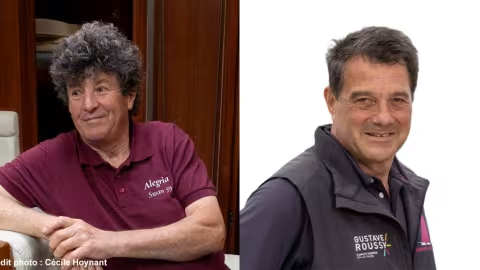
Route du Rhum 2026 Jean Le Cam and Christophe Rateau to sail for Gustave Roussy
For the Route du Rhum - Destination Guadeloupe 2026, Jean Le Cam and Christophe Rateau will sail under the colors of Gustave Roussy, the leading cancer center in France and Europe. Competing respectively in the Vintage and Class40 categories, the two skippers will carry the Institute's mission to the general public, supporting cancer research and raising awareness of prevention, innovation and patient care.
-
Owkin and Gustave Roussy partner to bring K Pro into real-world clinical practice
Owkin and Gustave Roussy, Europe's leading cancer center, today announced a partnership to test K Pro directly within the hospital's real-world clinical and research workflows.