
Welcome to the new Gustave Roussy website
A new website designed to offer you a simpler, clearer, and more intuitive experience. Patients, caregivers, healthcare professionals, and donors: find information, news, and services more easily.
Cancer Treatment: Identification of the Blood Vessels That Allow Killer Lymphocytes to Access and Destroy Tumors
On
Changed on
Paris, le 2 février 2022
Cancer Treatment: Identification of the Blood Vessels That Allow Killer Lymphocytes to Access and Destroy Tumors
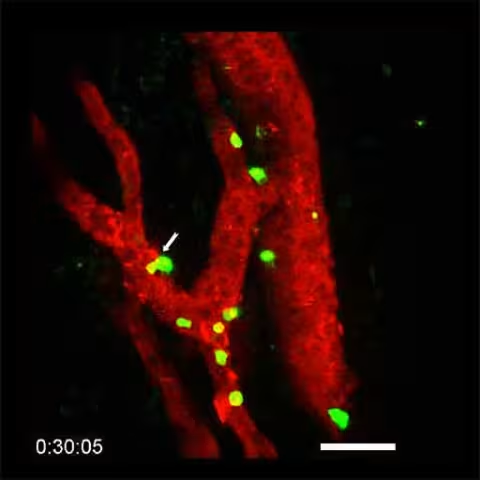
Microscopic visualization of lymphocytes (in green) infiltrating a tumor HEV (in red) during combination anti-PD-1 plus anti-CTLA-4 immunotherapy. The white arrow indicates a lymphocyte that is leaving the bloodstream and entering the tumor (in black). © Elisabeth Bellard and Jean-Philippe Girard - IPBS (CNRS/UT3 Paul Sabatier)
Immunotherapy, a therapeutic strategy aimed at increasing the activity of the immune system in order to recognize and destroy cancer cells, has revolutionized cancer treatment over the past decade. A better understanding of how this therapeutic approach works, and more particularly how killer lymphocytes access tumors during immunotherapy, could improve the efficacy of the treatments. The team of Jean-Philippe Girard, Inserm Research Director at the Institute of Pharmacology and Structural Biology (French National Center for Scientific Research [CNRS]/Université Toulouse III - Paul Sabatier), in collaboration with Gustave Roussy, has recently discovered the essential role played in this process by specific blood vessels known as tumor-associated HEVs. For the first time, the scientists were able to film the lymphocytes infiltrating the walls of the HEV vessels to enter the tumors. What is more, the researchers have shown in animal models that increasing the proportion of HEV vessels in a tumor improves the efficacy of the immunotherapy and leads to the eradication of the tumors. Finally, they found that the likelihood of recovery of patients with metastatic melanoma (skin cancer) and treated with immunotherapy is increased when a large number of HEV vessels are present in tumors. The findings of this study have been published in the February 3, 2022 issue of Cancer Cell1 .
Immunotherapy with therapeutic antibodies represents a real revolution in cancer treatment. In particular, it is used to cure certain patients with metastatic melanoma (skin cancer), who would previously not have survived. Unfortunately, immunotherapy is not effective in all patients or on all cancers. A better understanding of the mechanism of action of the treatment could improve it and make it effective in a larger number of patients.
Killer lymphocytes – white cells present in the blood – are capable of eradicating cancer cells. It is essential that many of these killer cells have access to tumors in order to defend the body against cancer. The Toulouse team has lifted the veil on the mechanisms that allow killer lymphocytes to penetrate tumors in order to destroy them – either spontaneously or following immunotherapy with anti-PD-1 plus anti-CTLA-4 antibodies.
The scientists have discovered that the HEVs, very specific blood vessels known as high endothelial venules, constitute the major gateway of lymphocytes to tumors. Using sophisticated microscopy techniques, the researchers were able to film the passage of lymphocytes from the blood to the tumor in animal models. For the first time, they were able to visualize, directly and in real time, the lymphocytes in the process of infiltrating the walls of the HEV vessels in order to access the cancer cells in the tumor. "We thought that HEV vessels played an important role in the entry of lymphocytes into the tumor, but we were surprised to see that they were virtually the only gateway," says Jean-Philippe Girard, Inserm Research Director and last author of the study.
The researchers then observed in their models that the presence of a large number of killer lymphocytes in tumors is associated with the presence of a large number of HEV vessels. What is more, they provided proof of concept that increasing the proportion of HEV vessels in a tumor improves the efficacy of combination anti-PD-1 plus anti-CTLA-4 immunotherapy and leads to tumor eradication.
Finally, in collaboration with Caroline Robert's team at Gustave Roussy2, the scientists studied patients with metastatic melanoma. They discovered that the presence of a large number of HEV vessels in tumors is associated with a better response to combination anti-PD-1 plus anti-CTLA-4 immunotherapy.
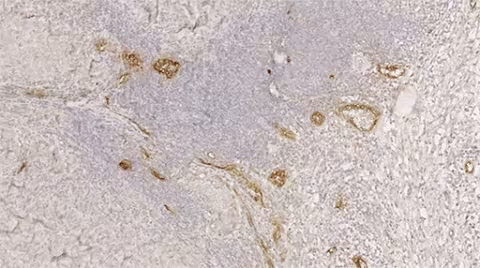
Labeling of HEV vessels (brown) on a tumor section from a patient with metastatic melanoma and treated with immunotherapy. © Jean-Philippe Girard - IPBS (CNRS/UT3 Paul Sabatier)
The next step for the researchers will be to develop treatments to increase the proportion of HEV vessels in tumors, in order to improve the efficacy of immunotherapy, allowing massive recruitment of killer lymphocytes to eradicate cancer cells. "Our research could improve immunotherapy treatment in the longer term for patients with metastatic melanoma and other types of solid tumors. It also has prognostic implications, as clinicians can now look at the HEV vessels to predict a patient's response to immunotherapy," concludes Girard.
1 This study was funded by Fondation ARC, the Foundation for Medical Research (FRM), the French National Cancer Institute (INCa), the French National Research Agency (ANR), and Labex TOUCAN
2 And also team leader at Inserm U981
Sources
“Tumor-associated high endothelial venules mediate lymphocyte entry into tumors and predict response to PD-1 plus CTLA-4 combination immunotherapy”
Assia Asrir1,7, Claire Tardiveau1,7, Juliette Coudert1,7, Robin Laffont1,7, Lucas Blanchard1,7, Elisabeth Bellard1, Krystle Veerman1, Sarah Bettini1, Fanny Lafouresse1, Estefania Vina1, Dorian Tarroux1, Severine Roy2, Isabelle Girault2, Irma Molinaro5, Frédéric Martins3,4, Jean-Yves Scoazec5,6, Nathalie Ortega1, Caroline Robert2,6 and Jean-Philippe Girard1,8*
1 Institut de Pharmacologie et de Biologie Structurale, IPBS, Université de Toulouse, CNRS, UPS, Toulouse, France
2 Department of Medicine, Gustave Roussy, Villejuif, France
3 Institut des Maladies Métaboliques et Cardiovasculaires, I2MC, UMR1048, INSERM, UPS, Toulouse, France
4 Plateforme Genome et Transcriptome, GeT, Genopole Toulouse, France
5 Department of Pathology, Gustave Roussy, Villejuif, France
6 Paris-Saclay University, Orsay, France
7 These authors contributed equally: Assia Asrir, Claire Tardiveau, Juliette Coudert, Robin Laffont, Lucas Blanchard
Cancer Cell, February 2022
DOI: https://doi.org/10.1016/j.ccell.2022.01.002
pr-immunocancer-20220202.pdf
Press contact
If you are a journalist and have a question, please contact:
Claire Parisel or Léona Pinto
Tel. +33 1 42 11 50 59
Tel. +33 1 42 11 63 59
Mob. +33 6 17 66 00 26
Email
The Media Team cannot respond to patient inquiries.
Last press releases
-
Gold september: two new research programmes launched to tackle childhood cancers
Two of Gustave Roussy’s four new medical and scientific programmes are dedicated to childhood cancers. The first, DECRIPT, aims to improve understanding of the role played by genetics in the development of certain childhood cancers, as well as second cancers that may occur in adulthood. The second, INSPIRE, will draw on the knowledge and techniques already developed at the Institute to create organoids, with the aim of deciphering the mechanisms underlying metastasis and resistance to treatment.

-
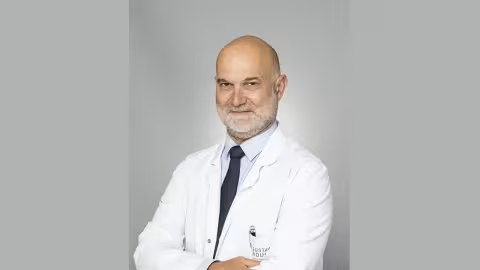
Prof. Fabrice Barlesi reappointed at the head of Gustave Roussy, the leading cancer center in France and Europe
By order of Ms. Stéphanie Rist, Minister of Health, Families, Autonomy and Persons with Disabilities, dated 27 July 2026, Professor Fabrice Barlesi has been reappointed as Director General of Gustave Roussy, effective 1 August 2026. At the helm of the Institute for five more years, Prof. Barlesi will continue the transformations undertaken during his first term. This renewal reflects the confidence placed in the project led by the institution to accelerate progress in the fight against cancer, foster and support the development of innovations set to change the future of oncology, and strengthen the influence of one of the world's leading cancer centers.
-
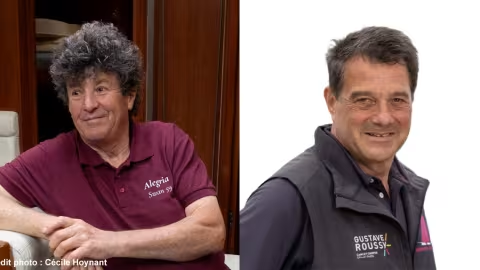
Route du Rhum 2026 Jean Le Cam and Christophe Rateau to sail for Gustave Roussy
For the Route du Rhum - Destination Guadeloupe 2026, Jean Le Cam and Christophe Rateau will sail under the colors of Gustave Roussy, the leading cancer center in France and Europe. Competing respectively in the Vintage and Class40 categories, the two skippers will carry the Institute's mission to the general public, supporting cancer research and raising awareness of prevention, innovation and patient care.
-
Owkin and Gustave Roussy partner to bring K Pro into real-world clinical practice
Owkin and Gustave Roussy, Europe's leading cancer center, today announced a partnership to test K Pro directly within the hospital's real-world clinical and research workflows.