Welcome to the new Gustave Roussy website
A new website designed to offer you a simpler, clearer, and more intuitive experience. Patients, caregivers, healthcare professionals, and donors: find information, news, and services more easily.
ASCO 2024 - certain socio-economic factors influence adherence to a remote monitoring system
On

Villejuif, 4 June 2024
ASCO 2024 – Clinical science symposium
Certain socio-economic factors influence adherence to a remote monitoring system
At a time when remote monitoring has demonstrated its benefits in cancerology and is being deployed, no studies have so far focused on the barriers that could prevent access for all, and in particular the role of socio-economic factors. The findings presented by Dr. Maria Alice Franzoi, an oncologist at Gustave Roussy, show that several of these factors are slowing down patients’ adherence to a remote monitoring pathway.
Abstract no. 1506 presented orally by Dr Maria Alice Franzoi on Tuesday 4 June at 11:45 a.m. UTC-5.
This oral presentation is one of the 135 presentations on the agenda for this 2024 edition of ASCO, in which Gustave Roussy’s research physicians took part, including 29 oral presentations. Gustave Roussy is present in many fields of expertise, attesting to the quality of the research carried out there and its international recognition.
Social health determinants are a concept of public health, referring to several socio-economic factors that can influence the state of health of a population, and upon which action is possible. In cancerology, these determinants are responsible for the disparities observed in access to care, adherence to treatments, severity of symptoms, and also those concerning quality of life.
No scientific studies have so far studied the impact of these social health determinants on patient adherence to a remote monitoring scheme deployed in routine care. The work presented orally this year at ASCO by Dr Maria Alice Franzoi focused on ensuring patients have fair access to remote monitoring schemes.
A study conducted in 42 French and Belgian hospitals
This work, sponsored by Gustave Roussy, was carried out in 42 French and Belgian hospitals, on nearly 2,000 patients with cancer. Within this cohort, 896 agreed to provide personal data relating to their social health determinants (income, diplomas, digital culture, etc.), of which 69% were women, with a median age of 60. The most highly represented tumour was the breast, in 49% of patients, followed by gastrointestinal tumours.
Of these nearly 900 patients, 73% reported at least one negative social health determinant, via an online questionnaire designed by the study physicians who conducted the study. 39% reported difficulties in receiving support from their loved ones, 24% reported a weak digital culture, 22% reported difficulties with their level of education, 15% reported difficulties in understanding their medical situation, and 12% reported difficulties with financial security.
An impact on remote monitoring compliance
"Data analysis shows the negative impact of social health determinants on adherence to remote monitoring. Patients who reported difficulties in understanding their treatment plan have a 10% lower remote monitoring adherence rate, and a 5% lower adherence rate when they report a weak digital culture," says Dr Maria Alice Franzoi.
At the same time, the severity of symptoms is more pronounced in patients in financial difficulties (+6%), but also in those with a poor understanding of their disease (+10%). Thus, patients for whom remote monitoring would have the most significant benefits, particularly in the management of toxicities and symptoms, are paradoxically those in whom less adherence to this scheme is observed.
"In order to reduce the disparities observed and ensure access to remote monitoring so that there is no loss of chances, early screening for negative health determinants in patients with cancer would allow us to propose adapted pathways, and thus strengthen their adherence to these monitoring technologies," concludes Dr Maria Alice Franzoi.
Abstract no. 1506 - The impact of self-reported social determinants of health (SDOH) on patient engagement and symptom burden across a remote patient monitoring (RPM) pathway in 42 European hospitals - Oral session – Tuesday 4 June 2024 | 11:45 UTC-5.
cp-asco24-franzoi-en-140624.pdf
Press contact
If you are a journalist and have a question, please contact:
Claire Parisel or Léona Pinto
Tel. +33 1 42 11 50 59
Tel. +33 1 42 11 63 59
Mob. +33 6 17 66 00 26
Email
The Media Team cannot respond to patient inquiries.
Last press releases
-
Gold september: two new research programmes launched to tackle childhood cancers
Two of Gustave Roussy’s four new medical and scientific programmes are dedicated to childhood cancers. The first, DECRIPT, aims to improve understanding of the role played by genetics in the development of certain childhood cancers, as well as second cancers that may occur in adulthood. The second, INSPIRE, will draw on the knowledge and techniques already developed at the Institute to create organoids, with the aim of deciphering the mechanisms underlying metastasis and resistance to treatment.

-
Prof. Fabrice Barlesi reappointed at the head of Gustave Roussy, the leading cancer center in France and Europe
By order of Ms. Stéphanie Rist, Minister of Health, Families, Autonomy and Persons with Disabilities, dated 27 July 2026, Professor Fabrice Barlesi has been reappointed as Director General of Gustave Roussy, effective 1 August 2026. At the helm of the Institute for five more years, Prof. Barlesi will continue the transformations undertaken during his first term. This renewal reflects the confidence placed in the project led by the institution to accelerate progress in the fight against cancer, foster and support the development of innovations set to change the future of oncology, and strengthen the influence of one of the world's leading cancer centers.
-
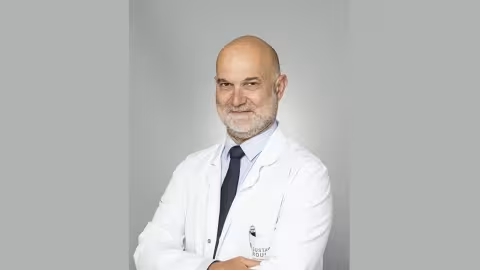
Route du Rhum 2026 Jean Le Cam and Christophe Rateau to sail for Gustave Roussy
For the Route du Rhum - Destination Guadeloupe 2026, Jean Le Cam and Christophe Rateau will sail under the colors of Gustave Roussy, the leading cancer center in France and Europe. Competing respectively in the Vintage and Class40 categories, the two skippers will carry the Institute's mission to the general public, supporting cancer research and raising awareness of prevention, innovation and patient care.
-
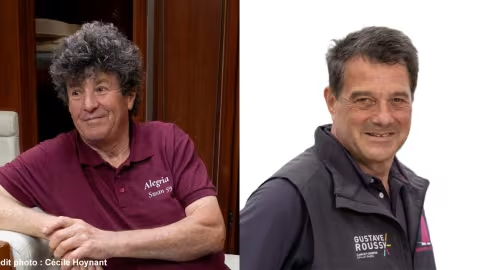
Owkin and Gustave Roussy partner to bring K Pro into real-world clinical practice
Owkin and Gustave Roussy, Europe's leading cancer center, today announced a partnership to test K Pro directly within the hospital's real-world clinical and research workflows.