Welcome to the new Gustave Roussy website
A new website designed to offer you a simpler, clearer, and more intuitive experience. Patients, caregivers, healthcare professionals, and donors: find information, news, and services more easily.
ASCO 2020 - Lung cancers: hopes for conjugated antibodies
On
Changed on
ASCO 2020
Lung cancers: hopes for conjugated antibodies
Villejuif, 25 may 2020
Some non-small cell cancers of lung that are resistant to therapy might benefit from a novel treatment combining an antibody with a cytotoxic drug. The results of an early trial conducted at Gustave-Roussy, presented in an oral session at ASCO 2020, show that an agent consisting of an antibody complexed with a maytansine derivative has anti-tumour activity without major adverse effects in patients whose tumour overexpresses CEACAM5.
One of the recent ambitions in oncology has been to develop medication in which antibodies capable of identifying cancer cells are complexed with a cytotoxic agent, thus enabling direct targeting of the tumour cell. These conjugated antibodies or antibody drug conjugates (ADC) would seem at the outset to possess two qualities: the ability to destroy cancer cells by virtue of delivering higher cytotoxic concentrations than is possible with conventional chemotherapy while at the same time sparing healthy cells. This principle has already been used in the treatment of metastatic breast cancers over-expressing HER2 and validated in that of Hodgkin’s lymphomas. It might also provide a novel therapeutic pathway in treatment of certain lung cancers according to findings in the phase I/II study presented in an oral session at the ASCO Conference by Dr Anas Gazzah, oncologist in the Drug Development Department (DITEP) at Gustave-Roussy. These promising results do show that such medication could control the disease without having major side effects in 64% of locally advanced or metastatic non-small cell, non-squamous cell lung cancers that were strongly overexpressing CEACAM5 and displaying resistance to other treatment. The mean duration of response was 5.6 months.
The conjugated antibody, whose safety and efficacy in man has been evaluated for the first time by the research team in patients with advanced solid tumours, goes for the present by the code name SAR408701. It comprises a monoclonal anti-CEACAM5 antibody and a cytotoxic maytansine derivative, DM4, an anti-tubulin agent which induces cell death. The antibody detects and targets cells expressing the carcinoembryonic antigen CEACAM 5. This protein has a role in the mechanism of cell adhesion and is present in the body during fetal development. Its expression in adults is very limited but it is found in a number of tumours including those of the gastrointestinal tract and adenocarcinoma of lung.
The data presented at ASCO specifically concern the action of this conjugated antibody on locally advanced or metastatic non-squamous cell, non-small cell lung cancer (NSCLC). These constitute the majority of lung cancers and are most commonly treated, other than surgically, with one or more lines of chemotherapy (platinum salts combined with pemetrexed and taxanes), sometimes concomitantly with or followed by anti-PD(L)1 immunotherapy. “Pre-screening of tumour specimens has shown that 44% of these tumours express carcinoembryonic antigen strongly or moderately (20 and 24% respectively),” explained Dr Gazzah.
This overexpression was the principal inclusion criterion for the study. Patients with NSCLC were assigned to one of two cohorts depending on whether they expressed CEACAM5 strongly in more than 50% of tumour cells (64 patients) or moderately (28 patients). The 92 patients were recruited from several centres in France, Spain and Korea. All of them had received at least three lines of treatment prior to receiving conjugated anti-CEACAM5 antibody by intravenous injection (100 mg/m2) at two-weekly intervals. Tumour response was assessed by CT scan every eight weeks.
The final analysis of the data at 9th March 2020 showed that only a third of all the recruited patients had not responded to treatment. The level for control of disease was above 60% in both groups. The level of tumour response, principal end-point of the study, was higher in those patients strongly overexpressing CEACAM5 compared with those in the “moderate” group (20.3% vs 7.1%). The median duration of the response was estimated at 5.6 months, but this period was sometimes prolonged in “overexpressing” patients: “some have been on treatment for more than two years” pointed out Dr Gazzah. Ocular side effects were predominant in the unwanted effects noted. These arose after the early injections during the first 4 cycles. “The ocular events are common side effect of ADCs using antitubulin agents,” explained Dr Gazzah, “but they are reversible and can be managed by a reduction in dose or postponement of the injection and do not appear to represent a limiting factor.”
A phase III trial is due to commence. Its objective is to compare the benefit of conjugated anti-CEACAM5 antibody with single agent chemotherapy using docetaxel, in patients with treatment failure after receiving one standard first line therapy (chemotherapy + anti PD1/PD-L1)
Oral presentation by Dr Anas Gazzah
▶ See abstract No. 9505
Key facts
- Anti-tumour efficacy of conjugated antibody in patients in treatment failure who have nonsmall cell lung cancers (the majority of lung cancers).
- Only a third of the patients did not respond to treatment.
- A phase III trial to evaluate this conjugated antibody has commenced.
▶
cp-asco-2020-lungs-gazzah-en-209052020.pdf
Press contact
If you are a journalist and have a question, please contact:
Claire Parisel or Léona Pinto
Tel. +33 1 42 11 50 59
Tel. +33 1 42 11 63 59
Mob. +33 6 17 66 00 26
Email
The Media Team cannot respond to patient inquiries.
Last press releases
-
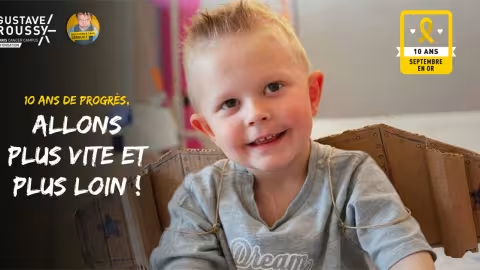
Gold september: two new research programmes launched to tackle childhood cancers
Two of Gustave Roussy’s four new medical and scientific programmes are dedicated to childhood cancers. The first, DECRIPT, aims to improve understanding of the role played by genetics in the development of certain childhood cancers, as well as second cancers that may occur in adulthood. The second, INSPIRE, will draw on the knowledge and techniques already developed at the Institute to create organoids, with the aim of deciphering the mechanisms underlying metastasis and resistance to treatment.
-
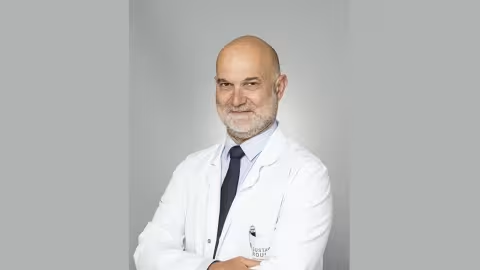
Prof. Fabrice Barlesi reappointed at the head of Gustave Roussy, the leading cancer center in France and Europe
By order of Ms. Stéphanie Rist, Minister of Health, Families, Autonomy and Persons with Disabilities, dated 27 July 2026, Professor Fabrice Barlesi has been reappointed as Director General of Gustave Roussy, effective 1 August 2026. At the helm of the Institute for five more years, Prof. Barlesi will continue the transformations undertaken during his first term. This renewal reflects the confidence placed in the project led by the institution to accelerate progress in the fight against cancer, foster and support the development of innovations set to change the future of oncology, and strengthen the influence of one of the world's leading cancer centers.
-
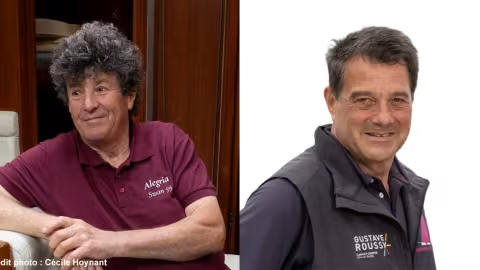
Route du Rhum 2026 Jean Le Cam and Christophe Rateau to sail for Gustave Roussy
For the Route du Rhum - Destination Guadeloupe 2026, Jean Le Cam and Christophe Rateau will sail under the colors of Gustave Roussy, the leading cancer center in France and Europe. Competing respectively in the Vintage and Class40 categories, the two skippers will carry the Institute's mission to the general public, supporting cancer research and raising awareness of prevention, innovation and patient care.
-
Owkin and Gustave Roussy partner to bring K Pro into real-world clinical practice
Owkin and Gustave Roussy, Europe's leading cancer center, today announced a partnership to test K Pro directly within the hospital's real-world clinical and research workflows.