Welcome to the new Gustave Roussy website
A new website designed to offer you a simpler, clearer, and more intuitive experience. Patients, caregivers, healthcare professionals, and donors: find information, news, and services more easily.
ASCO 2017 - Metastatic melanoma: PD1-blocking immunotherapy confirms its long-term clinical efficacy, even after cessation of treatment
On
Changed on
Villejuif, 31 may 2017
ASCO 2017
Metastatic melanoma: PD1-blocking immunotherapy confirms its long-term clinical efficacy, even after cessation of treatment
Pembrolizumab, an immunotherapeutic agent that blocks the PD1 (Programmed-cell death 1) receptor, prolongs the life of patients and the benefits of treatment persist in the long-term, even after cessation of treatment. On 4th June, Professor Caroline Robert, Head of the Gustave Roussy Dermatology Department, will present all the results of this study in an oral session devoted to melanoma and other skin cancers at the Congress of the American Society of Clinical Oncology (Asco), in Chicago, the largest world congress in oncology.
In 2011, ipilimumab (ipi), the first immunotherapeutic drug for the treatment of metastatic melanoma, had already been shown to markedly improve the prognosis in patients with this skin cancer, for which no effective treatment had previously been available. Since then, a new generation of anti-PD1 antibody immunotherapeutic agents has been developed, in particular pembrolizumab (pembro), which was marketed in September 2015. Gustave Roussy, by virtue specifically of the work of Caroline Robert, has made a major contribution to the validation of these drugs. In the phase 3 international clinical study launched in 2013 by the MSD Company, Keynote-006, pembrolizumab was compared to ipi. Ipi is administered as four injections at three week intervals, whereas pembro is a long-term treatment for which the optimal duration of therapy with injections given every three weeks is not known. In this clinical trial, the treatment was stopped after two years in those patients who were still on pembrolizumab. The trial (834 patients) had already shown that pembro was superior to ipi: it increased patient survival as well as the period during which the disease did not progress. It also displayed less toxicity than ipi.
We now have findings in the even longer term, having observed those patients who stopped pembrolizumab after two years of treatment. “We have a median follow-up period of almost three years (33 months) in several hundred patients. Half of those who had pembro are still alive, compared with only 39% of those treated with ipi alone. 31% of the former group have not experienced disease progression, compared with 14% of the latter. In 41% of the patients treated with pembro, the malignant foci regressed completely or partially, compared with 16% on ipi. Of those who received the two full years of pembro treatment, 98% are still alive nine months later and 91% did not have disease progression,” explained Caroline Robert.
Melanoma constitutes between 2 and 3 % of all cancers, and 10 % of skin cancers, but its incidence has doubled every 10 years over recent decades. Thus, 11,000 patients were affected by it in France in 2012. The responsibility for this is excessive exposure to the sun of the palest skins, especially in childhood. In addition, melanoma is particularly dangerous because it can be fatal in around one case in ten, especially if it is diagnosed late at a stage when metastases are present. Up to the early 2010s, there was no effective treatment for advanced disease of this type.
Immunotherapy has intervened to change the situation. Today the anti-PD1 agents, of which pembro is one, play a major role in the strategy of helping the patient’s defence mechanisms to fight cancer.
"While it remains difficult to talk of cure, we can still say that these results are very encouraging. Only 9% of patients had disease progression at nine months after cessation of treatment and we are now concentrating on those and on novel combined therapies to reduce the relapse rate further," concluded Caroline Robert.
Title : Long-term outcomes in patients (pts) with ipilimumab (ipi)-naive advanced melanoma in the phase 3 KEYNOTE-006 study who completed pembrolizumab (pembro) treatment.
Oral presentation by Caroline Robert, Gustave Roussy
Session: Melanoma/Skin Cancers
Sunday 4 june, 9 h 12 (local time)
Place: Arie Crown Theater
Abstract n° 9504 available sur http://abstracts.asco.org
► Long-term efficacy of pembrolizumab in advanced melanoma: see the video on Youtube
cp-asco-2017-metastatic-melanoma-en.pdf
Press contact
If you are a journalist and have a question, please contact:
Claire Parisel or Léona Pinto
Tel. +33 1 42 11 50 59
Tel. +33 1 42 11 63 59
Mob. +33 6 17 66 00 26
Email
The Media Team cannot respond to patient inquiries.
Last press releases
-
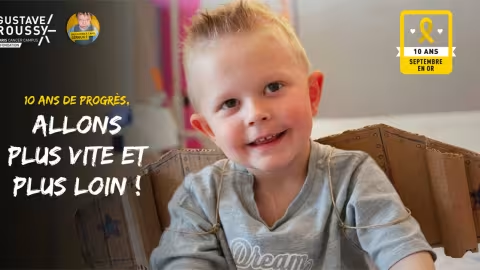
Gold september: two new research programmes launched to tackle childhood cancers
Two of Gustave Roussy’s four new medical and scientific programmes are dedicated to childhood cancers. The first, DECRIPT, aims to improve understanding of the role played by genetics in the development of certain childhood cancers, as well as second cancers that may occur in adulthood. The second, INSPIRE, will draw on the knowledge and techniques already developed at the Institute to create organoids, with the aim of deciphering the mechanisms underlying metastasis and resistance to treatment.
-
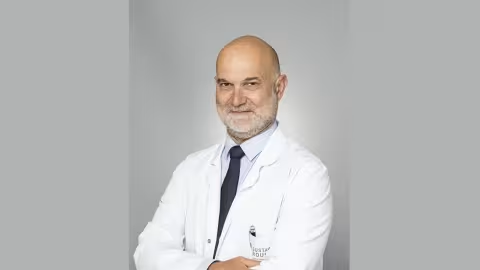
Prof. Fabrice Barlesi reappointed at the head of Gustave Roussy, the leading cancer center in France and Europe
By order of Ms. Stéphanie Rist, Minister of Health, Families, Autonomy and Persons with Disabilities, dated 27 July 2026, Professor Fabrice Barlesi has been reappointed as Director General of Gustave Roussy, effective 1 August 2026. At the helm of the Institute for five more years, Prof. Barlesi will continue the transformations undertaken during his first term. This renewal reflects the confidence placed in the project led by the institution to accelerate progress in the fight against cancer, foster and support the development of innovations set to change the future of oncology, and strengthen the influence of one of the world's leading cancer centers.
-
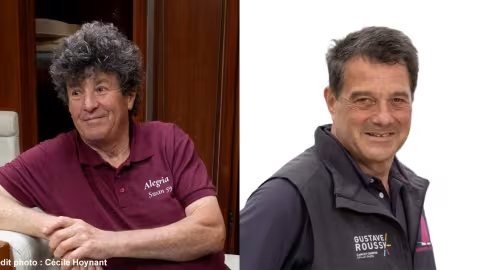
Route du Rhum 2026 Jean Le Cam and Christophe Rateau to sail for Gustave Roussy
For the Route du Rhum - Destination Guadeloupe 2026, Jean Le Cam and Christophe Rateau will sail under the colors of Gustave Roussy, the leading cancer center in France and Europe. Competing respectively in the Vintage and Class40 categories, the two skippers will carry the Institute's mission to the general public, supporting cancer research and raising awareness of prevention, innovation and patient care.
-
Owkin and Gustave Roussy partner to bring K Pro into real-world clinical practice
Owkin and Gustave Roussy, Europe's leading cancer center, today announced a partnership to test K Pro directly within the hospital's real-world clinical and research workflows.