Welcome to the new Gustave Roussy website
A new website designed to offer you a simpler, clearer, and more intuitive experience. Patients, caregivers, healthcare professionals, and donors: find information, news, and services more easily.
Colorectal cancer awareness month: from organoids to surgery, Gustave Roussy at the forefront of advances in colorectal cancers
On
Villejuif, 12 March 2026
Colorectal cancer awareness month: from organoids to surgery, Gustave Roussy at the forefront of advances in colorectal cancers
Colorectal tumours are among the most common cancers in France, with approximately 47,500 cases diagnosed each year, making it the second most common cancer in women and the third in men, according to figures from the French National Cancer Institute. Gustave Roussy, through its digestive oncology committee and various research laboratories, is a leading institution in the fight against and research into colorectal cancers.
In most cases, colorectal cancers develop from a polyp, an initially benign lesion of the mucous membrane of the colon or rectum, which can gradually progress into a malignant tumour in the absence of screening and treatment. When detected at an early (localised) stage, this condition has a five-year survival rate of over 90%. However, low participation in the national screening programme and the absence of symptoms in the early stages of the disease delay diagnosis in many cases. Colorectal cancer, therefore, remains the third leading cause of cancer-related death in France, in both men and women.
To cure a growing number of patients, Gustave Roussy is involved in numerous research projects and clinical initiatives, all dedicated to curing more patients, more effectively. From the development of colon organoids, miniature tumour replicas used to test treatments in advance, to the performance of day-case colectomies, the Institute's teams are mobilised daily to challenge an ever-greater number of prognoses.
Organoids
The research team led by Fanny Jaulin at Gustave Roussy specialises in the biological modelling of colorectal cancers. This work is based on the use of organoids: tumour replicas cultivated in the laboratory from tumour cells taken directly from the patient, generally by biopsy. The tumour cells are then multiplied in the laboratory to create a tumour avatar specific to each patient.
These organoids are used to understand the mechanisms by which cancer cells invade surrounding tissue and their capacity to spread throughout the body to form metastases, the leading cause of cancer-related death. These avatars are also used to test the efficacy of different treatments in advance, to identify the most effective option for each patient. Researchers are not limited to standard treatments validated for colorectal cancer; they also extend their research to drugs used in other cancers, to determine whether they may prove effective for a given patient. This personalised medicine approach helps to tailor treatment to the unique biology of each tumour.
All these research initiatives are carried out within the RHU (Hospital-University Research) Organomic project, funded by the French National Research Agency. The first phase of this project has been completed successfully: it demonstrated the feasibility of the method within a clinical setting, meaning that the results of organoid tests can be transmitted to clinicians early enough to influence therapeutic decision-making. Of the 54 patients who benefited from this approach, 21% experienced clinical benefit following the use of organoids, despite having reached a therapeutic impasse. The second phase, currently underway, aims to extend the project to a broader population (150 patients), including people with colon or pancreatic cancer, to increase the reach and clinical benefits of organoids.
Day-case colectomy
A colectomy is a surgical procedure consisting of removing the portion of the colon affected by a tumour, to eliminate the colorectal cancer and prevent its progression. It is indicated for patients whose disease is localised and can be treated effectively through surgery.
One year ago, Gustave Roussy launched a day-case colectomy pathway — whereby the patient arrives in the morning and is discharged the same evening — demonstrating the Institute's capacity to offer innovative, safer, and less invasive surgical care for people with cancer. Post-surgical follow-up at home required the development of a dedicated application, featuring daily questionnaires completed by patients over five days (covering pain levels, diet, return of bowel function, and so on), along with dedicated nursing staff available to respond to any issues flagged through the application. These questionnaires are accompanied by two blood tests, taken one day and three days after the operation.
This pathway has been deemed safe. No significant increase in complications has been observed compared with conventional hospitalisation, and the timelines for managing any complications are comparable. Several benefits have been noted for patients, including faster recovery, reduced pain, and a positive psychological impact. This approach is not currently available to all patients: those with significant obesity or a high risk of complications are, for example, not eligible.
Also, in the field of surgery, Gustave Roussy acquired the da Vinci Single Port robotic surgery system in March 2025, which enables surgical procedures, including colectomies, to be performed through a single incision of 3 to 4 centimetres. This robot offers a minimally invasive approach, potentially associated with reduced post-operative pain. The Institute is among the first French centres to have acquired significant experience in "Single Port" colectomy.
Contact radiotherapy
The radiotherapy department at Gustave Roussy is equipped with the Papillon+ contact radiotherapy device. In patients presenting with a small rectal tumour, this device makes it possible to limit recourse to major, invasive surgery that might otherwise require the creation of a stoma.
Combined with chemoradiotherapy, contact radiotherapy is associated with a rectal preservation rate of up to 97% in patients with a tumour of three centimetres or less. By comparison, with the standard approach, chemoradiotherapy followed by external radiotherapy, this rate stands at approximately 63% in the same population, according to data from the OPERA study[1] after three years of follow-up.
To extend the application of contact radiotherapy to other rectal cancers, a randomised phase III clinical trial is currently underway at Gustave Roussy and other French centres. Entitled TRESOR, it is aimed at patients presenting with a rectal tumour measuring between 3.5 and 6 cm. The objective is to demonstrate the value of this approach in preserving the rectum in a larger patient population, with a view to expanding access to contact radiotherapy.
[1] Neoadjuvant chemoradiotherapy with radiation dose escalation with contact x-ray brachytherapy boost or external beam radiotherapy boost for organ preservation in early cT2–cT3 rectal adenocarcinoma (OPERA): a phase 3, randomised controlled trial ; Gerard, Jean-Pierre et al. The Lancet Gastroenterology & Hepatology, Volume 8, Issue 4, 356 - 367
Press contact
If you are a journalist and have a question, please contact:
Claire Parisel or Léona Pinto
Tel. +33 1 42 11 50 59
Tel. +33 1 42 11 63 59
Mob. +33 6 17 66 00 26
Email
The Media Team cannot respond to patient inquiries.
Last press releases
-
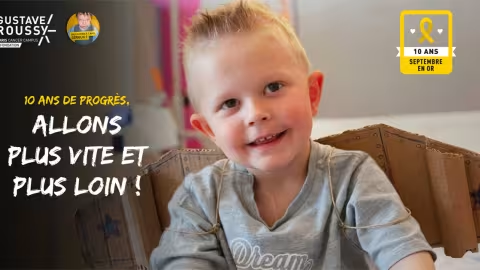
Gold september: two new research programmes launched to tackle childhood cancers
Two of Gustave Roussy’s four new medical and scientific programmes are dedicated to childhood cancers. The first, DECRIPT, aims to improve understanding of the role played by genetics in the development of certain childhood cancers, as well as second cancers that may occur in adulthood. The second, INSPIRE, will draw on the knowledge and techniques already developed at the Institute to create organoids, with the aim of deciphering the mechanisms underlying metastasis and resistance to treatment.
-
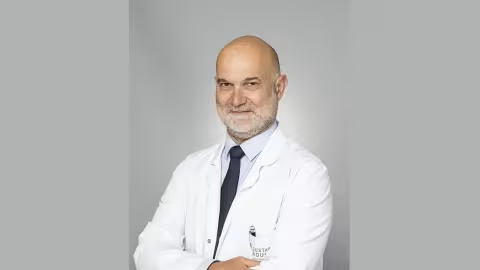
Prof. Fabrice Barlesi reappointed at the head of Gustave Roussy, the leading cancer center in France and Europe
By order of Ms. Stéphanie Rist, Minister of Health, Families, Autonomy and Persons with Disabilities, dated 27 July 2026, Professor Fabrice Barlesi has been reappointed as Director General of Gustave Roussy, effective 1 August 2026. At the helm of the Institute for five more years, Prof. Barlesi will continue the transformations undertaken during his first term. This renewal reflects the confidence placed in the project led by the institution to accelerate progress in the fight against cancer, foster and support the development of innovations set to change the future of oncology, and strengthen the influence of one of the world's leading cancer centers.
-
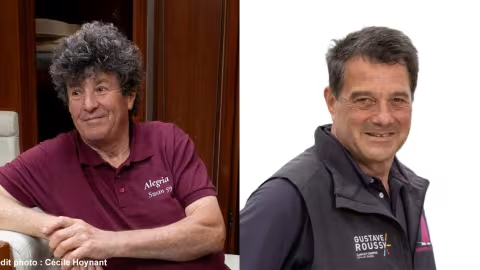
Route du Rhum 2026 Jean Le Cam and Christophe Rateau to sail for Gustave Roussy
For the Route du Rhum - Destination Guadeloupe 2026, Jean Le Cam and Christophe Rateau will sail under the colors of Gustave Roussy, the leading cancer center in France and Europe. Competing respectively in the Vintage and Class40 categories, the two skippers will carry the Institute's mission to the general public, supporting cancer research and raising awareness of prevention, innovation and patient care.
-
Owkin and Gustave Roussy partner to bring K Pro into real-world clinical practice
Owkin and Gustave Roussy, Europe's leading cancer center, today announced a partnership to test K Pro directly within the hospital's real-world clinical and research workflows.