Welcome to the new Gustave Roussy website
A new website designed to offer you a simpler, clearer, and more intuitive experience. Patients, caregivers, healthcare professionals, and donors: find information, news, and services more easily.
After a breast cancer diagnosis, how can treatment be started more quickly?
Gustave Roussy is launching a new care pathway designed to accelerate the management of women recently diagnosed with breast cancer. It brings together, in a single day, the radiology examinations, blood tests, and oncology consultation required to initiate treatment. This new pathway complements the Institute’s rapid breast care offering. The InstaDiag Breast pathway already consolidates all diagnostic examinations into a single day to establish a diagnosis.
On
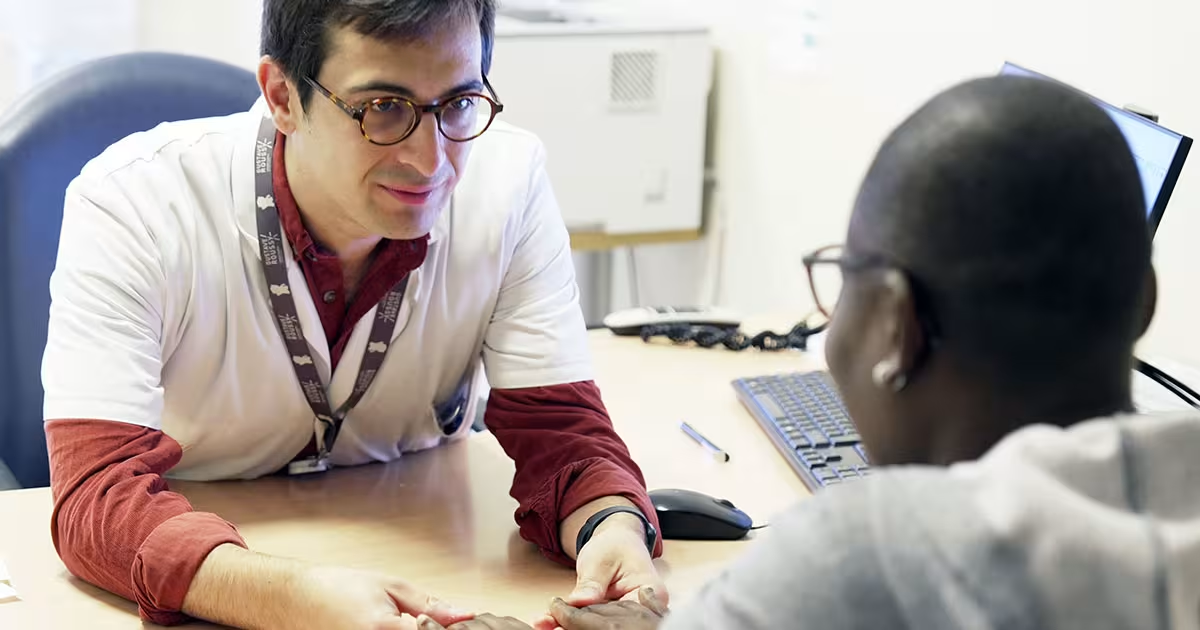
The time taken to begin treatment after a cancer diagnosis can have an impact on patient outcomes. In response to this challenge, since January 2026 Gustave Roussy has been offering a one-day therapeutic consultation pathway dedicated to breast cancer.
"Since the launch of InstaDiag Breast in 2004, an increasing number of breast imaging centres have offered women with suspicious lesions the possibility of undergoing a diagnostic biopsy directly. As a result, many patients now arrive at Gustave Roussy with a confirmed diagnosis. However, it remains necessary to review and complete the staging work-up before initiating a personalised treatment plan. Previously, this pre-treatment assessment could take several weeks," explains Dr Thomas Grinda, medical oncologist within the Breast Cancer Committee.
A Multidisciplinary Organisation and Expertise
To address these delays, Gustave Roussy's new therapeutic pathway brings together, within its day hospital and over the course of a single day, all the examinations and medical appointments required to rapidly initiate treatment. Patients arrive in the morning and first meet with a radiologist, who reviews their imaging examinations to confirm tumour size, identify any additional breast lesions and assess nearby lymph nodes.
Where necessary, a second biopsy is performed, together with a PET scan to establish an initial staging assessment of the disease. Blood tests and breast photographs are also carried out to support planning for any potential breast reconstruction procedure. The day concludes with an appointment with a medical oncologist, who is then able to outline the proposed treatment strategy, whether surgery, chemotherapy, radiotherapy or another therapeutic approach.
"Today, around two-thirds of our patients arrive at Gustave Roussy having already undergone an initial biopsy. We developed this multidisciplinary pathway in response to this new reality and to further reduce treatment delays. It enables us to propose an initial treatment strategy to the patient very quickly, which is subsequently reviewed and validated during the multidisciplinary tumour board meeting," says Dr Barbara Pistilli, medical oncologist and Head of the Breast Cancer Committee.
Rapid Access to Clinical Research
The therapeutic pathway, which is open to all women recently diagnosed with breast cancer, is the result of extensive care coordination. It is made possible by the multidisciplinary organisation of the Institute’s consultation platform and by the pivotal role played by nurse coordinators. Dedicated consultation slots are reserved for these patients every Thursday.
The pathway is also intended to shorten access times to innovative therapies and clinical trials. "During the consultation with the medical oncologist at the end of the assessment day, the patient can already be directed towards a clinical trial suited to her profile, evaluating an innovative medicine or therapeutic approach if appropriate," says Dr Thomas Grinda. "We aim to place Gustave Roussy’s multidisciplinary expertise at the service of patients, accelerating not only their therapeutic management but also their access to innovation. Our ambition is simple: to ensure that every woman can benefit from the latest advances in research," he adds.
Strengthening Rapid Access Pathways
This new pathway further strengthens Gustave Roussy’s rapid-access care offering. Since 2004, the InstaDiag Breast pathway has enabled all examinations required to establish a diagnosis to be completed in a single location and within a single day for women presenting with a breast abnormality detected through mammography or clinical examination and suspected of having a malignant lesion. Over the past 20 years, 25,000 women have benefited from the programme.
Several other InstaDiag pathways have since been introduced at Gustave Roussy. These include the One-Day Thyroid Nodule Clinic, established in 2008, followed in 2022 by InstaDiag Lung, developed within the framework of the International Thoracic Cancers Centre (CICT), which brings together Gustave Roussy and the Paris Saint-Joseph – Marie Lannelongue Hospital Group. Since 2024, four additional rapid diagnostic InstaDiag pathways have been launched, focusing on suspected lesions of the liver, pancreas, gynaecological organs and skin, including a dedicated pathway for skin carcinomas.
"Thanks to advances in research and patient care, we are now able to cure nine out of ten women diagnosed with breast cancer. One of the major challenges that urgently needs to be addressed today is improving the way we care for these women, not only by reducing the toxicities associated with certain treatments, but also by shortening delays, both at the diagnostic stage and throughout therapeutic management. Our objective is to provide every woman with the treatment best suited to her situation while preserving her quality of life," concludes Dr Barbara Pistilli.
Last press releases
-
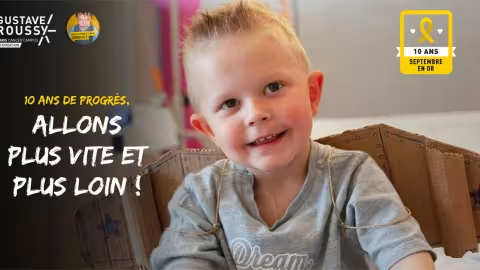
Gold september: two new research programmes launched to tackle childhood cancers
Two of Gustave Roussy’s four new medical and scientific programmes are dedicated to childhood cancers. The first, DECRIPT, aims to improve understanding of the role played by genetics in the development of certain childhood cancers, as well as second cancers that may occur in adulthood. The second, INSPIRE, will draw on the knowledge and techniques already developed at the Institute to create organoids, with the aim of deciphering the mechanisms underlying metastasis and resistance to treatment.
-
Prof. Fabrice Barlesi reappointed at the head of Gustave Roussy, the leading cancer center in France and Europe
By order of Ms. Stéphanie Rist, Minister of Health, Families, Autonomy and Persons with Disabilities, dated 27 July 2026, Professor Fabrice Barlesi has been reappointed as Director General of Gustave Roussy, effective 1 August 2026. At the helm of the Institute for five more years, Prof. Barlesi will continue the transformations undertaken during his first term. This renewal reflects the confidence placed in the project led by the institution to accelerate progress in the fight against cancer, foster and support the development of innovations set to change the future of oncology, and strengthen the influence of one of the world's leading cancer centers.
-
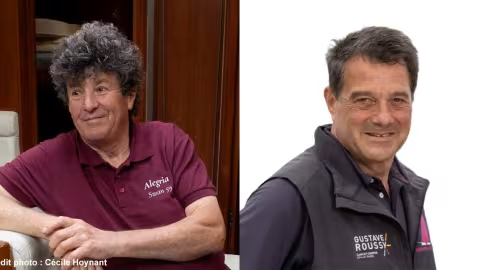
Route du Rhum 2026 Jean Le Cam and Christophe Rateau to sail for Gustave Roussy
For the Route du Rhum - Destination Guadeloupe 2026, Jean Le Cam and Christophe Rateau will sail under the colors of Gustave Roussy, the leading cancer center in France and Europe. Competing respectively in the Vintage and Class40 categories, the two skippers will carry the Institute's mission to the general public, supporting cancer research and raising awareness of prevention, innovation and patient care.
-
Owkin and Gustave Roussy partner to bring K Pro into real-world clinical practice
Owkin and Gustave Roussy, Europe's leading cancer center, today announced a partnership to test K Pro directly within the hospital's real-world clinical and research workflows.