
Welcome to the new Gustave Roussy website
A new website designed to offer you a simpler, clearer, and more intuitive experience. Patients, caregivers, healthcare professionals, and donors: find information, news, and services more easily.
Oncogenetics Committee
Director: Dr. Olivier Caron, oncogeneticist
Identifying and Managing Genetic Predispositions to Cancer
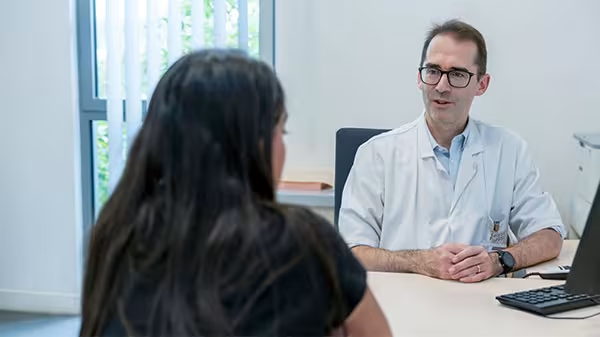
The oncogenetics committee brings together physicians and professionals from complementary disciplines to assess a possible hereditary predisposition to cancer in adults or children.
A consultation may be offered when a personal or family history suggests a genetic risk. The team analyzes the situation, explains the possibilities and limitations of genetic testing, and then makes recommendations tailored to the individual and, when appropriate, to their family.
When should you seek medical advice?
An unusual cluster of cancers among related individuals may prompt an investigation into a possible predisposition.
Age at diagnosis, tumor type, and family history are considered together.
Certain tumor characteristics or combinations of cancers may warrant a specialized evaluation.
When a known familial genetic disorder is present, a targeted test may be offered to affected relatives following a consultation.
The Stages of Care
Gather personal and family medical history, construct a family tree, and assess the appropriateness of genetic testing.
If the indication is met and with the person’s consent, screen for a genetic abnormality associated with an increased risk of cancer.
Explain the purpose of the test, its possible results, and their potential implications for the individual and their family.
Explain the results and, depending on the situation, make recommendations regarding prevention, monitoring, or management, in consultation with the organ-specific committees.
The absence of any identified abnormalities does not always rule out a predisposition. The recommendations therefore also take into account personal and family history, as well as evolving scientific knowledge.
The main conditions covered
Assessment of genetic predispositions associated with an increased risk of breast or gynecologic cancers.
Assessment of hereditary forms of gastrointestinal cancers, particularly colorectal cancers.
Consultations focused on genetic predispositions that may be associated with certain endocrine tumors.
Pediatric oncogenetic testing when the diagnosis, age, or family history suggests a predisposition.
Specialized care networks
- The Gustave Roussy FAR
Network is partnering with the Institut Curie in this network dedicated to individuals at high risk for breast cancer. - Pred-IdF
Network The Île-de-France Network for Predisposition to Gastrointestinal Cancers brings together Gustave Roussy, several AP-HP hospitals, and the Institut Curie.
The committee's professionals
- Committee Leadership:
Dr. Olivier Caron, oncogeneticist - Pediatric Oncology:
Dr. Laurence Brugières
Dr. Léa Guerrini-Rousseau - Genetic Counseling
Marina Di Maria
Sophie Villebasse - Adult Oncology:
Dr. Eric Baudin
Dr. David Malka (gastrointestinal oncology) - Related Specialties
Dr. Pascal Burtin, Gastroenterology and Endoscopy
Dr. Delphine Wehrer, Gynecology
Oncogenetics and Research
Oncogenetics is evolving as our understanding of predisposition genes and analytical techniques advances. Clinical data, family history, and—with the individuals’ consent—biological samples can contribute to research aimed at better identifying and characterizing hereditary cancer risks.
To investigate family or pediatric cases in which a genetic predisposition is suspected, including when standard tests do not provide an explanation.
The DECRIPT program studies predispositions to childhood cancers and the risk of a second cancer using clinical and biological cohorts.
To generate knowledge that can improve risk assessment and the monitoring strategies recommended for individuals at risk.
Individuals with certain predispositions may be referred to tailored care pathways, in coordination with prevention teams and the relevant committees. As part of Gustave Roussy’s personalized prevention program, Interception, clinical trials related to prevention are being conducted.