Welcome to the new Gustave Roussy website
A new website designed to offer you a simpler, clearer, and more intuitive experience. Patients, caregivers, healthcare professionals, and donors: find information, news, and services more easily.
Endoscopic Mastectomy: Advancing Minimally Invasive Breast Surgery
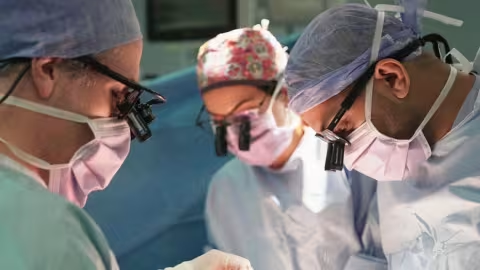
On 28 May, teams from the Department of Anaesthesia, Surgery and Interventional Procedures performed the 60th endoscopic mastectomy at Gustave Roussy. This technique, carried out under continuous visual guidance using a camera, enables the removal of the breast through a very short incision, thereby improving the aesthetic outcomes of breast reconstruction. This approach enhances Gustave Roussy’s surgical offering, alongside robotic surgery, and helps widen access to less invasive techniques for a greater number of patients.
Published on
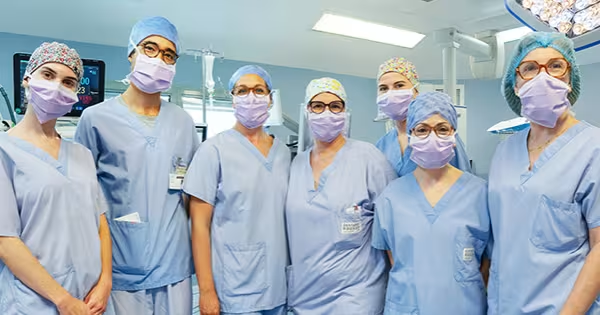
On 28 May, teams from the Department of Anaesthesia, Surgery and Interventional Procedures performed the 60th endoscopic mastectomy at Gustave Roussy. This technique, carried out under continuous visual guidance using a camera, enables the removal of the breast through a very short incision, thereby improving the aesthetic outcomes of breast reconstruction. This approach enhances Gustave Roussy’s surgical offering, alongside robotic surgery, and helps widen access to less invasive techniques for a greater number of patients.
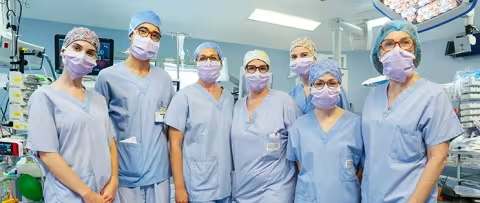
With 2,376 plastic and reconstructive breast surgeries performed in 2024, Gustave Roussy is France’s leading centre for breast surgery and reconstruction, according to data from the French National Health Insurance’s Visuchir ranking. To continue innovating and to offer the latest clinical advances, teams from the Department of Anaesthesia, Surgery and Interventional Procedures of Gustave Roussy have been offering selected patients endoscopic mastectomy since 2025.
When breast size allows, this approach requires only a short incision concealed within a natural fold, such as the armpit or the inframammary fold, compared with the longer scar on the breast associated with conventional mastectomy.
Continuous visual control
“Significantly reducing the size of the incision helps preserve the breast skin and its blood supply,” explains Dr Anne Puchar, breast surgeon at Gustave Roussy and specialist in endoscopic mastectomy.
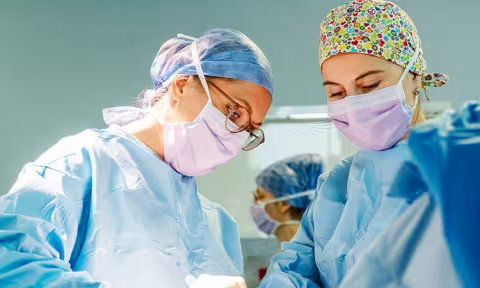
Once the incision has been made, a camera is introduced along with the endoscopic surgical instruments required for the procedure. The breast is then insufflated with gas to improve visibility. This endoscopic approach allows the mastectomy to be performed under continuous visual control and requires little specialised equipment. Endoscopic mastectomy uses the same instruments as laparoscopy, a minimally invasive surgical technique commonly used in various types of cancer.
Compatible with immediate reconstruction
In addition to the continuous visual control provided by the camera, endoscopic mastectomy offers improved visualisation of dissection planes and tissues. “All of these factors allow the surgeon to remove the mammary gland with great precision, particularly around the nipple–areola complex, which is a particularly delicate area where the dissection plane can be difficult to identify. This highly precise approach also helps limit trauma to the skin and improves the quality of breast reconstruction for our patients,” concludes Dr Puchar.
At Gustave Roussy, where the 60th endoscopic mastectomy has just been performed, this approach is compatible with all immediate reconstruction techniques: a single operation is required to remove the patient’s mammary gland and reconstruct the breast, either through the placement of an implant or by fat grafting.
Last news
-
Breast Cancer: Gustave Roussy Ranked No. 1 in France for Breast Surgery and Breast Reconstruction
On the occasion of Breast Cancer Awareness Month, the 2025 data from Visuchir, the national surgical activity monitoring tool of the French Health Insurance system, places Gustave Roussy in first position for both breast surgery and breast reconstruction. Beyond this ranking, these figures highlight that reconstruction is now an integral part of breast cancer treatment. It is considered at every stage of care: from tumor removal surgery, whether lumpectomy or mastectomy, through to the post-cancer period, helping to restore the body and support women in regaining their physical integrity and quality of life.
-
Newsweek Ranking: Gustave Roussy Named Europe’s Leading Cancer Centre and Third Best Worldwide
The 2027 edition of Newsweek’s World's Best Specialized Hospitals ranking once again recognises Gustave Roussy as the leading cancer centre in France and Europe, and the third best worldwide. This distinction highlights the excellence of the Institute’s care and research, as well as the daily commitment of all its professionals.

-
Living with and beyond cancer: the promises and challenges of digital health
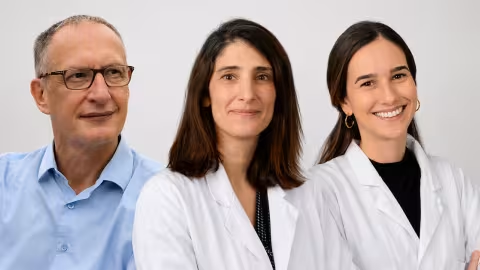
In a Viewpoint article published in The Lancet Digital Health, Drs Ines Vaz-Luis and Maria Alice Franzoi, together with Emmanuel Mussault, a patient partner at the PRISM University Hospital Institute, examine the role that digital tools can play in supporting people living with and beyond cancer. Their central message is that these technologies can support more personalised and accessible care, but their value depends primarily on how they are integrated into care pathways, the human support provided, their ability to address individual needs and their evaluation in real-world settings.
-
Gustave Roussy and The Lancet launch an international lecture series on innovations transforming cancer care
The inaugural lecture in the “Lecture Series on Cancer Breakthroughs” will take place on Friday 18 September at 5:00 pm. It will be delivered by Professor Timothy R. Rebbeck, a leading cancer prevention specialist at Harvard University and the Dana-Farber Cancer Institute.