Welcome to the new Gustave Roussy website
A new website designed to offer you a simpler, clearer, and more intuitive experience. Patients, caregivers, healthcare professionals, and donors: find information, news, and services more easily.
Research scientist Sophie de Carné named Young Leader by the Franco-British Council
Since 2017, the Franco-British Council has annually selected a cohort of Young Leaders from the worlds of science, the arts, media and academia, all of whom have ties to both France and the United Kingdom. The goal? “To build a generation of 21st-century leaders committed to nurturing and advancing Franco-British relations and shaping their future across all areas of our societies and economies.”
Published on
Changed on
Since 2017, the Franco-British Council has annually selected a cohort of Young Leaders from the worlds of science, the arts, media and academia, all of whom have ties to both France and the United Kingdom. The goal? “To build a generation of 21st-century leaders committed to nurturing and advancing Franco-British relations and shaping their future across all areas of our societies and economies.”
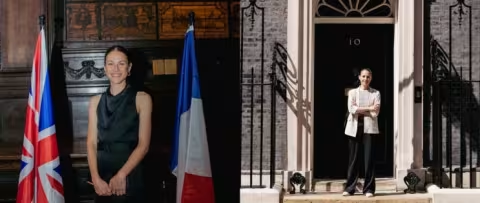
Sophie de Carné, head of the Inflammation and Cancer Plasticity lab (IHU-Prism, UMR 981) at Gustave Roussy, has been selected by the Franco-British Council to join the 2025 Young Leaders cohort.
The programme, born of a joint initiative by President François Hollande and Prime Minister David Cameron, aims to deepen mutual understanding and cooperation between France and the United Kingdom by creating a high-level bilateral dialogue platform. It relies on a prestigious alumni network committed to strengthening Franco-British ties. Today, the programme brings together a network of 176 influential figures holding senior positions across a wide range of fields.
A cancer biology specialist, Sophie de Carné spent nearly ten years in the UK, where she conducted cutting-edge research at the Francis Crick Institute. Her work focused on lung cancers with KRAS gene mutations, one of the most altered genes in such tumours. To better understand these cancers, she developed experimental models and used single-cell sequencing technologies to study them. She also designed a tool that can measure how active the KRAS cancer-driving programme is inside a tumour — even when no obvious RAS gene mutations are present. An innovative approach that paves the way for more personalised treatments tailored to the actual behaviour of each tumour.
Upon returning to France in autumn 2024, she joined Gustave Roussy and the IHU-Prism as a young team leader and junior professor at Université Paris-Saclay, where she holds a chair dedicated to cancer prevention.
Her current work seeks to understand why some mutated cells progress to become tumours, while others remain dormant. The central hypothesis? Cancer is not solely the result of a genetic mutation, but also of a favourable biological or environmental context, a so-called “promotion” phase. Her laboratory explores the links between obesity, metabolic dysfunction, and tumour transformation, particularly in KRAS-mutated pancreatic and lung cancers. To this end, she is developing organoid models derived from reprogrammed stem cells. She also aims to expand her research to investigate the role of pesticides in oncogenesis.
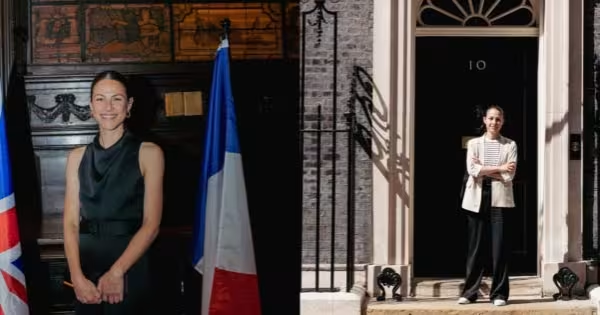
At the beginning of July, during a working seminar organised by the Franco-British Council in London, Sophie de Carné and the other Young Leaders had the opportunity to meet and exchange with the President of the French Republic, Emmanuel Macron, and the British Prime Minister, Keir Starmer.
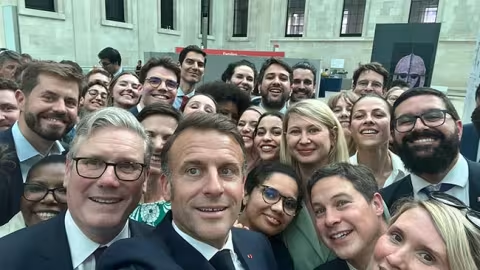
By joining the Young Leaders network, Sophie de Carné hopes to bring translational research and cancer prevention into the public debate. “If you want your research to truly benefit society, you need to step beyond the scientific community to share your discoveries, exchange ideas, and engage in wider conversations. The Franco-British Young Leaders programme is a unique opportunity to do this, and build bridges between science, policy, and society,” she concludes.
Last news
-
Breast Cancer: Gustave Roussy Ranked No. 1 in France for Breast Surgery and Breast Reconstruction
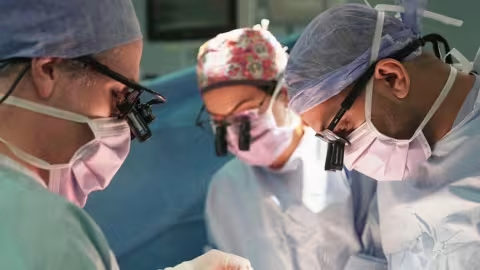
On the occasion of Breast Cancer Awareness Month, the 2025 data from Visuchir, the national surgical activity monitoring tool of the French Health Insurance system, places Gustave Roussy in first position for both breast surgery and breast reconstruction. Beyond this ranking, these figures highlight that reconstruction is now an integral part of breast cancer treatment. It is considered at every stage of care: from tumor removal surgery, whether lumpectomy or mastectomy, through to the post-cancer period, helping to restore the body and support women in regaining their physical integrity and quality of life.
-
Newsweek Ranking: Gustave Roussy Named Europe’s Leading Cancer Centre and Third Best Worldwide
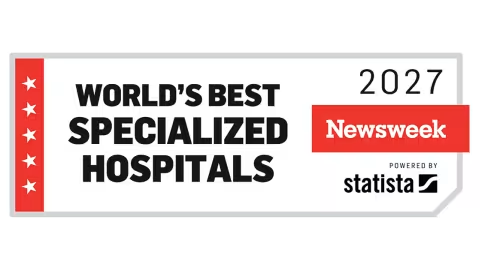
The 2027 edition of Newsweek’s World's Best Specialized Hospitals ranking once again recognises Gustave Roussy as the leading cancer centre in France and Europe, and the third best worldwide. This distinction highlights the excellence of the Institute’s care and research, as well as the daily commitment of all its professionals.
-
Living with and beyond cancer: the promises and challenges of digital health
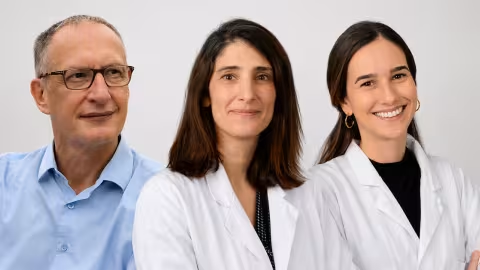
In a Viewpoint article published in The Lancet Digital Health, Drs Ines Vaz-Luis and Maria Alice Franzoi, together with Emmanuel Mussault, a patient partner at the PRISM University Hospital Institute, examine the role that digital tools can play in supporting people living with and beyond cancer. Their central message is that these technologies can support more personalised and accessible care, but their value depends primarily on how they are integrated into care pathways, the human support provided, their ability to address individual needs and their evaluation in real-world settings.
-
Gustave Roussy and The Lancet launch an international lecture series on innovations transforming cancer care
The inaugural lecture in the “Lecture Series on Cancer Breakthroughs” will take place on Friday 18 September at 5:00 pm. It will be delivered by Professor Timothy R. Rebbeck, a leading cancer prevention specialist at Harvard University and the Dana-Farber Cancer Institute.