Welcome to the new Gustave Roussy website
A new website designed to offer you a simpler, clearer, and more intuitive experience. Patients, caregivers, healthcare professionals, and donors: find information, news, and services more easily.
Skin Cancer Sponsorship
Sponsor the skin cancer research team
Month after month, your sponsorship accelerates skin cancer research toward new breakthroughs.
With an estimated 14,325 cases in 2015, melanoma accounts for between 2 and 3 percent of all cancers. It is the cancer with the fastest-growing number of new cases per year (10 percent annually over the past 50 years). When detected at a metastatic stage, its progression can be devastating.
However, since 2011, research has made spectacular progress thanks to the emergence of targeted therapies and immunotherapy. This represents a true therapeutic revolution to which Professor Caroline Robert’s team has contributed significantly. But these advances are not enough, as one-third of patients still do not respond at all to these new treatments.
It is for these patients that the high-level expertise of Professor Caroline Robert’s research team is absolutely essential; it is for them that your donation makes a direct difference.
- More than 60,000 people affected each year
- 14,000 develop melanoma (metastatic skin cancer)
- More than 1,700 deaths per year
- Two-thirds of these cancers are linked to excessive sun exposure
Through your sponsorship, become a driving force for innovation and accelerate skin cancer research for the direct benefit of patients!
Innovating to improve skin cancer treatment: three flagship research programs:
● Understanding the mechanisms of treatment
resistance ● Identifying new molecules to overcome these resistance
mechanisms ● Studying biomarkers of treatment
efficacy and toxicity Goal: to develop more effective and less toxic personalized treatments for metastatic melanoma Benefits for patients:
● Receive the most effective treatment from the moment of diagnosis
● Predict treatment
toxicity ● Achieve more frequent complete remissions, with the hope of being able to stop treatment
Annual program budget: €150,000
Becoming a sponsor means taking part in a great scientific adventure every day
What if, for just €8.50 a month*, you could help accelerate skin cancer research?
With a regular donation of at least €25 per month (or €8.50 after tax deduction), you become a valued partner of your research team.
Your sponsorship provides essential support for bringing innovative skin cancer projects to fruition.
Our research on skin cancer will advance thanks to you
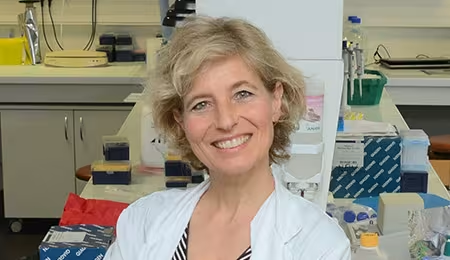
Professor Caroline Robert, Oncodermatologist and Head of the Dermatology Department

Without you, we wouldn’t be able to carry out our research projects… Despite advances, melanoma remains a very serious disease that still resists current treatments. Your sponsorship allows us to maintain a highly active research team whose goal is to overcome mechanisms of treatment resistance and find more effective drugs. The time spent applying for institutional grants is time taken away from research—and, above all, time taken away from patients. With the regular support of our sponsors, we’re accelerating our research and achieving much better results: we make so much more progress together!

Dr. Shensi Shen, Postdoctoral Fellow in Professor Caroline Robert’s laboratory
Sponsorships are invaluable……Without these donations, we would not have been able to discover a new resistance mechanism: “translational reprogramming.” We’ve also identified a molecule that can counteract this mechanism, and we’re now working with a team of chemists to synthesize this compound and develop an effective drug. We are working tirelessly to launch a clinical trial so that patients can benefit from this new treatment. The ongoing support of our sponsors is essential to achieving our research goals.
*after a 66% tax deduction
Colorectal Cancer Childhood Cancer Gynecologic Cancers Living Better with Cancer Skin Cancer Lung Cancer Prostate Cancer Sarcomas Breast Cancer Brain Tumors