Welcome to the new Gustave Roussy website
A new website designed to offer you a simpler, clearer, and more intuitive experience. Patients, caregivers, healthcare professionals, and donors: find information, news, and services more easily.
Strategic Plan 2030: 3 Questions for Prof. Fabrice Barlesi, Executive Director of Gustave Roussy
An interview with Professor Fabrice Barlesi, the new executive director of Gustave Roussy, to understand the decisive changes that will take place over the next ten years.
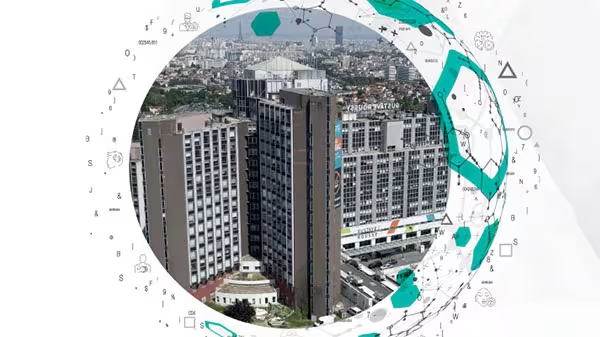
True to its pioneering heritage and drawing on 100 years of interdisciplinary work and success within a vibrant hub of knowledge, Europe’s leading organization in the fight against cancer is launching its new strategic plan for 2030 and joining forces to create a future for patients living with cancer. A 3.0 strategy that bridges science and humanity and increases the chances of recovery.
Stopping cancer by 2030—science fiction or reality?
Faced with the immense challenges posed by scientific advances and the need to help people with cancer, we must transform the scientific, medical, technological, and societal approach to oncology. Our new strategic plan for 2030 is highly ambitious and will guide our actions over the coming years, which will change the way we understand cancer. It is structured around three pillars, the first of which is to prevent and treat cancer differently to defy prognoses and offer a future to every patient.
As a public health organization, we will focus on developing new areas of expertise by intervening at all stages of the disease—including the earliest stages in the field of prevention—to intercept cancer before it even appears or before it becomes difficult to treat. This is already a reality today at Gustave Roussy with the Interception program, launched in 2021 within a pilot clinic for personalized cancer prevention. In addition, we will draw on our experience with “one-day diagnostics,” which Gustave Roussy has offered since 2004 (for breast and thyroid cancer, followed by lung cancer within a week), to establish a rapid and intelligent diagnostic center on our campus.
Following the decade of genotyping and targeted therapies in the 2000s, and the decade of immuno-oncology in the 2010s, we are now entering the era of drug combinations and ultra-personalization by offering our patients tailored care pathways, from pre-cancer through post-cancer care. Screening based on individual risk, diagnosing even earlier and faster, offering personalized treatments that increase the chances of recovery, anticipating relapses or treatment-related toxicity by identifying, at the outset of care, patients at increased risk of recurrence and long-term effects, and personalizing support for each patient to improve their quality of life after cancer—particularly through digital technology and artificial intelligence—these are our challenges.
What do you plan to do about cancers that cannot be cured today?
We must bring together and harness the best of all scientific disciplines for “Research 3.0” that delivers rapid results. This is the second pillar of our strategic plan: collaborative research that is increasingly interdisciplinary and technology-driven, focused on rapid solutions that directly benefit patients and serve society.
We are now shifting toward research focused on prevention—for example, to avoid the disease and better control it. For instance, the Prism program, which brings together teams from Gustave Roussy and other partners, is already working to develop solutions for the future.
The goal is that, within five years, it will be possible to create a biological and digital avatar for each patient—a virtual cancer model—that will reveal the molecular, cellular, immunological, and genetic mechanisms driving cancer progression, thereby enabling personalized treatments to be offered from the moment of diagnosis.
This is also the mission of the Paris Saclay Cancer Cluster, which Gustave Roussy co-founded and which closely connects key players in oncology innovation. It will serve as a true catalyst for projects and the concentration of talent. The goal is to foster the development of French “unicorns” in oncology to enable patients to quickly access research advances and ensure healthcare independence. Within ten years, the goal is to be able to offer patients rapid diagnosis, including modeling of their disease markers and the development of personalized therapies.
The creation of large cohorts to profile each patient and generate more knowledge, along with the use of AI to analyze this data with extreme precision, are also key to this approach. We are expanding our partnerships in various scientific fields, notably with Paris-Saclay University. We are convinced that the cross-fertilization of complementary fields of expertise—such as mathematics, physics, and the humanities and social sciences—will help resolve crucial, as-yet-unanswered questions in oncology.
Prof. Fabrice Barlesi, Executive Director of Gustave Roussy
"By 2030, our goal is to provide personalized care for every patient through the convergence of science and technology."

What will Gustave Roussy look like in 2030?
The third key pillar of our strategic plan is to transform Gustave Roussy into a smart hospital—the hub of European oncology. We will transform our facility into a 3.0 hospital within a high-performance ecosystem that addresses both organizational and structural challenges related to new patient care pathways that are more connected and better tailored to society’s needs. This new, more digitized organizational structure will also allow healthcare providers to rediscover a sense of purpose in their work by spending more quality time with patients, enabling them to refocus on tasks that draw on their humanity—the very heart of their calling.
Because we firmly believe that patients who receive good care recover faster and more fully, the smart hospital will offer a personalized experience for our patients. We will thus build a new outpatient care model 3.0. Thanks to the digitization of certain aspects of care, patients will be able to monitor their vital signs from home, record their symptoms or side effects, and choose their treatment time slots so that their illness has as little impact as possible on their personal and professional lives. Care units will be renovated and redesigned, following the example of our very recent interventional oncology and pharmacy facilities. The creation of additional inpatient units, improved access to the current site with the upcoming arrival of Metro lines 14 and 15, and large-scale real estate projects—including the construction of new buildings—are already underway or in the planning stages. These developments will lay the foundation for a European cancer campus centered around Gustave Roussy, dedicated to cutting-edge research and the most innovative care.
Finally, it involves developing partnerships, alliances, and collaborations to spread our new models both domestically and internationally.
To implement this plan, major investments totaling several hundred million euros are required. We have already secured the support of the government, investment funds, our patrons, and our loyal donors. We hope to see them joined by new civil society actors who wish to join us in the fight to cure cancer. For 100 years, building on the visionary spirit of its founder, Gustave Roussy has strived to earn its place as a European leader in the fight against cancer. Today, we stand at a turning point in our history, pursuing our grand ambition: to cure cancer in adults and children in the 21st century.