
Welcome to the new Gustave Roussy website
A new website designed to offer you a simpler, clearer, and more intuitive experience. Patients, caregivers, healthcare professionals, and donors: find information, news, and services more easily.
RHU REMISSION : Characterizing the biological specificities of patients and their tumors to develop new immunotherapies
The REMISSION program was granted by the 6th call for projects of the Hospital-University Research (RHU) endeavor of the France 2030 government investment plan. It proposes to use fresh tissues (blood and tumor) as a source of biomarkers to adapt new immunotherapy strategies to the biology of patients and their cancer. This program aligns with Gustave Roussy's objectives to personalize treatments for cancer patients.
This program is led by Professor Aurélien Marabelle, M.D., Ph.D., a medical oncologist within the Department of therapeutic innovation and early phase trials (DITEP), a researcher affiliated with INSERM (U1015 & CIC1428), and a clinical immunology professor at Paris-Saclay University. The RHU REMISSION (Rapid Evaluation of Molecular & Immune Status for Stratified Immunotherapies in ONcology) is part of the ongoing immunotherapy revolution, which for over 10 years has initiated a new paradigm in oncology: no longer directly targeting cancer cells but leveraging the patient's immune system to eradicate the disease. Previously prescribed as a second or third-line treatment, immunotherapy is now used at the beginning of therapeutic management for many cancers.
Enhancing immunotherapy clinical trials
"REMISSION starts from the observation that in clinical research, there is a very high failure rate with approximately 95% of new molecules evaluated, across all pathologies, not reaching the market. For an immunotherapy to be effective, it is essential that the biological specificity it targets is present in the patient's body. This failure rate is partly due to the lack of biomarkers indicating the presence of the target at the time the patient is enrolled in the trial. This problem is explained in part by the poor predictive value and the multiple weeks required for the analysis of frozen or fixed tissues used routinely, preventing personalized patient care," explains Professor Marabelle.
The objective is therefore to significantly reduce the waiting time for the results of biological tissue analysis. To achieve this, the RHU REMISSION will develop fresh tissue analyses, which provide biological data from a biopsy or blood sample within 24 hours of receipt. Ultimately, this significant biological analysis work will contribute to the development of a new classification of metastatic cancers, no longer focused on tumor localization or histology - lung cancer, pancreatic cancer, kidney cancer, etc. - but on its biology. Patients will be treated according to the biological characteristics of their disease. This extensive taxonomy work will be supported by Gustave Roussy's vast clinical-biological biobank and data set.
Three main research axes
To address these objectives, three areas of work are being developed:
- Continuing the identification of predictive biomarkers
In order to provide better patient orientation in clinical trials, the RHU REMISSION aims to identify biomarkers predictive of efficacy or therapeutic resistance. Professor Marabelle has already contributed to the approval in the United States and Europe of immunotherapies prescribed based on biomarkers (MSI/MMRd and TMB), regardless of cancer type. With his teams, he aims to further develop personalized immunotherapy.
- Developing expertise and capabilities at Gustave Roussy in the analysis of fresh tissues
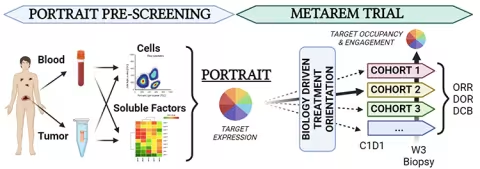
The use of fresh tissues - tumor biopsies and whole blood - allows for the deployment of sensitive and specific techniques that are rarely or not used in clinical routine. Rapidly providing results from these analyses requires the deployment of new technical and logistical capabilities within Gustave Roussy. This activity will provide a rapid immunological profile of the patient and their disease. This PORTRAIT (Profile in Onco-immunology for the Research of a Treatment upon Referral Adapted to your Immunity and your Tumor) will help oncologists guide their patients towards therapeutic cohorts that are tailored to them.
- Building a national bioclinical research platform
In parallel, the RHU REMISSION will launch a national bioclinical research platform, with two multicenter phase 2 Master Protocols therapeutic trials. The goal will be to prospectively test new immunotherapy strategies in selected patients based on their molecular and immunological PORTRAIT, rather than solely on histology. The neo-adjuvant trial NEOREM will involve patients with localized cancer and propose immunotherapy before surgery. The METAREM trial will focus on patients with metastatic cancers.
The consortium of the RHU REMISSION includes 12 partners: Gustave Roussy, Paris-Saclay University, INSERM, the Cordeliers Research Center, CentraleSupélec engineering school, Unicancer, the French Society of Cancer Immunotherapy (FITC), as well as five industrial partners: Servier laboratories, HiFiBiO, PegaOne, ImCheck, and the biotech Veracyte, specialized in diagnostics and biomarkers.
Renforcer les essais cliniques en immunothérapie
L’objectif est donc de réduire considérablement le délai d’attente des résultats de l’analyse de tissus biologiques. Pour ce faire, le RHU REMISSION va développer les analyses de tissus frais, qui permettent d’obtenir des données biologiques d’une biopsie ou d’une prise de sang dans les 24 heures suivant sa réception. À terme, cet important travail d’analyse biologique participera à l’élaboration d’une nouvelle classification des cancers métastatiques, non plus centrée sur la localisation ou l’histologie tumorale - cancer du poumon, du pancréas, du rein... - mais sur sa biologie. Les patients seront traités selon les caractéristiques biologiques de leur maladie. Cet important travail de taxonomie sera appuyé par la vaste biobanque clinico-biologique et l’ensemble de données dont dispose Gustave Roussy.
Trois axes majeurs de recherche
Pour répondre à ces objectifs, trois axes de travail sont développés :
Afin de proposer une meilleure orientation des patients dans les essais cliniques, le RHU REMISSION vise à identifier des biomarqueurs prédictifs d’efficacité ou de résistance thérapeutique. Le Pr Marabelle a déjà contribué à l’approbation aux États-Unis et en Europe d’immunothérapies prescrites en fonction de biomarqueurs (MSI/MMRd et TMB), indépendamment du type de cancer. Avec ses équipes, il vise à renforcer le développement d’une immunothérapie personnalisée.
L’utilisation de tissus frais – biopsies tumorales et sang total – permet de déployer des techniques sensibles et spécifiques qui sont peu ou pas utilisées en routine clinique. Rendre rapidement les résultats issus de ces analyses nécessite le déploiement de nouvelles capacités techniques et logistiques au sein de Gustave Roussy. Cette activité permettra de fournir rapidement un profil immunologique du patient et de sa maladie. Ce PORTRAIT (Profil Onco-immunologique pour la Recherche de Traitement de Recours Adapté à votre Immunité et à votre Tumeur) permettra d’aider les oncologues à orienter leurs patients vers des cohortes thérapeutiques qui leur sont adaptées.
Enfin, le RHU REMISSION participera à l’élaboration d’une plateforme nationale de recherche bioclinique, avec deux essais thérapeutiques de type Masters Protocols multicentriques de phase 2. L’objectif sera de tester de manière prospective de nouvelles stratégies d’immunothérapies, chez des patients sélectionnés en fonction de leur PORTRAIT moléculaire et immunologique, et non pas uniquement en fonction de leur histologie. L’essai néo-adjuvant NEOREM concernera des patients atteints d’un cancer localisé et proposant une immunothérapie avant chirurgie. L’essai METAREM se concentrera sur les patients atteints de cancers métastatiques.
Un consortium national
Le consortium du RHU REMISSION regroupe plusieurs partenaires, Gustave Roussy, l’université Paris-Saclay, l’Inserm, le Centre de recherche des Cordeliers, CentraleSupélec, Unicancer, la Société française d’immunothérapie du cancer (FITC), ainsi que quatre partenaires industriels : les laboratoires HiFiBiO, PegaOne, ImCheck, et la biotech Veracyte, spécialisée en diagnostic et en biomarqueurs.