Welcome to the new Gustave Roussy website
A new website designed to offer you a simpler, clearer, and more intuitive experience. Patients, caregivers, healthcare professionals, and donors: find information, news, and services more easily.
Cancer Survivorship
- Thematic(s)
- Data & AI, Precision Medicine, Public Health & Epidemiology
- Manager(s)
- Ines Vaz Luis
- Institutional connection
-
Gustave Roussy, Inserm, Paris-Saclay University, UVSQ
Summary
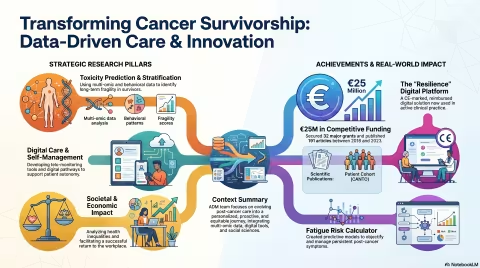
The team is developing a personalized, participatory, proactive, and equitable approach to post-cancer care. Its goal is to better prevent, detect, and manage symptoms and side effects related to cancer and its treatments, improve survivors’ quality of life, and reduce the social burden of cancer. The challenge is to evolve care toward pathways that integrate clinical and biological data, the humanities and social sciences, digital tools, and the active involvement of patients.
The research is organized around three main areas:
-
predicting and stratifying long-term side effects and post-cancer frailty using clinical, behavioral, biological, and multi-omic data;
-
designing and evaluating care pathways and digital tools that promote self-management, remote monitoring, and supportive care;
-
analyzing the societal impact of cancer, particularly return to work and social inequalities.
These areas of focus are supported by CANTO (>13,000 patients), weSHARE, a national digital research platform, and the INTERVAL and PATH-FOR-YOUNG programs.
Between 2018 and 2023, the team secured 32 competitive grants totaling nearly €25 million and published 151 articles. Its work has quantified the extent of persistent symptoms after cancer, produced predictive models and a fatigue risk calculator, and contributed to telehealth monitoring and supportive care pathways, including Resilience, a CE-marked device covered by insurance. Future prospects include the integration of multi-omic data, the validation of digital therapies, expansion to multiple types of cancer, and monitoring of health disparities. The expected impact is scientific, through the structuring of the field; clinical, through transferable tools; and societal, through improved quality of life, return to work, and more equitable care.
Team members
-
VAZ LUIS Ines - Team Leader
Hospital Physician, Gustave Roussy
MENVIELLE Gwenn - Assistant Unit Director
Research Director and Equivalents, Inserm
BALL Sarah
Research Engineer or equivalent, Gustave Roussy
BARBIER Aude
Research Engineer or equivalent, Gustave Roussy
Chayma Bousrih
Hospital Physician, Gustave Roussy
Antonio Di Meglio
Hospital Physician, Gustave Roussy
FRANZOI Maria Alice
Hospital Physician, APHP
HAVAS Julie
Design Engineer or equivalent, Gustave Roussy
LAPIDARI Pietro
Ph.D. Candidate, Gustave Roussy
Sophie LAURENT
Hospital Physician, Gustave Roussy
Patricia MacNeil
Ph.D. student, Inserm
Elise Martin
Research Engineer or equivalent, Gustave Roussy
Estelle MEIMOUN
Design Engineer or equivalent, Gustave Roussy
Koketso NTOBENG
Ph.D. Candidate, Paris-Saclay University
Martina PAGLIUCA
Ph.D. student, SCUOLA SUPERIORE MERIDIONALE
RUIZ DE AZUA UNZURRUNZAGA Garazi
Postdoctoral Researcher, Gustave Roussy
VOLATIER ETIENNE
Research Engineer or equivalent, Gustave Roussy
ZYUMBILEVA Petya
Postdoctoral Fellow, Gustave Roussy
Key publications
Other scientific productions
Contacts