Welcome to the new Gustave Roussy website
A new website designed to offer you a simpler, clearer, and more intuitive experience. Patients, caregivers, healthcare professionals, and donors: find information, news, and services more easily.
U1361 - Cancer Data Science

- Thematic(s)
- Data & AI, Genetics / Genomics, Precision Medicine, Onco-hematology
- Director(s)
- Sergey Nikolaev
- Institutional connection
-
Gustave Roussy, CentraleSupélec, Inserm, Paris-Saclay University
Summary
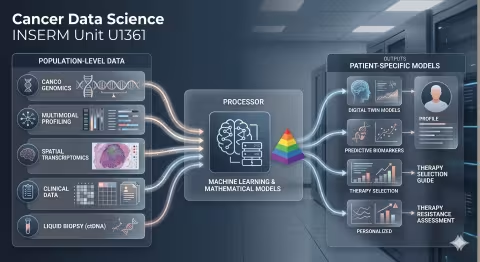
The Cancer Data Science Unit U1361 studies the molecular profiling of cohorts of cancer patients to determine the characteristics of the disease. The unit uses a deductive strategy to translate multimodal population-based data into patient-specific models. Its research areas include cancer genomics, computational oncology, and biomathematics. The unit analyzes tumor progression, genotype-phenotype relationships, and determinants of treatment response for solid tumors and hematologic malignancies. The methodologies used include sequencing, spatial transcriptomics, and analysis of circulating tumor DNA. The goal is to develop mathematical and machine learning tools to process biomedical data. The main challenges involve integrating different data modalities, identifying biomarkers of treatment resistance, and extracting actionable variables from biological systems.
Researchers in the unit have produced open-access datasets detailing clinical and genomic data related to myeloid neoplasms and solid tumors, as well as decision-support tools such as the Molecular International Prognostic Scoring System. Algorithms dedicated to spatial omics and mutation analysis have been developed. Future directions will focus on “pan-cancer” approaches centered on the mechanisms of action and resistance to systemic therapies. The unit will develop predictive models aimed at stratifying patients based on clinical and genetic parameters. The scientific impact stems from contributions to open-source software and the taxonomic criteria defined by the consortium. The clinical impact will come through the deployment of algorithms and biomarker panels to guide treatment selection within the framework of precision medicine. The societal impact encompasses the dissemination of digital health technologies, recommendations on standards of care, and data sharing via public platforms.
Research team
Contacts
- Phone
- 01.42.22.57.75