
Welcome to the new Gustave Roussy website
A new website designed to offer you a simpler, clearer, and more intuitive experience. Patients, caregivers, healthcare professionals, and donors: find information, news, and services more easily.
INSPIRE programme: Developing organoids to decipher the mechanisms underlying metastasis and treatment resistance in paediatric cancers
The INSPIRE programme aims to improve understanding of why some paediatric cancers resist treatment and develop metastases, paving the way for new therapeutic strategies. By developing innovative models derived from patient cells, the programme seeks to reproduce the complexity of tumours and their environment in the laboratory. Its ambition is to turn the knowledge generated into tangible advances that improve care for children with cancer.
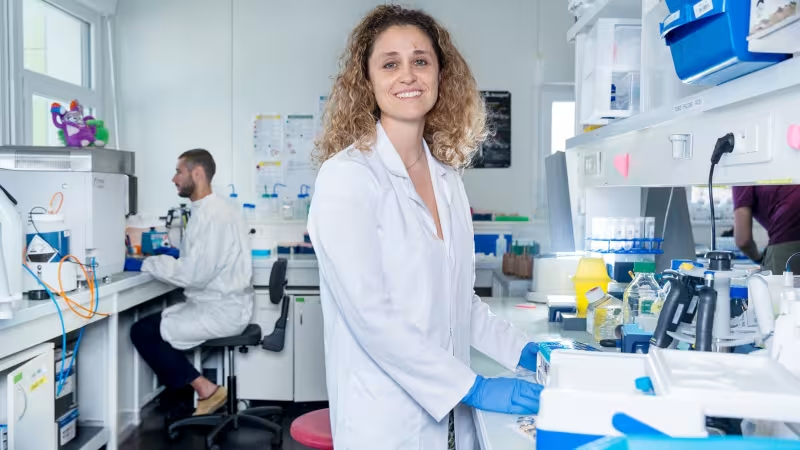
Programme leads
Professor Florent Ginhoux
Dr Claudia Pasqualini
Context and challenges
Paediatric cancers remain the leading cause of death from disease among children and adolescents in many countries, with nearly 400,000 new cases diagnosed worldwide each year.
Although therapeutic advances have improved survival in some cancers, high-risk forms remain difficult to treat. In these cases, relapses and metastases account for most deaths, reflecting treatment-resistance mechanisms that are still poorly understood.
Paediatric cancers have specific biological characteristics. Treatments developed for adults, particularly immunotherapies, show limited effectiveness in children. This difference is partly explained by the nature of the tumours, but also by distinctive features of the immune system and the tumour environment.
Research now highlights the central role of the tumour microenvironment, meaning all the cells surrounding the tumour. In paediatric cancers, this environment can hinder the immune system and reduce the effectiveness of treatments.
Macrophages are among the cells that play a key role. Normally involved in the body's defences, they can be hijacked by the tumour and help to suppress the immune response, promote treatment resistance, and enable cancer cells to spread, leading to the formation of metastases.
Despite their importance, the precise role of macrophages in paediatric cancers remains poorly understood. One of the main obstacles is the lack of experimental models able to reproduce the complexity of human tumours and their environment.
Objectives
The INSPIRE medical and scientific programme, which stands for Integrated Systems of Patient-derived models to Investigate tumour dissemination and Resistance to immunotherapies in paediatric cancers, aims to improve understanding of the role of macrophages in the progression of paediatric cancers and in treatment-resistance mechanisms.
- One of the programme's central objectives is to characterise, in exceptional detail, interactions between tumour cells and their immune environment, particularly macrophages, and to determine how these interactions change over time and across the organs involved.
- INSPIRE also has a specific objective focused on analysing the mechanisms of tumour spread. The aim is to understand how cancer cells acquire the ability to migrate, colonise new tissues and adapt to them through their interactions with local microenvironments.
- Beyond advancing fundamental knowledge, the programme aims to identify potential therapeutic levers. By revealing the signalling pathways and cellular interactions involved in resistance and metastasis, INSPIRE seeks to uncover new targets and guide the development of more effective therapeutic strategies for paediatric cancers.
Video explanation

Approach
To achieve these objectives, INSPIRE is developing next-generation experimental models derived from patient cells.
Using samples of tumour tissue, skin cells and blood cells, researchers recreate organoids in the laboratory. These three-dimensional structures reproduce the characteristics of a tumour. The models can be regarded as true avatars of each patient's disease, allowing researchers to study its progression and response to treatment under conditions that closely reflect reality.
This approach draws on expertise developed at Gustave Roussy, particularly within Professor Florent Ginhoux's team, which has shown that immune cells can be incorporated into these models to reproduce the tumour microenvironment faithfully.
One of the distinctive features of the INSPIRE programme is that it does not focus on the tumour alone but also reconstructs its environment. The organoids are enriched with immune-system cells, particularly macrophages, to reproduce as closely as possible the interactions occurring in the human body. These cells are generated from the same samples used to create the tumour. This produces models derived entirely from a single patient, in which all the cells recognise and interact with one another as they would in the body. The approach makes it possible to recreate a tumour environment in the laboratory that is much more faithful to reality.
The programme goes further by developing multi-organ systems in which several organoids representing different tissues are brought into interaction. These systems can model tumour spread across the body by reproducing exchanges between organs and the conditions that favour the establishment of metastases.
All these models are analysed using advanced technologies, including single-cell sequencing and spatial analyses. These methods provide a detailed characterisation of cell populations, their functions and their interactions within tissues.
Outlook
Alongside its ambition to understand fundamental mechanisms, INSPIRE has a translational focus and aims to turn this knowledge into clinical advances.
The models developed through the programme provide a particularly suitable framework for testing new therapeutic approaches under conditions that closely reflect patients' disease. They will make it possible to assess strategies designed to modulate the tumour microenvironment or specifically target the pro-tumour functions of macrophages.
In the longer term, this work could help to stratify patients more accurately, tailor treatment to the biological characteristics of their tumour and improve the effectiveness of existing therapeutic approaches.
By combining cutting-edge technologies with an integrated approach to the biology of paediatric cancers, the INSPIRE programme aims to open up new possibilities for the care of children with aggressive, treatment-resistant cancers.