
Welcome to the new Gustave Roussy website
A new website designed to offer you a simpler, clearer, and more intuitive experience. Patients, caregivers, healthcare professionals, and donors: find information, news, and services more easily.
Oncological Visceral Surgery
Oncological visceral surgery focuses on the treatment of cancers of the abdomen and pelvis at all stages of the disease. At Gustave Roussy, surgeons work closely with oncologists, radiation oncologists, radiologists, and medical pathologists to provide each patient with a personalized care plan and the most appropriate treatment strategy.
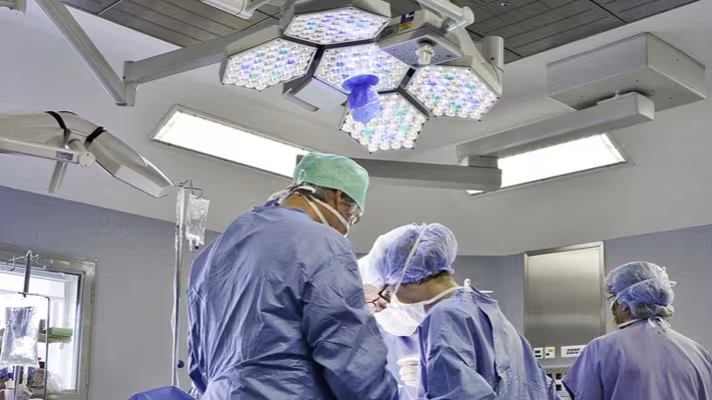
What is oncological visceral surgery?
Visceral oncology surgery specializes in the treatment of gastrointestinal cancers, peritoneal cancers, neuroendocrine tumors, abdominal sarcomas, and certain rare tumors of the abdomen and pelvis.
Depending on the situation, surgery may be used alone or in combination with other treatments such as chemotherapy, radiation therapy, or innovative therapies.
Key Takeaways
Each case is discussed at a multidisciplinary team meeting to determine the most appropriate course of treatment for the patient's situation.
Conditions Treated
Conditions Treated
- Esophageal and gastric cancers
- Hepatobiliary and pancreatic cancers
- Adrenal cancers
- Colorectal cancers
- Rare gastrointestinal cancers
- Neuroendocrine tumors
- Peritoneal Cancers
- Soft tissue sarcomas
- Complex pelvic surgery
Gustave Roussy's Expertise
The Visceral Oncology Surgery Department is dedicated exclusively to cancers of the abdomen and pelvis, regardless of stage. It works closely with teams specializing in gastrointestinal oncology, gynecologic oncology, sarcomas, dermatology, adrenal tumors, and neuroendocrine tumors.
This collaboration has led to the development of innovative approaches combining surgery and drug therapies, including hyperthermic intraperitoneal chemotherapy (HIPC), aerosol intraperitoneal chemotherapy (PIPAC), intra-arterial hepatic chemotherapy (IAHC), and isolated limb perfusion (ILP)—areas in which the department’s expertise is internationally recognized.
The department is staffed by expert surgeons trained in open, laparoscopic, and robot-assisted surgery. It also contributes to the training of future specialists by regularly hosting interns within the department.
The teams contribute to numerous clinical and translational research projects focusing, in particular, on complex cancers and rare tumors, understanding metastatic mechanisms, preventing recurrence, and ensuring patient safety in oncologic surgery.
The department also participates in university-level teaching through Gustave Roussy Education and the Paris-Sud Faculty of Medicine.
Expert Opinion
Dr. Charles Honoré
Chair of the Sarcoma Committee and Head of the Visceral Oncology Surgery Department.
Our goal is to offer each patient the most effective combination of treatments by combining surgical expertise with the most innovative therapeutic approaches, even for the most complex or rare cancers.

Increasingly Targeted Treatments
In certain complex situations, medical teams may combine surgery with innovative treatments to improve disease control and further personalize patient care.
A treatment that involves administering heated chemotherapy directly into the abdominal cavity during surgery.
An innovative technique that enables the targeted delivery of chemotherapy into the abdominal cavity.
A specialized treatment used in certain cases of liver metastases.
Surgeons are trained in open, laparoscopic, and robot-assisted surgery so they can adapt their technique to each clinical situation.
The team is actively involved in the development of minimally invasive robotic surgery, particularly in liver surgery. Dr. Maximiliano Gelli was notably involved in the first liver resection performed in France using the Single Port robot.
Request a second surgical opinion
The Visceral Oncology Surgery Department offers a free surgical second opinion service for patients enrolled in the French national health insurance system who are being treated for gastrointestinal cancer, sarcoma, or peritoneal carcinomatosis.