
Welcome to the new Gustave Roussy website
A new website designed to offer you a simpler, clearer, and more intuitive experience. Patients, caregivers, healthcare professionals, and donors: find information, news, and services more easily.
Oncologic and Reconstructive Plastic Surgery
Plastic and reconstructive surgery plays an important role in the care of many cancer patients. Its goal is to repair or reconstruct tissue that has been removed or damaged by the disease and its treatments, while preserving function and quality of life as much as possible. Surgeons work closely with other specialists to integrate reconstruction into the patient’s overall care.
Department Chair
Dr. Nicolas Leymarie
Schedule an Appointment
Tel.: 01 42 11 65 36
chirurgie.plastique@gustaveroussy.fr
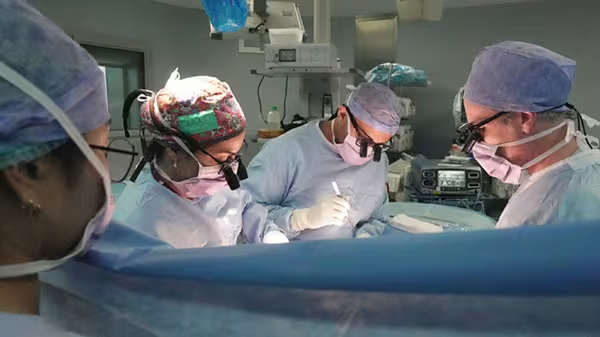
What is plastic and reconstructive surgery?
Reconstructive surgery aims to restore the anatomy, appearance, and function of body areas affected by cancer or its treatments.
It is typically performed after the removal of a tumor, but may also be recommended to correct certain functional or cosmetic complications.
Definition
Reconstructive Surgery
A set of techniques used to repair or replace tissue removed during treatment in order to restore its function and appearance as much as possible.
The surgeons in the Department of Oncologic and Reconstructive Plastic Surgery at Gustave Roussy specialize in surgery for breast cancer, skin cancer, and sarcomas, as well as in all areas of reconstruction following cancer surgery.
Plastic and reconstructive surgery is an integral part of breast cancer care at every stage of the treatment journey. The teams perform both immediate reconstructions—carried out during the same surgical procedure as the mastectomy—and delayed reconstructions, as well as the treatment of certain side effects resulting from cancer treatments.
All innovative breast reconstruction techniques are available at Gustave Roussy: breast reconstruction using the patient’s own tissues, such as fat injections (lipofilling); microsurgical breast reconstruction (free flaps including DIEP, PAP, gracilis, lumbar, and fascia lata flaps…) or using pedicled flaps (latissimus dorsi with a short scar and no implant, etc.).
Our team also treats the side effects of cancer treatments (breast deformity after lumpectomy, lymphedema of the arm...).
Surgeries performed for ENT cancers may require reconstruction of facial, oral, or jaw tissues to preserve speech, swallowing, and facial appearance.
Surgeons in the Plastic Surgery Department at Gustave Roussy perform complex reconstructions of the mandible, the maxilla, and the oral and pharyngolaryngeal cavities using microsurgical techniques and free flaps, along with custom-made guides and anatomical implants created using 3D modeling, in close collaboration with the Head and Neck Oncology Department.
Surgery for skin cancers (carcinomas, melanomas, etc.) is performed in collaboration with dermatologists at Gustave Roussy. When tumor removal results in significant tissue loss, plastic surgeons may step in to reconstruct the tissue and preserve the function and appearance of the treated area as much as possible.
Some sarcoma surgeries require the removal of significant amounts of tissue. Reconstruction then helps restore volume, protect deep structures, and preserve the affected functions.
Surgery for soft tissue sarcomas and reconstructive procedures on the limbs and trunk are performed in collaboration with the Sarcoma Committee and surgeons from the Department of Visceral Surgery.
Surgeries to reconstruct the chest wall and trachea are performed in collaboration with the Department of Thoracic and Vascular Surgery at Marie Lannelongue Hospital.
Pediatric reconstructive surgery is performed in collaboration with the Department of Pediatrics and the departments of maxillofacial surgery, otolaryngology, and neurosurgery at Necker Hospital.
Preserving Functionality and Quality of Life
Reconstructive surgery is not solely for cosmetic purposes. Its role is also to restore or preserve essential functions that may be impaired by cancer or its treatment.
In particular, it can help:
- preserve speech, swallowing, or chewing;
- restore certain movements or functions of the limbs;
- improve daily comfort;
- facilitate a return to personal, social, and professional life;
- improve body image and quality of life.
Key Takeaways
Today, many reconstructive procedures can be performed during the same surgical procedure as the tumor removal, thereby reducing the number of surgeries and facilitating recovery.
Testimonials and Feedback
The Art of Rebuilding Yourself
Discover the video series “The Art of Reconstruction,” which features interviews with patients and the teams at Gustave Roussy about the process of immediate reconstruction following breast cancer.

Advances in reconstructive surgery now make it possible to offer increasingly personalized procedures, with the goal of restoring patients' tissues, functions, and quality of life as effectively as possible.
Some complex reconstructive procedures use tissue taken from another part of the body. Surgeons then reconnect the blood vessels under a microscope to ensure the survival of the transferred tissue.
For certain complex reconstructive procedures, particularly in ENT, teams use digital tools to model the procedure before surgery and to design surgical guides or custom implants.
In certain situations, facial prostheses or epitheses may be recommended as a supplement to or alternative to reconstructive surgery.
Robot-assisted surgery is opening up new possibilities in reconstructive surgery and for certain complex procedures performed at Gustave Roussy.
Gustave Roussy's Expertise
The plastic and reconstructive surgery teams work across many of the Institute’s specialties and help manage the most complex cases.
Recognized expertise in complex reconstructive procedures
- reconstruction following head and neck cancer;
- reconstruction following sarcoma surgery;
- breast reconstructive surgery;
- reconstructive microsurgery;
- computer-assisted surgery and 3D planning.
Multidisciplinary care
Plastic and reconstructive surgery is part of a coordinated care pathway involving plastic surgeons, organ-specific surgeons, oncologists, radiation oncologists, dentists, prosthetists, and rehabilitation teams.
This collaboration makes it possible to offer each patient a personalized reconstruction plan tailored to their specific situation, treatments, and quality-of-life goals.
Expert Insights
Dr. Nicolas Leymarie
Surgeon, Chief of the Department of Oncologic and Reconstructive Plastic Surgery
“Reconstruction is an integral part of cancer treatment. Together, we perform highly technical and innovative procedures that enable patients to preserve their functions, appearance, and quality of life after cancer treatment.”

Patient Organizations and Information
Would you like more information or to talk with patients or their loved ones? Patient organizations are here to help:
- Patients en réseau, a social network for people affected by cancer and their loved ones.
- Europa Donna, an organization fighting breast cancer
- GenetiCancer, an organization dedicated to the fight against genetic and/or hereditary cancers
- Corasso, an organization that supports and educates people affected by head and neck cancer
In addition, practical information on breast cancer provided by healthcare professionals at Gustave Roussy is available on the Facebook page and YouTube channel “Informations Cancer du sein.”