Welcome to the new Gustave Roussy website
A new website designed to offer you a simpler, clearer, and more intuitive experience. Patients, caregivers, healthcare professionals, and donors: find information, news, and services more easily.
Thyroid Cancer Surgery: Everything You Need to Know About Treatments
Thyroid surgery is one of the standard treatments for thyroid cancer and certain thyroid conditions that require surgery. At Gustave Roussy, patients receive specialized care that combines surgical expertise, technological innovations, and personalized support.
Our Commitments
- Specialized care for thyroid cancers, including complex cases and recurrences.
- A personalized treatment strategy developed during multidisciplinary team meetings.
- Access to the most innovative surgical techniques.
- Special attention is given to preserving the voice, the parathyroid glands, and quality of life.
- Coordinated care with specialists in endocrinology, nuclear medicine, imaging, and oncology.
What is thyroid surgery?
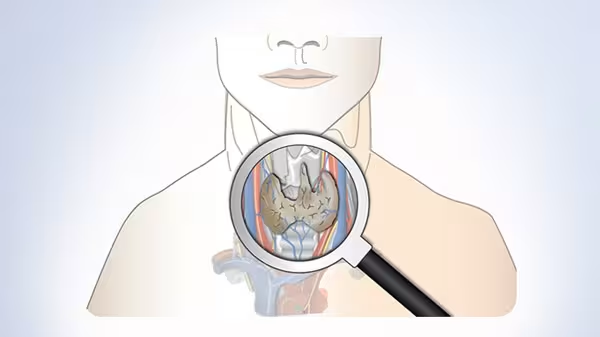
The thyroid gland is located in the lower part of the neck, below the larynx. It consists of two lobes connected by a central portion called the isthmus.
Surgery is frequently used to treat thyroid nodules, whether benign or cancerous.
The decision to perform surgery is based primarily on:
- the size of the nodule(s);
- the results of the fine-needle aspiration biopsy;
- the presence of discomfort or local compression;
- the presence of suspicious lymph nodes in the neck.
Key Takeaways
Each procedure is tailored to the patient's specific situation and discussed by a multidisciplinary team consisting of surgeons, endocrinologists, radiologists, nuclear medicine physicians, and pathologists.
The "Thyroid Nodule in a Day" Clinic
For patients with a thyroid nodule, Gustave Roussy offers a dedicated care pathway that allows them to complete the following in a single day:
- a specialist consultation;
- an expert thyroid ultrasound;
- a fine-needle aspiration biopsy, when necessary;
- prompt delivery of results.
This approach speeds up diagnosis and allows for the rapid determination of an appropriate treatment strategy.
What types of surgical procedures are performed?
Removal of a single thyroid lobe.
Removal of a thyroid lobe and the isthmus.
Removal of the thyroid isthmus only.
Complete removal of the thyroid gland.
Some thyroid cancers can spread to the lymph nodes in the neck. When a lymph node is affected or suspected of being affected, a lymph node dissection may be performed during the same surgical procedure as the thyroid surgery. This procedure allows for better control of the disease and enables the adjustment of additional treatments when necessary.
Increasingly Precise Procedures
Surgeons use intraoperative monitoring technologies for the recurrent nerves to ensure the safety of the procedure and preserve vocal cord function whenever possible.
Fluorescence imaging makes it possible to identify the parathyroid glands during surgery in order to minimize the risk of complications resulting from damage to them.
In certain situations, minimally invasive or robot-assisted surgery may be recommended. The team is part of a network of centers with expertise in using these approaches for thyroid surgery.
How does the procedure work?
The surgery is performed under general anesthesia.
The incision is usually made at the base of the neck. Depending on the situation, an intraoperative examination may be performed to help guide the surgical strategy.
The procedure usually lasts between one and two hours and involves minimal blood loss.
Patients then receive personalized postoperative care.
What are the postoperative effects?
The procedure generally causes little pain. You may experience some discomfort in your throat, similar to a sore throat, for a few days.
The scar is usually inconspicuous and continues to heal for several months after the surgery.
Swelling or a temporary decrease in sensation in the neck may sometimes occur before a gradual return to normal.
Like any surgical procedure, thyroid surgery carries certain risks of complications, including hematoma, infection, or temporary problems involving the vocal cord nerves or the parathyroid glands. The medical team closely monitors these risks.
Multidisciplinary care
The management of thyroid cancer involves a team of surgeons, endocrinologists, nuclear medicine physicians, oncologists, radiologists, pathologists, and specialists in supportive care.
This collaboration makes it possible to develop a personalized treatment plan for each patient that takes into account the disease, the proposed treatments, and quality of life.
Gustave Roussy's Expertise
Gustave Roussy is one of the leading French and international centers specializing in the treatment of thyroid cancer.
In particular, it utilizes the latest technologies for preserving thyroid function and develops innovative approaches in minimally invasive and robot-assisted surgery.
The team is particularly involved in:
- locally advanced thyroid cancers;
- recurrent cases;
- complex surgical cases;
- the development of minimally invasive and robot-assisted techniques;
- clinical research and therapeutic innovation.
Recognized expertise
- surgery for differentiated thyroid cancers;
- medullary thyroid cancers;
- advanced and recurrent thyroid cancers;
- robot-assisted surgery;
- specialized multidisciplinary care.
- The team actively participates in clinical research, therapeutic trials, and teaching activities conducted at Gustave Roussy.