
Welcome to the new Gustave Roussy website
A new website designed to offer you a simpler, clearer, and more intuitive experience. Patients, caregivers, healthcare professionals, and donors: find information, news, and services more easily.
Radiation Therapy
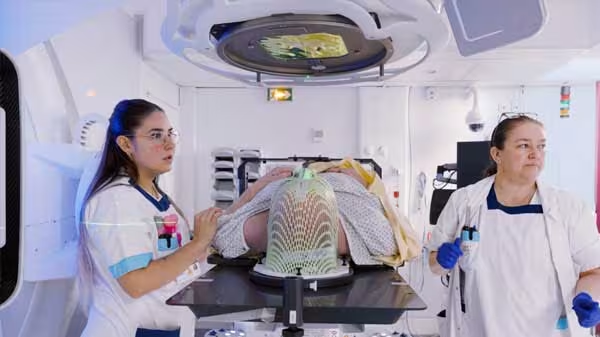
Radiation therapy is one of the most commonly used treatments for cancer. It involves the use of radiation to destroy cancer cells while sparing healthy tissue as much as possible. At Gustave Roussy, patients benefit from state-of-the-art techniques and personalized care throughout their treatment journey.
Director
: Prof. Eric Deutsch
Radiotherapy
Patient
Services Tel.: +33 (0)1 42 11 33 20 or 49 56
Brachytherapy
Tel.: +33 (0)1 42 11 33 65 or 45 66
Key Figures
-
4,000
Approximately 4,000 radiation therapy treatments are performed each year
-
1 technical facility
A technical facility covering most of the radiation therapy techniques currently available
-
150
A team of nearly 150 specialized professionals (doctors, physicists, dosimetrists, radiologic technologists, administrative staff)
What is radiation therapy?
Radiation therapy is a locoregional treatment that uses ionizing radiation to destroy cancer cells or prevent them from multiplying. It can be used alone or in combination with other treatments such as surgery, chemotherapy, hormone therapy, or immunotherapy.
Ionizing radiation
The radiation used in radiation therapy affects the DNA of cancer cells to prevent them from multiplying.
The Main Types of Radiation Therapy
- External Beam Radiation Therapy
- Brachytherapy
- Vectorized internal radiation therapy
In what cases is radiation therapy recommended?
Radiation therapy may be prescribed:
- to destroy a tumor;
- to reduce its size before surgery;
- to complement surgical treatment;
- in combination with other treatments;
- to relieve certain symptoms related to the disease.
The choice of treatment depends, in particular, on:
- the type of cancer;
- its location;
- its stage;
- the patient’s overall health;
- the treatments already received.
How does the treatment work?
- Pre-Radiotherapy
Consultation: The radiation oncologist explains the treatment, answers questions, and develops the treatment plan. - Pre-treatment
CT Scan A simulation CT scan is performed to precisely define the area to be treated. In some cases, additional tests (MRI, nuclear medicine) are used. - Treatment
Planning Physicians, medical physicists, and dosimetrists determine the most appropriate radiation therapy strategy for each patient. - Radiation
Therapy Sessions The sessions are painless and generally last only a few minutes. Treatment is spread out over several days or weeks, depending on the situation. - Post-Treatment
Follow-Up Regular follow-up visits allow for an assessment of the treatment’s effectiveness and monitoring for any potential side effects.
Good to Know
Radiation therapy is painless. The radiation is invisible and cannot be felt during treatment.
High-precision treatments
Advances in radiation therapy now make it possible to target tumors with ever-greater precision in order to minimize radiation exposure to healthy tissue.

What technologies are used at Gustave Roussy?
A high-precision treatment that delivers high doses of radiation to a very small target area.
This allows the dose delivered to be tailored to the shape of the tumor and provides better protection for nearby organs.
A technique that involves placing a radioactive source as close as possible to the tumor, either temporarily or permanently.
Gustave Roussy's Expertise
The Department of Radiation Oncology treats patients under care at Gustave Roussy as well as those referred from other institutions. It combines patient care, research, and education to offer the most innovative treatments.
Expert Opinion
Dr. Sofia Rivera
Oncology radiation therapist, deputy head of the Department of Radiation Oncology at Gustave Roussy
“Our goal is to offer each patient the most effective treatment while minimizing its impact on daily life as much as possible. Advances in radiation therapy now allow us to achieve the same results with treatment regimens that are sometimes shorter, more comfortable, and just as safe.”

Frequently Asked Questions
No. The sessions are painless. Some side effects may develop gradually during or after treatment.
Depending on the type of cancer and the treatment goal, the number of sessions can range from a few sessions to several weeks of treatment.
They vary depending on the area being treated and each patient's individual characteristics. The healthcare team provides follow-up care throughout the course of treatment.