Welcome to the new Gustave Roussy website
A new website designed to offer you a simpler, clearer, and more intuitive experience. Patients, caregivers, healthcare professionals, and donors: find information, news, and services more easily.
Research Focus – Kidney cancer, targeted therapy, combination therapy… Four other breakthroughs to watch
Last quarter, we also learned that the protein MAdCAM-1 could become a prognostic biomarker in patients with kidney cancer, that a targeted therapy can be effective across several cancer types, that hormone therapy is more effective when combined with other treatments, and that a rare form of lung cancer (RET mutation) is sensitive to a new targeted therapy.
Published on
Last quarter, we also learned that the protein MAdCAM-1 could become a prognostic biomarker in patients with kidney cancer, that a targeted therapy can be effective across several cancer types, that hormone therapy is more effective when combined with other treatments, and that a rare form of lung cancer (RET mutation) is sensitive to a new targeted therapy.
A new biomarker identified in kidney cancers
When patients with metastatic kidney cancer develop resistance to treatment, this resistance may be due to a disruption in the production of the protein MAdCAM-1, which is linked to an imbalance in the gut microbiota.
To identify earlier and more effectively the patients who are likely to develop such resistance, researchers measured blood levels of soluble MAdCAM-1 in more than 1,000 patients with metastatic kidney cancer. The results show that the lower the level of this protein, the poorer the patients’ prognosis.
Thus, when comparing a group of patients with high blood levels of MAdCAM-1 to a group with low levels, progression-free survival falls from 13.9 months to 8.4 months. These findings confirm soluble MAdCAM-1 as a promising biomarker in kidney cancers and pave the way for clinical trials in which it could be used to guide microbiota-targeted interventions to overcome treatment resistance.
Soluble MAdCAM-1 as a biomarker in metastatic renal cell carcinoma
C. Alves Costa Silva et al., Nature Medicine 32, 671–681 (2026).
An innovative treatment evaluated across multiple cancer types
Fusion of the NTRK gene with another gene is a rare biological abnormality, found in approximately 0.7% of all solid tumours. Some cancer types are more frequently affected, notably rare cancers of the breast or salivary glands.
This abnormality plays a key role in cancer cell development and represents an attractive therapeutic target, already exploited by several first-generation TRK inhibitors. However, resistance to these treatments can develop over time.
The TRIDENT-1 clinical trial investigated a second-generation TRK inhibitor targeting this genetic fusion: repotrectinib. The study included more than 120 adult patients with different types of solid tumours, all harbouring an NTRK gene fusion, whether or not they had previously received a TRK inhibitor.
The results demonstrate the promising efficacy of repotrectinib. Among patients who had never received a TRK inhibitor, nearly 6 out of 10 responded to treatment, with no disease progression for an average of more than two years. Treatment tolerability was good. Among patients previously treated with a drug from the same class, nearly one in two also responded to repotrectinib. This is the first time a treatment has shown such efficacy in patients already exposed to a TRK inhibitor. Finally, the treatment proved effective against brain metastases, which are particularly challenging to manage.
Repotrectinib in NTRK fusion–positive advanced solid tumours: a phase 1/2 trial
B. Besse et al., Nature Medicine 32, 682–689 (2026).
New hope for triple therapy in metastatic breast cancer
The phase III VIKTORIA-1 trial evaluated a new targeted therapy, gedatolisib, in patients with HER2-negative metastatic breast cancer who had experienced treatment failure after several lines of therapy. Gedatolisib aims to enhance the effectiveness of hormone therapy by blocking the PI3K/AKT/mTOR pathway, which drives disease progression.
In this international clinical trial, gedatolisib was assessed in combination with palbociclib and fulvestrant, a hormone therapy that has been used for several decades. This innovative triple therapy showed encouraging results: patients who received it achieved a progression-free survival of 9.3 months, compared with 7.4 months for those treated with gedatolisib and fulvestrant alone, and 2 months for those who received fulvestrant only.
These results highlight the potential of gedatolisib, which, when administered in combination with palbociclib and fulvestrant, significantly increases progression-free survival in patients with treatment-resistant disease. A second analysis of the VIKTORIA study was presented orally at the ASCO 2026 conference.
VIKTORIA-1 Trial of Gedatolisib Plus Fulvestrant With or Without Palbociclib in Hormone Receptor–Positive/HER2−/PIK3CA Wild-Type Advanced Breast Cancer
S. A. Hurvitz et al., Journal of Clinical Oncology 44, 1108–1119 (2026), volume 44, number 12.
Demonstrated efficacy of a new therapy in a rare form of lung cancer
Non-small cell lung cancers account for approximately 85% of all lung cancers. Around 1–2% of these tumours harbour a fusion of the RET gene, which acts as a driver of tumour growth and represents an identified therapeutic target.
The ARROW study evaluated the efficacy and safety of pralsetinib, a RET inhibitor, in the treatment of these tumours. A total of 281 patients received this drug, and the final results demonstrate its effectiveness. The response rate reached 78% in treatment-naïve patients and 63% in those previously treated with chemotherapy. Across all patients included, median overall survival reached 44.3 months — a highly encouraging result for a disease with a poor prognosis — with acceptable toxicity (notably hypertension).
The results of the ARROW study led the US Food and Drug Administration (FDA) to approve pralsetinib for the treatment of non-small cell lung cancers and thyroid cancers harbouring RET gene fusions.
Final Efficacy and Safety Data From the Phase I/II ARROW Study of Pralsetinib in Patients With Advanced RET Fusion–Positive Non–Small Cell Lung Cancer
B. Besse et al., Journal of Clinical Oncology 44, 1190–1197 (2026), volume 44, number 13.
Last news
-
Breast Cancer: Gustave Roussy Ranked No. 1 in France for Breast Surgery and Breast Reconstruction
On the occasion of Breast Cancer Awareness Month, the 2025 data from Visuchir, the national surgical activity monitoring tool of the French Health Insurance system, places Gustave Roussy in first position for both breast surgery and breast reconstruction. Beyond this ranking, these figures highlight that reconstruction is now an integral part of breast cancer treatment. It is considered at every stage of care: from tumor removal surgery, whether lumpectomy or mastectomy, through to the post-cancer period, helping to restore the body and support women in regaining their physical integrity and quality of life.

-
Newsweek Ranking: Gustave Roussy Named Europe’s Leading Cancer Centre and Third Best Worldwide
The 2027 edition of Newsweek’s World's Best Specialized Hospitals ranking once again recognises Gustave Roussy as the leading cancer centre in France and Europe, and the third best worldwide. This distinction highlights the excellence of the Institute’s care and research, as well as the daily commitment of all its professionals.

-
Living with and beyond cancer: the promises and challenges of digital health
In a Viewpoint article published in The Lancet Digital Health, Drs Ines Vaz-Luis and Maria Alice Franzoi, together with Emmanuel Mussault, a patient partner at the PRISM University Hospital Institute, examine the role that digital tools can play in supporting people living with and beyond cancer. Their central message is that these technologies can support more personalised and accessible care, but their value depends primarily on how they are integrated into care pathways, the human support provided, their ability to address individual needs and their evaluation in real-world settings.
-
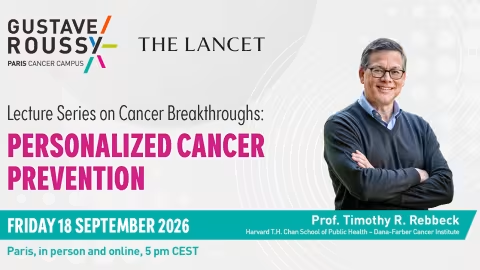
Gustave Roussy and The Lancet launch an international lecture series on innovations transforming cancer care
The inaugural lecture in the “Lecture Series on Cancer Breakthroughs” will take place on Friday 18 September at 5:00 pm. It will be delivered by Professor Timothy R. Rebbeck, a leading cancer prevention specialist at Harvard University and the Dana-Farber Cancer Institute.