Welcome to the new Gustave Roussy website
A new website designed to offer you a simpler, clearer, and more intuitive experience. Patients, caregivers, healthcare professionals, and donors: find information, news, and services more easily.
From Those Who've Been There – Alrone and Cléo: Hope and Advice from Two Young People Facing Cancer
To mark International Childhood and Adolescent Cancer Day on February 15, Alrone and Cléo, two young patients receiving treatment at Gustave Roussy, reflect on their journeys and the realities of their daily lives as they cope with their illnesses.
Published on
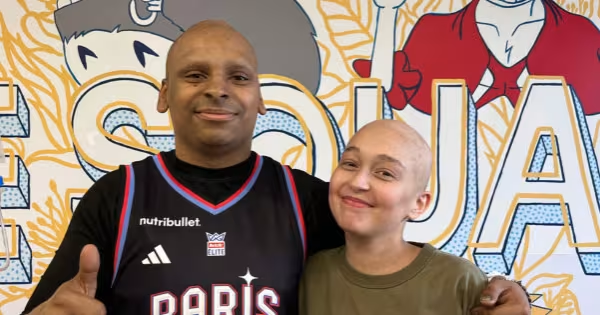
Alrone’s Story, Age 20
“For me, the hardest part was accepting that I had become weak. That’s why seeing the department’s psychologist helped me a lot. I was completely disconnected from my illness, and it felt like I was experiencing my cancer in bits and pieces—I was less shocked by it than my loved ones were. So the first piece of advice I can give is to talk about it and not isolate yourself. During your illness, you go through a lot of different phases. Seeing a psychologist helps you explore your thoughts more deeply and not feel ashamed to ask for support. You also shouldn’t view nurses and doctors solely through the lens of their profession. They’re human beings you can talk to about topics other than your illness.
When I first had symptoms, I was pursuing a bachelor’s degree in English and Spanish. I had a lump on my pubic area, and at first I was told it might be a hernia. I remember that at the time, I was mostly afraid of having surgery, because that meant I wouldn’t be able to play soccer anymore. I’m a PSG fan. After further tests, the doctors told me it was actually a tumor, and eventually, I was diagnosed with DSCRT sarcoma. It’s a very rare, aggressive disease, with about 10 cases a year in France. I was told to go to Gustave Roussy, and that’s where I started my treatment.
My life at the hospital today is very regimented. Every day follows almost the same routine: I get up at nine o’clock, then it’s time to be weighed, and so on. The walls may be painted every color of the rainbow, but you’re still surrounded by negativity. So you have to do everything you can to hold on to the 10% of positivity there is in every day, stay true to yourself, and keep your friends. I love American rap and video games. I still hold on to my passions even here. In fact, every time I’m admitted, I bring my TV and game console to my room. I have an awesome taxi driver who helps me set them up every time.
Another piece of advice I can offer is that when the doctor gives you a treatment timeline and adds “if all goes well,” you have to keep that “if all goes well” in mind and not get discouraged if it ends up taking longer. Finally, you have to take a step back when they list all the possible side effects of the treatments and remind yourself that every patient is different. I, for example, lost my dreadlocks, but I also gained 11 kilos. And I also have some advice for people who know someone who’s sick: don’t try to put yourself in our shoes. When I announced that I had cancer in a Snapchat story, a lot of people told me, “But how do you cope?” ‘I couldn’t do it if I were you,’ and so on. You shouldn’t tell people how to react. I’m not asking you to put yourself in my shoes—just to give me strength.
These days, I feel like I’m splitting my time between home and the hospital, and personally, I’m having a hard time planning for the future, because being here makes everything more complicated. I’ve graduated with my bachelor’s degree, but I now know that I want to work in social services and continue helping others. I created a TikTok account, @alronelbs, where I give advice to young people with cancer. I’ve already received 3–4 messages from people who were in my situation and who told me that my videos helped them. That’s what matters most to me.
At the end of the day, whether we cry about it or laugh about it, we still have cancer. So we might as well laugh about it. If we constantly dwell on negative things, we’ll never get through it. We have to enjoy life and do what we want, when we can.”
Cléo’s story, age 21
“I was an au pair in Chicago, in the United States, when I was diagnosed with Hodgkin’s lymphoma. I’d gone there because I’d just finished my BTS in managerial support, and before continuing my studies in marketing, I wanted to improve my English. I’d already been coughing before I left, but I told myself it wasn’t a big deal. It got worse when I arrived in Chicago, and one day, I felt a lump in my neck. I mentioned it to the mother of the host family, and she made an appointment for me with a doctor. I had an X-ray, and at first, they thought it was pneumonia. But another doctor looked at my X-ray, caught up with me in the hallway before I left, and told me to go to the hospital.
Even though my host family was great, it was really hard at first not to have my parents with me. I tried to send them updates in real time based on what the doctors were telling me. I remember they had some kind of translation app that tried to translate what they were telling me, but it wasn’t very effective, so in the end, I did the translating myself. Then my dad was able to join me for my appointment with an oncologist, and we returned to France. My mom contacted Gustave Roussy, and during my treatments I’m staying with my godmother, who lives in the Paris suburbs.
Even though they immediately reassured me by telling me I had a type of cancer that responds well to treatment, I experienced significant side effects from the chemotherapy. Nausea, but also muscle loss, which came as a shock because I’m very athletic. I’ve been doing modern jazz dance for a long time, and I’ve even qualified for European competitions. But the hardest part was losing my hair. I didn’t cry when I found out I had cancer, but I cried when my hair was cut—after I took my first look in the mirror. Fortunately, my godmother, her husband, and her son tried to make the moment as lighthearted as possible by leaving two strands of hair hanging over my forehead.
The loss of independence is also something difficult to cope with, especially since I was very independent before the illness. Now, I ask to be hospitalized during my chemo treatments because I don’t want my mom to have to take care of everything. My daily life has changed a lot. I don’t dance anymore, and I don’t go to the movies anymore—even though I used to love it… I also have a really hard time with smells, especially those in the hospital. As soon as a product smells like disinfectant or is too chemical-smelling, it makes me nauseous.
What I don’t want is to elicit pity. I’m lucky to have such a great support system, and I don’t know how I would’ve managed without my mom. At first, my best friend didn’t dare talk to me about herself or her problems anymore—she thought they were too trivial compared to my illness. But I explained to her that, on the contrary, it actually made me feel better when she talked to me about herself and her worries, or shared gossip with me, and so on. It helps me when the people around me are funny; it lets me feel a little bit normal again. In fact, now, whenever I can, I love going grocery shopping with my mom, and I spend my time gushing over silly little things.
I’m now making plans for what comes next—once my chemo is over and I’m discharged. First off, I want to have a raclette, and in April, I’m planning to make up for the Christmas dinner I missed this year. There’ll be turkey, beans, foie gras, duchesse potatoes, and a Yule log made by my grandmother. I’ve enrolled to start a bachelor’s degree in marketing in 2026, and I’d also like to go back to the United States to wrap up my previous experience, which feels unfinished. I loved Chicago, where all the buildings are magnificent and huge. And I want to get back in shape and go to Morocco to eat couscous—it’s my favorite dish. My motto is really, “Better to laugh than to cry.”
Last news
-
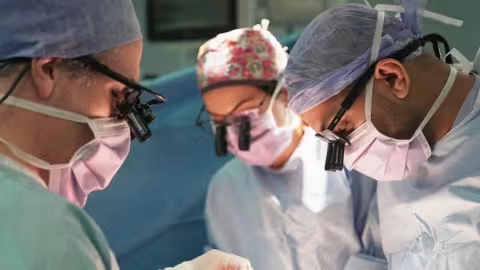
Breast Cancer: Gustave Roussy Ranked No. 1 in France for Breast Surgery and Breast Reconstruction
On the occasion of Breast Cancer Awareness Month, the 2025 data from Visuchir, the national surgical activity monitoring tool of the French Health Insurance system, places Gustave Roussy in first position for both breast surgery and breast reconstruction. Beyond this ranking, these figures highlight that reconstruction is now an integral part of breast cancer treatment. It is considered at every stage of care: from tumor removal surgery, whether lumpectomy or mastectomy, through to the post-cancer period, helping to restore the body and support women in regaining their physical integrity and quality of life.
-
Newsweek Ranking: Gustave Roussy Named Europe’s Leading Cancer Centre and Third Best Worldwide
The 2027 edition of Newsweek’s World's Best Specialized Hospitals ranking once again recognises Gustave Roussy as the leading cancer centre in France and Europe, and the third best worldwide. This distinction highlights the excellence of the Institute’s care and research, as well as the daily commitment of all its professionals.
-
Living with and beyond cancer: the promises and challenges of digital health
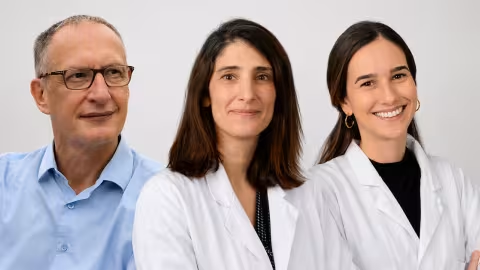
In a Viewpoint article published in The Lancet Digital Health, Drs Ines Vaz-Luis and Maria Alice Franzoi, together with Emmanuel Mussault, a patient partner at the PRISM University Hospital Institute, examine the role that digital tools can play in supporting people living with and beyond cancer. Their central message is that these technologies can support more personalised and accessible care, but their value depends primarily on how they are integrated into care pathways, the human support provided, their ability to address individual needs and their evaluation in real-world settings.
-
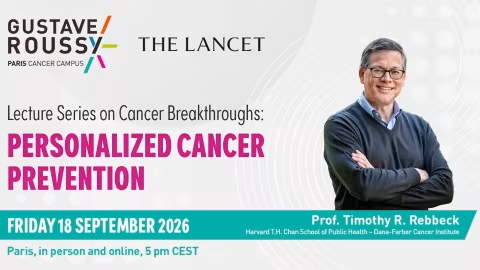
Gustave Roussy and The Lancet launch an international lecture series on innovations transforming cancer care
The inaugural lecture in the “Lecture Series on Cancer Breakthroughs” will take place on Friday 18 September at 5:00 pm. It will be delivered by Professor Timothy R. Rebbeck, a leading cancer prevention specialist at Harvard University and the Dana-Farber Cancer Institute.