Welcome to the new Gustave Roussy website
A new website designed to offer you a simpler, clearer, and more intuitive experience. Patients, caregivers, healthcare professionals, and donors: find information, news, and services more easily.
The President of the French Republic lays the foundation stone for Gustave Roussy’s new research building
The laying of the foundation stone marks a decisive milestone in developing the Paris-Saclay Cancer Cluster, which is currently being established around Gustave Roussy and is set to become the largest oncology hub in Europe.
Published on
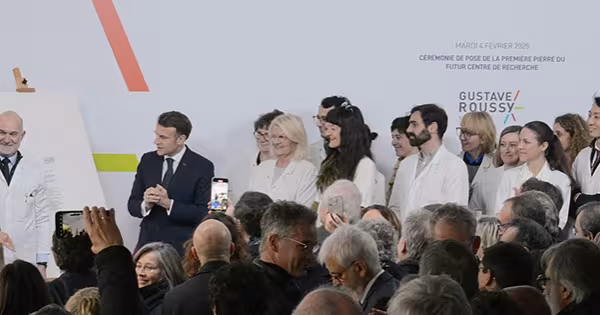
The laying of the foundation stone marks a decisive milestone in developing the Paris-Saclay Cancer Cluster, which is currently being established around Gustave Roussy and is set to become the largest oncology hub in Europe.
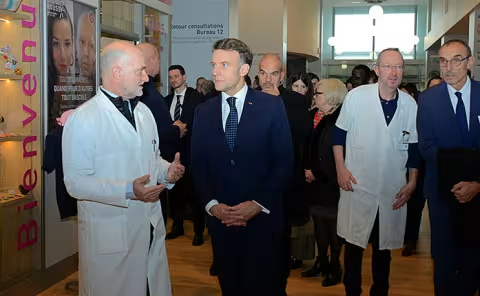
On Tuesday, 4 February, World Cancer Day, President Emmanuel Macron and First Lady Brigitte Macron visited Gustave Roussy, accompanied by five ministers, including Elisabeth Borne, Minister of State, Minister of National Education, Higher Education and Research; Catherine Vautrin, Minister of Labour, Health, Solidarity and Families; Philippe Baptiste, Minister Delegate for Higher Education, and Research; Yannick Neuder, Minister of Health and Access to Care; Clara Chappaz, Minister Delegate for Artificial Intelligence. Also in attendance were Etienne Stoskopf, Prefect of Val-de-Marne; Marc Guillaume, Prefect of Île-de-France; Valérie Pécresse, President of the Île-de-France Regional Council; Olivier Capitanio, President of the Val-de-Marne Departmental Council; Pierre Garzon, Mayor of Villejuif; Michel Leprêtre, President of the Grand-Orly Seine Territorial Public Establishment; Denis Robin, General Director of the Île-de-France Regional Health Agency; Professor Fabrice Barlesi, General Director of Gustave Roussy; and Professor Eric Vivier, President of the Paris-Saclay Cancer Cluster.
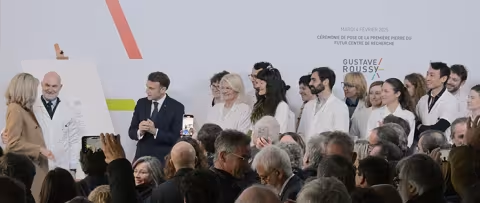
During this official visit, President Emmanuel Macron and Professor Fabrice Barlesi laid the foundation stone for the Institute’s new research building, which is scheduled for completion by late 2027.
32,000 m2 dedicated to research
This new 32,000 m² building has been designed to foster synergies between researchers. It will house 60 internationally renowned teams and will feature 12 cutting-edge technological platforms.
Among these, infrastructures dedicated to data analysis, organoids, and rare circulating cells will help advance oncology research and accelerate scientific discoveries for the benefit of patients.
An ambitious master plan for infrastructure
The President’s visit also allowed Professor Barlesi to present the “Campus Grand Parc,” which is currently under development around Gustave Roussy.
In addition to the new research centre, the Institute’s master infrastructure plan includes the construction of a 13,600 m2 building to accommodate the Interception prevention program, the Instadiag rapid diagnostic pathways, as well as outpatient and international patient services. Another 32,000 m2 building will house administrative and teaching facilities, including a multi-storey car park and a large lecture hall.
With these new facilities, Gustave Roussy reaffirms its ambition to remain at the forefront of innovation in oncology and to offer patients the latest scientific and medical advances.
Meeting with Gustave Roussy researchers
During this official visit, Professors Fabrice Barlesi and Eric Vivier presented the activities of the Paris-Saclay Cancer Cluster to the President, of which Gustave Roussy is a founding member.
President Macron then met with several of the Institute’s researchers and their teams to discuss topics such as data science and artificial intelligence applied to oncology research, resistance mechanisms to innovative therapies, paediatric cancers, and cellular therapies. This was followed by an exchange with patients and healthcare professionals.
“The President’s visit and the laying of this foundation stone are an honour for Gustave Roussy and a strong signal of national commitment to the fight against cancer. This new research building, designed to foster innovation and scientific collaboration, embodies our ambition to transform discoveries into tangible progress for patients. With the support of public authorities and our partners, we are reaffirming our position as the European leader in oncology and our determination to tackle the major challenges of tomorrow” concluded Professor Fabrice Barlesi.
Last news
-
Breast Cancer: Gustave Roussy Ranked No. 1 in France for Breast Surgery and Breast Reconstruction
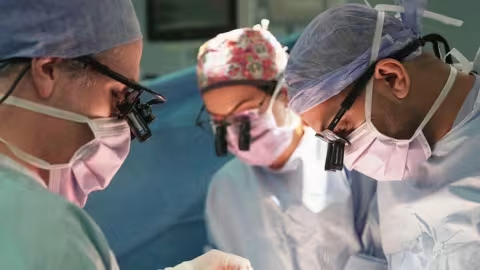
On the occasion of Breast Cancer Awareness Month, the 2025 data from Visuchir, the national surgical activity monitoring tool of the French Health Insurance system, places Gustave Roussy in first position for both breast surgery and breast reconstruction. Beyond this ranking, these figures highlight that reconstruction is now an integral part of breast cancer treatment. It is considered at every stage of care: from tumor removal surgery, whether lumpectomy or mastectomy, through to the post-cancer period, helping to restore the body and support women in regaining their physical integrity and quality of life.
-
Newsweek Ranking: Gustave Roussy Named Europe’s Leading Cancer Centre and Third Best Worldwide
The 2027 edition of Newsweek’s World's Best Specialized Hospitals ranking once again recognises Gustave Roussy as the leading cancer centre in France and Europe, and the third best worldwide. This distinction highlights the excellence of the Institute’s care and research, as well as the daily commitment of all its professionals.
-
Living with and beyond cancer: the promises and challenges of digital health
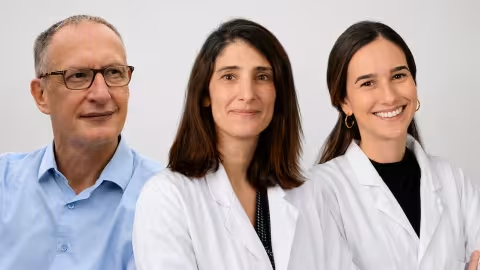
In a Viewpoint article published in The Lancet Digital Health, Drs Ines Vaz-Luis and Maria Alice Franzoi, together with Emmanuel Mussault, a patient partner at the PRISM University Hospital Institute, examine the role that digital tools can play in supporting people living with and beyond cancer. Their central message is that these technologies can support more personalised and accessible care, but their value depends primarily on how they are integrated into care pathways, the human support provided, their ability to address individual needs and their evaluation in real-world settings.
-
Gustave Roussy and The Lancet launch an international lecture series on innovations transforming cancer care
The inaugural lecture in the “Lecture Series on Cancer Breakthroughs” will take place on Friday 18 September at 5:00 pm. It will be delivered by Professor Timothy R. Rebbeck, a leading cancer prevention specialist at Harvard University and the Dana-Farber Cancer Institute.