Welcome to the new Gustave Roussy website
A new website designed to offer you a simpler, clearer, and more intuitive experience. Patients, caregivers, healthcare professionals, and donors: find information, news, and services more easily.
Understand the molecular medecine effect on acute myeloid leukaemia thanks to "Family Trees"
For the first time, a team of international researchers have mapped the family trees of cancer cells in acute myeloid leukaemia (AML) to understand how this blood cancer responds to a new drug.
Published on
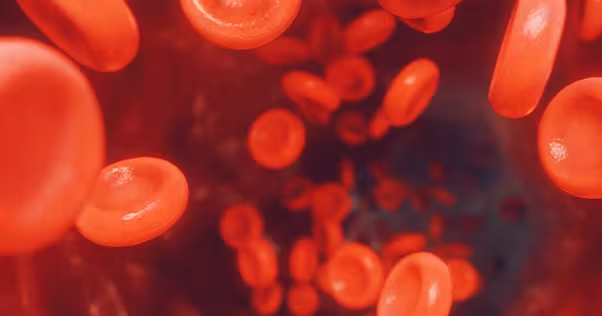
For the first time, a team of international researchers have mapped the family trees of cancer cells in acute myeloid leukaemia (AML) to understand how this blood cancer responds to a new drug. The work also explains what happens when a patient stops responding to the treatment, providing important clues about how to combine enasidenib with other anti-cancer drugs to produce longer-lasting remissions and to prevent relapse.
The study published in Nature Medicine today (Monday), is an international collaboration between researchers from the Gustave Roussy Cancer Campus and Inserm in Paris (France), the MRC Molecular Haematology Unit and the MRC Weatherall Institute of Molecular Medicine at the University of Oxford (UK), Memorial Sloan Kettering Cancer Center (USA) and Celgene (USA).
Acute myeloid leukaemia (AML) is the most common and aggressive blood cancer in adults and is incurable in most patients. About 12-15% of AML patients have a mutation in the IDH2 gene that stops bone marrow cells from differentiating, or maturing, into blood cells that are required for life. Instead these immature cells accumulate in the bone marrow and blood, which is a hallmark of AML. Previous research from the same team showed that enasidenib prompts blood cell differentiation and restores normal blood cell production.
As AML is caused by errors in DNA sequence, or mutations, in blood cells, the team studied the genetic make-up of AML cells from 37 patients. They found that AML cells from the same patient can be grouped into families which share genetic mutations, called clones. Cells belonging to the same clone or family, come from the same ancestor cell. Understanding how clones relate to each other is important as they provide information as to how the AML started in the first place.
The cancer returned in almost all the patients in the clinical trial, and the team was able to show for the first time that the leukaemic cells stop responding to the drug when some of the clones develop additional mutations. These new sub-clones are resistant to enasidenib, providing clues about the mechanism of drug resistance. This may help in designing future therapy trials to overcome therapy resistance. It may also mean that enasidenib needs to be combined with other anti-cancer drugs to prevent relapse, and clinical trials have already started investigating whether patients respond to these combinations, for how long and whether they are likely to relapse.
- For more informations, read the press release
Last news
-
Breast Cancer: Gustave Roussy Ranked No. 1 in France for Breast Surgery and Breast Reconstruction
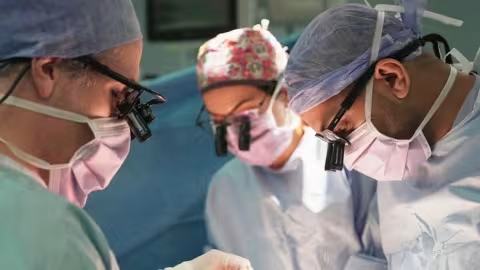
On the occasion of Breast Cancer Awareness Month, the 2025 data from Visuchir, the national surgical activity monitoring tool of the French Health Insurance system, places Gustave Roussy in first position for both breast surgery and breast reconstruction. Beyond this ranking, these figures highlight that reconstruction is now an integral part of breast cancer treatment. It is considered at every stage of care: from tumor removal surgery, whether lumpectomy or mastectomy, through to the post-cancer period, helping to restore the body and support women in regaining their physical integrity and quality of life.
-
Newsweek Ranking: Gustave Roussy Named Europe’s Leading Cancer Centre and Third Best Worldwide
The 2027 edition of Newsweek’s World's Best Specialized Hospitals ranking once again recognises Gustave Roussy as the leading cancer centre in France and Europe, and the third best worldwide. This distinction highlights the excellence of the Institute’s care and research, as well as the daily commitment of all its professionals.

-
Living with and beyond cancer: the promises and challenges of digital health
In a Viewpoint article published in The Lancet Digital Health, Drs Ines Vaz-Luis and Maria Alice Franzoi, together with Emmanuel Mussault, a patient partner at the PRISM University Hospital Institute, examine the role that digital tools can play in supporting people living with and beyond cancer. Their central message is that these technologies can support more personalised and accessible care, but their value depends primarily on how they are integrated into care pathways, the human support provided, their ability to address individual needs and their evaluation in real-world settings.
-
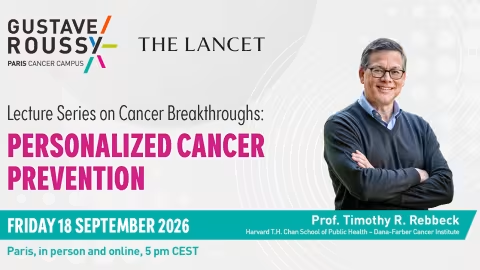
Gustave Roussy and The Lancet launch an international lecture series on innovations transforming cancer care
The inaugural lecture in the “Lecture Series on Cancer Breakthroughs” will take place on Friday 18 September at 5:00 pm. It will be delivered by Professor Timothy R. Rebbeck, a leading cancer prevention specialist at Harvard University and the Dana-Farber Cancer Institute.