Welcome to the new Gustave Roussy website
A new website designed to offer you a simpler, clearer, and more intuitive experience. Patients, caregivers, healthcare professionals, and donors: find information, news, and services more easily.
Carlos Pérez González awarded a prestigious ERC Starting Grant
Awarded by the European Research Council, the ERC Starting Grant is a recognised mark of excellence. It provides funding for ambitious projects while giving researchers full scientific independence. This European Research Council grant recognises early-career scientists leading ambitious projects. It will enable Carlos Pérez González to develop the EvoSelf project at Gustave Roussy, focusing on how tumour cells organise themselves, evolve and become more aggressive.
Published on
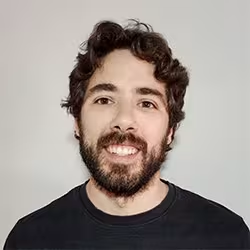
A specialist in organoid development, creating tumour avatars that make it possible to observe cancer progression and mechanisms of treatment resistance at close range, Carlos Pérez González has been awarded a Starting Grant by the European Research Council (ERC). The young researcher is joining the Tumour Cell Dynamics unit (U1279), led by Professor Guillaume Montagnac at Gustave Roussy, to conduct the EvoSelf project. The project aims to investigate the diversity observed among tumour cells, which is considered a factor in cancer progression and aggressiveness.
ERC Starting Grants support promising early-career researchers who are ready to develop an independent research programme. Open to all fields of research, they fund frontier research projects selected for their excellence and enable grant holders to build a team at a host institution located in an EU Member State or associated country.
Understanding how tumours self-organise
Within a tumour, not all cells look or behave in the same way. Some multiply rapidly, others resist treatment, while others acquire the ability to invade neighbouring tissues and form metastases. This diversity, known as tumour heterogeneity, plays a major role in disease progression, treatment resistance and relapse.
Until now, researchers have mainly explained it through the accumulation of genetic mutations or the influence of the tumour environment. However, Carlos Pérez González's work suggests that another mechanism could play an essential role: the ability of tumour cells to organise collectively and communicate with one another, through both biochemical signals and mechanical forces.
The EvoSelf project will therefore study cancer as a constantly evolving tissue capable of generating its own organisation. Its ambition is to understand how this collective dynamic contributes to the emergence of more aggressive cells, metastatic spread and treatment resistance.
Using organoids to decipher cancer evolution
To address these questions, Carlos Pérez González will use patient-derived organoids. These three-dimensional models, grown in the laboratory from tumour cells, reproduce some of the essential characteristics of tumours and make it possible to observe how they evolve. By combining bioengineering, quantitative imaging, mechanical force measurements and large-scale molecular analyses, his team will seek to identify the biological factors that shape cancer behaviour.
The project will investigate, in particular, how mutations arising during tumour progression gradually disrupt the normal organisation of tissues, promoting invasion and the formation of metastases. The researchers will also examine whether common principles of self-organisation exist across different patients despite the considerable diversity of tumours. Finally, EvoSelf will compare several cancer types, including colorectal and pancreatic cancers, to determine whether similar mechanisms govern their evolution.
“By revealing the mechanisms that enable tumours to organise and evolve, this project could transform our understanding of tumour heterogeneity and cancer-cell plasticity,” explains Carlos Pérez González.
Ultimately, this work could pave the way for new approaches to better predict cancer evolution and identify new therapeutic strategies targeting the collective mechanisms that drive its progression.
Grant Agreement number : 101303119
Last news
-
Breast Cancer: Gustave Roussy Ranked No. 1 in France for Breast Surgery and Breast Reconstruction
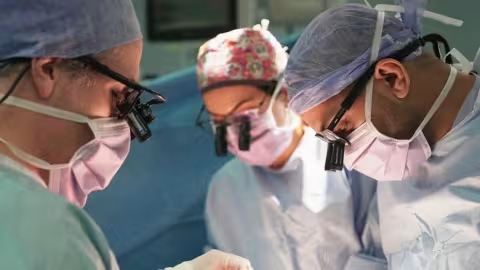
On the occasion of Breast Cancer Awareness Month, the 2025 data from Visuchir, the national surgical activity monitoring tool of the French Health Insurance system, places Gustave Roussy in first position for both breast surgery and breast reconstruction. Beyond this ranking, these figures highlight that reconstruction is now an integral part of breast cancer treatment. It is considered at every stage of care: from tumor removal surgery, whether lumpectomy or mastectomy, through to the post-cancer period, helping to restore the body and support women in regaining their physical integrity and quality of life.
-
Newsweek Ranking: Gustave Roussy Named Europe’s Leading Cancer Centre and Third Best Worldwide
The 2027 edition of Newsweek’s World's Best Specialized Hospitals ranking once again recognises Gustave Roussy as the leading cancer centre in France and Europe, and the third best worldwide. This distinction highlights the excellence of the Institute’s care and research, as well as the daily commitment of all its professionals.

-
Living with and beyond cancer: the promises and challenges of digital health
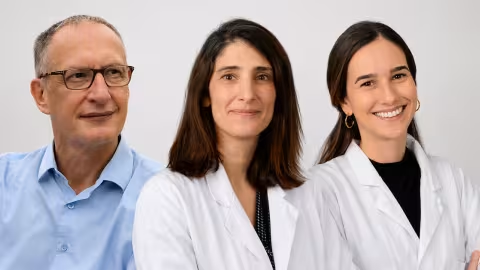
In a Viewpoint article published in The Lancet Digital Health, Drs Ines Vaz-Luis and Maria Alice Franzoi, together with Emmanuel Mussault, a patient partner at the PRISM University Hospital Institute, examine the role that digital tools can play in supporting people living with and beyond cancer. Their central message is that these technologies can support more personalised and accessible care, but their value depends primarily on how they are integrated into care pathways, the human support provided, their ability to address individual needs and their evaluation in real-world settings.
-
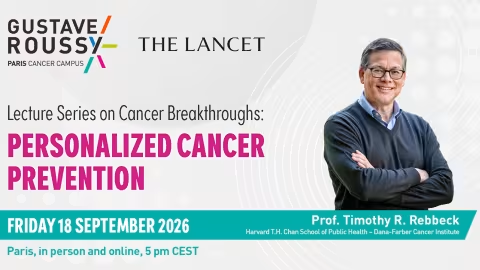
Gustave Roussy and The Lancet launch an international lecture series on innovations transforming cancer care
The inaugural lecture in the “Lecture Series on Cancer Breakthroughs” will take place on Friday 18 September at 5:00 pm. It will be delivered by Professor Timothy R. Rebbeck, a leading cancer prevention specialist at Harvard University and the Dana-Farber Cancer Institute.