
Welcome to the new Gustave Roussy website
A new website designed to offer you a simpler, clearer, and more intuitive experience. Patients, caregivers, healthcare professionals, and donors: find information, news, and services more easily.
Gastroenterology Committee
Head:
Prof. Michel Ducreux
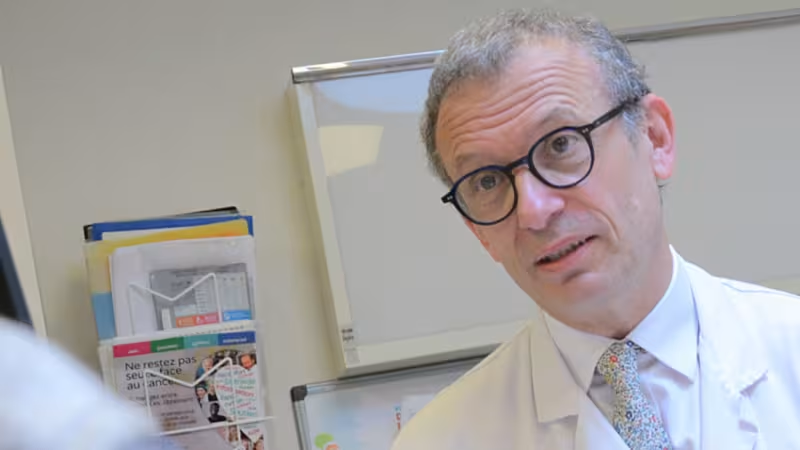
Multidisciplinary expertise in gastrointestinal cancers
The Gastrointestinal Pathology Committee brings together specialists involved in the diagnosis, evaluation, and management of tumors of the gastrointestinal tract, accessory glands, and certain rare abdominal tumors.
Each case is discussed in a multidisciplinary setting to determine a treatment strategy tailored to the affected organ, the tumor’s characteristics, its extent, the patient’s medical history, and current condition. This approach brings together medical oncology, surgery, radiology, radiation oncology, pathology, interventional radiology, and endoscopy.
Types of Cancer Treated
- Colorectal Cancer:
Tumors of the colon and rectum. - Stomach cancer:
Tumors of the stomach and the esophagogastric junction. - Esophageal cancer:
Tumors of the esophagus. - Small intestine cancer:
Tumors that develop in the small intestine. - Peritoneal cancer:
Primary or secondary tumors of the peritoneum. - Liver cancer:
Primary tumors of the liver. - Pancreatic cancer:
Tumors that develop in the pancreas. - Bile duct cancer:
Tumors of the intra- or extrahepatic bile ducts. - Anal cancer:
Tumors of the anal canal. - Rare abdominal tumors:
Rare conditions requiring specialized expertise, particularly certain digestive endocrine tumors, in collaboration with the Endocrine Tumors Committee.
Coordinated expertise to guide patient care
Endoscopy, imaging, and pathological analysis help determine the location, nature, and characteristics of the disease.
The test results are compiled and analyzed to assess local or distant spread and to provide information useful for decision-making.
Depending on the situation, the committee’s expertise may combine endoscopy, surgery, or interventional radiology in a coordinated approach.
A gastrointestinal genetics consultation may be offered to individuals with a personal or family history suggestive of a predisposition.
The committee's professionals
Prof. Michel Ducreux, medical oncologist
Dr. Valérie Boige
Dr. Alice Boileve
Dr. Géraldine Camilleri
Dr. Léonard Depotte
Dr. Francesco Facchinetti
Dr. Alina Fuerea
Dr. Antoine Hollebecque
Dr. Pierre Le-Gars
Dr. Thomas Pudlarz
Dr. Cristina Smolenschi
Dr. Anthony Tarabay
Dr. Marine Valery
Dr. Leonor Benhaim
Dr. Axel Bourgois
Dr. Elena Fernandez de Sevilla
Dr. Mathilde Floch
Dr. Maximiliano Gelli
Dr. Isabelle Sourrouille
Dr. Rémy Barbe
Prof. Yves Menu
Dr. Jérôme Durand-Labrunie
Dr. Linda Mrissa
Dr. Mohamed Bani
Dr. Peggy Dartigues
Dr. Paul Beunon
Dr. Baptiste Bonnet
Dr. Frédéric Deschamps
Dr. Lambros Tselikas
Dr. Hichem Belkhodja
Dr. Simona Cosconea
Research on Digestive Cancers
The research conducted by the committee combines clinical studies and translational programs to better characterize gastrointestinal cancers and their diversity. In particular, it explores tumor-derived models, the relationship between the microbiome and treatment response, and gastrointestinal cancers that occur in young adults.
Coordinated by Fanny Jaulin, this program develops organoids—miniaturized three-dimensional models derived from tumor biopsies—to study how gastrointestinal tumors respond to various treatments.
This program investigates the links between the gut microbiota and the efficacy of immunotherapies, with the goal of better understanding the variability in response.
Led by Drs. Alice Boileve and Cristina Smolenschi, YODA is studying the genetic and environmental factors associated with early-onset gastrointestinal cancers as part of a European cohort study.
The committee's physicians participate in studies that integrate the biological characterization of tumors, clinical data, and the evaluation of new strategies in eligible patients.
These programs bring together complementary expertise in oncology, tumor biology, microbiology, molecular analysis, epidemiology, and data science. They help facilitate the exchange of knowledge between the laboratory and the clinical setting, without replacing the individual assessment conducted by the medical team.