
Welcome to the new Gustave Roussy website
A new website designed to offer you a simpler, clearer, and more intuitive experience. Patients, caregivers, healthcare professionals, and donors: find information, news, and services more easily.
Department of Hematology
Department Head
Dr. Stéphane de Botton
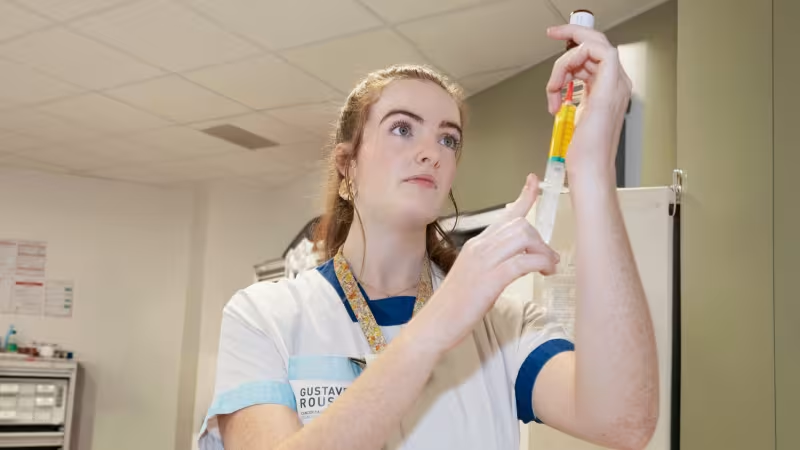
The department
Overview
The Department of Hematology at Gustave Roussy specializes in the treatment of all malignant blood disorders, particularly:
Myeloid blood cancers
-
Acute and chronic myeloid leukemias
-
Myeloproliferative syndromes
-
Myelodysplastic syndromes
-
Mixed, myelodysplastic, and myeloproliferative disorders
Lymphoid blood disorders
-
Acute and chronic lymphoid leukemias
-
Non-Hodgkin lymphomas
-
Hodgkin's disease,
-
Multiple myeloma
The Department of Hematology comprises five inpatient units, one day-care unit, and an outpatient clinic. The department’s physicians work closely with the staff of the clinical laboratory—part of which is dedicated to hematological testing—and with all other departments at Gustave Roussy to ensure optimal patient care.
Department Organization
The department’s six inpatient units are:
-
A day hospital unit (13 beds) on the ground floor of the Institute
-
Two intensive care units, known as “protected” areas
: - The Paris D1 unit (10 beds) located on the 8th
floor - The Paris D2 unit (10 beds) located on the 8th floor -
Three conventional inpatient units
: - The Côte d’Or unit (8 beds) on the 3rd
floor - The Suzanne Axel unit (14 beds) on the 8th floor -
The Manche unit (10 beds) on the 6th floor
Research
Hematology research is overseen by the Gustave Roussy Committee 110. The goal of the department’s research program is to make all possible treatment options available to its patients, including innovative solutions still under evaluation. The treatment offered to each patient meets international standards. The physician may invite the patient to participate in a research program, such as:
-
A Phase III clinical trial that compares a standard-of-care treatment—recognized by the international community as the gold standard—with a treatment that may improve outcomes based on previous studies, the findings of which are presented to the patient.
-
A Phase I or Phase II clinical trial when the standard of care has not produced the expected outcome. In such cases, the Department of Hematology collaborates with the Department of Therapeutic Innovation and Early-Phase Trials (DITEP). The physician ensures that the patient meets the criteria for eligibility to receive the new medication. The physician explains to the patient what this therapeutic option entails and why it is being offered.
-
A non-therapeutic study occurs when the physician asks the patient for permission to collect an additional tube of blood or bone marrow for research purposes as part of a routine blood test. The goal is to conduct research on the patient’s disease within one of the on-site INSERM or CNRS research teams. In-depth analysis of patient samples often provides a better understanding of the disease’s mechanisms and helps identify new treatment options than analysis of models developed in a laboratory.
In all cases, the studies conducted have been approved by an ethics committee and have received all administrative authorizations required by law. A patient is included in a study only if they have provided their signed consent and may withdraw at any time if they so choose.
In the field of hematology, the research teams at Gustave Roussy have a particular interest in:
-
Acute leukemias, particularly acute myeloid leukemias, and their treatment, whether primary or secondary. For example, the teams are very actively involved in the development of drugs targeting mutations in the IDH1 and IDH2 genes, as well as splicing inhibitors.
-
Myeloproliferative syndromes, particularly Vaquez disease, essential thrombocythemia, and myelofibrosis. It was at Gustave Roussy that the JAK2 gene mutation was identified in 2005, leading to the development of a drug that was brought to market in 2011.
-
Chronic myelomonocytic leukemia; Gustave Roussy is home to a team conducting in-depth research into the mechanisms of this disease and, more generally, the mechanisms of myelodysplastic syndromes
-
Genetic predispositions to malignant hematologic disorders and the genetic and epigenetic alterations leading to the onset of these diseases. It was at Gustave Roussy in 2009 that mutations in the TET2 gene were identified, which are now known to create a conducive environment for the emergence of these diseases.
In addition to DITEP, the Department of Hematology works very closely with research teams from Paris-Sud University, located on the hospital campus.
Teaching
Physicians in the department participate in teaching the discipline at the Paris-Sud Faculty of Medicine, and the department regularly hosts students in training. Medical residents benefit from weekly literature review sessions, training seminars organized at the Institute, the Île-de-France region, or the national level, and bedside teaching.
The research teams are affiliated with the Paris-Saclay University Doctoral School of Oncology within Gustave Roussy Education. Physicians and researchers at Gustave Roussy participate in graduate-level education (master’s programs and interuniversity degrees) organized by other universities. When appropriate, physicians from the department may be invited to participate in the training of foreign physicians as part of the Institute’s partnerships.
Heads of the Department of Hematology
- Dr. Stéphane de Botton
Chair of the Hematology Committee (110)
Chair of the Department of Hematology
Director of Myeloid Pathology - Dr. Vincent Ribrag
Director of Lymphoid Pathology - Pascale Usubelli
Clinical Coordinator - Miguel Maiz
Deputy Director of Management - Nathalie Anne
Administrative Manager
Contacts
Consultation Office
- Phone service reserved for new patients and medical emergencies (9 a.m.–5 p.m.)
+33 (0) 1 42 11 67 15
Fax: +33 (0) 1 42 11 52 70
Transplant Office
- Pre-transplant evaluation coordination
+33 (0) 1 42 11 42 39 - Post-Allograft Monitoring
+33 (0) 1 42 11 64 17